Best Electric Cars Under 50 Lakh in Nepal 2026: Top Picks by Expert Rating
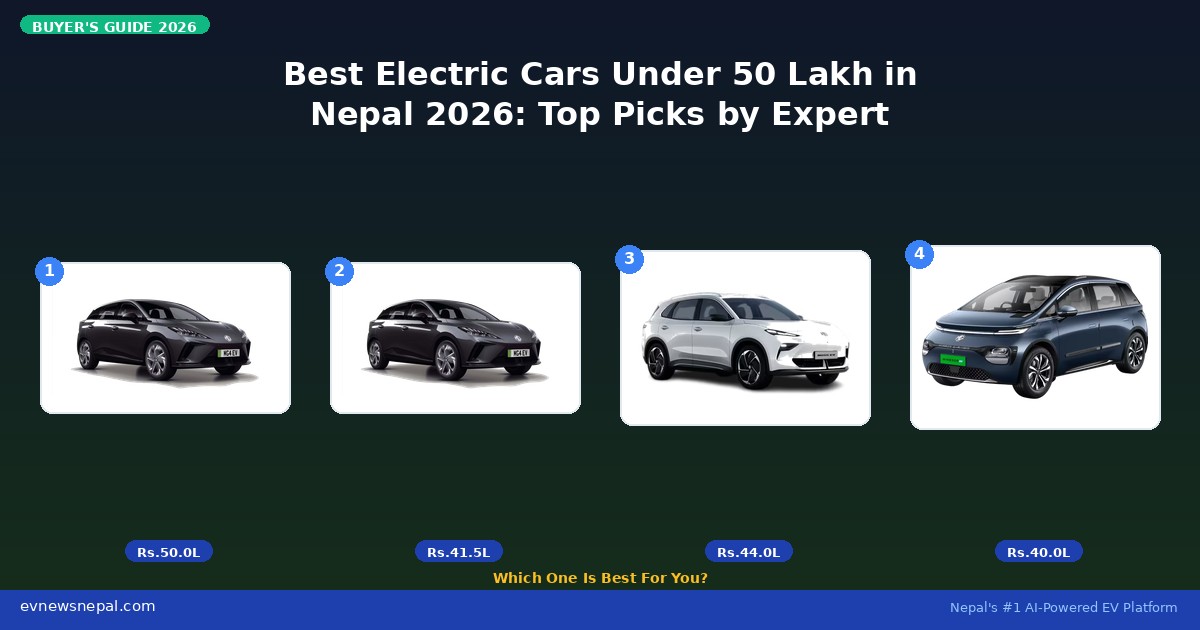
Key Takeaways
- Nepal offers 15 electric car options under Rs. 50 lakh in 2026, ranging from Rs. 22.96 lakh (Kaiyi e-Qute 02) to Rs. 49.99 lakh (MG MG4 Luxury)
- The BYD Dolphin (Rs. 41.15L) is our top overall pick for its Blade Battery safety, 6 airbags, ADAS features, and 340 km WLTP range
- Running an EV in Nepal costs just Rs. 1,000-2,000/month for daily commuting vs Rs. 8,000-12,000 for a petrol car
- Nepal's EV charging network has grown to 1,500+ stations with NEA planning 500 more, and import duties remain low at 10-15% vs 238% for petrol cars
- For Nepal's hilly terrain, prioritize ground clearance (200mm+) and WLTP-rated range — expect 15-25% less than claimed figures in real-world driving
Nepal's electric vehicle revolution is no longer a future promise — it's happening right now. With EV imports tripling to over 44,500 units in 2025 and the government maintaining favorable tax rates for FY 2025–26, there has never been a better time to go electric. The charging network has expanded to over 1,500 stations nationwide, NEA is adding 500 more, and electricity remains among the cheapest fuels on the planet.
But with dozens of new models flooding the market from BYD, MG, Tata, Kaiyi, and Citroën, choosing the right EV under Rs. 50 lakh can feel overwhelming. Which ones actually deliver on range claims in Nepal's hilly terrain? Which offer genuine value for money? We've driven, compared, and analyzed every EV in this segment to bring you our expert-rated top picks for 2026.
Whether you're a daily commuter navigating Kathmandu's traffic, a family looking for a reliable second car, or someone ready to ditch petrol entirely, this guide breaks down every option — with real specs, honest assessments, and Nepal-specific advice. Use our Compare EVs tool to stack any two models side by side.
Quick Summary
| Model | Price (from) | Range | Battery | Best For |
|---|---|---|---|---|
| Kaiyi e-Qute 02 | Rs. 22,96,000 | 301 km (CLTC) | 28.08 kWh | Budget city car |
| Citroën E-C3 Shine | Rs. 35,99,000 | 320 km (MIDC) | 29.2 kWh | Affordable first EV |
| MG Windsor Excite | Rs. 37,99,000 | 332 km (WLTP) | 38 kWh | Spacious CUV value |
| BYD Dolphin | Rs. 41,15,000 | 340 km (WLTP) | 44.9 kWh | Best all-rounder |
| MG MG4 Comfort | Rs. 41,49,000 | 350 km (WLTP) | 51 kWh | Driving enthusiasts |
| MG S5 Comfort | Rs. 43,99,000 | 340 km (WLTP) | 49 kWh | SUV buyers on a budget |
| BYD Atto 2 | Rs. 45,99,000 | 345 km (WLTP) | 51.13 kWh | Safety-first families |
| Tata Nexon EV XZ+ Lux Max | Rs. 48,99,000 | 453 km (ARAI) | 30 kWh | Maximum range & features |
Detailed Reviews
Kaiyi e-Qute 02 — Rs. 22,96,000 onwards
- Range: 301 km (CLTC) | Battery: 28.08 kWh | Motor: 40 kW
- Nepal's most affordable 4-wheeler EV — unbeatable city runabout
The Kaiyi e-Qute 02 rewrites what's possible under Rs. 25 lakh. At just 3,345 mm long, it's tiny enough for Kathmandu's tightest gullies yet seats five. The 28.08 kWh LFP battery delivers a claimed 301 km on the CLTC cycle — expect around 200–220 km in real-world city driving, which is still plenty for a week of Kathmandu commuting on a single charge.
The 40 kW motor and 100 km/h top speed mean this is strictly a city car — highway overtaking is not its strength. But that's the point. At home charging rates of roughly Rs. 280–340 per full charge, your monthly fuel bill could drop below Rs. 1,000. It comes with an 8-inch touchscreen, digital instrument cluster, rear camera, ESC, and hill start assist — genuinely impressive kit at this price. If you want the cheapest possible entry into EV ownership, this is it.
Citroën E-C3 Shine — Rs. 35,99,000 onwards
- Range: 320 km (MIDC) | Battery: 29.2 kWh | Motor: 42 kW
- Funky French styling meets practical Nepali commuting
The Citroën E-C3 brings something different to Nepal's EV scene: personality. With its distinctive SUV-inspired stance, 170 mm ground clearance, and two-tone colour options, it stands out in a sea of generic designs. The 10.2-inch touchscreen with Apple CarPlay and Android Auto handles infotainment well, and the 29.2 kWh battery manages a respectable 320 km (MIDC).
The 42 kW motor is modest — 0-100 km/h takes 12.9 seconds and top speed caps at 107 km/h — so this is firmly a city-and-suburbs car. But that's exactly how most Nepali buyers will use it. Fast charging hits 20-80% in just 26 minutes, which is impressive for this price range. The base E-C3 Live variant starts even lower at Rs. 34,99,000, making the Citroën twins the most affordable "proper" hatchback EVs in Nepal.
Pro tip: The Shine variant adds LED headlamps and front parking sensors — worth the extra Rs. 1 lakh if you drive in congested areas.
MG Windsor Excite — Rs. 37,99,000 onwards
- Range: 332 km (WLTP) | Battery: 38 kWh | Motor: 100 kW
- The most spacious interior under Rs. 40 lakh
The MG Windsor is MG's answer to buyers who want CUV space without paying SUV prices. The 15.6-inch "Grand-View" touchscreen dominates the dashboard and supports wireless Android Auto and Apple CarPlay. With 100 kW of power and front-wheel drive, it feels genuinely quick off the line — a significant step up from the budget EVs above.
The 38 kWh LFP battery provides 332 km of WLTP range, translating to roughly 260–280 km in real-world mixed driving around Kathmandu Valley. The DC fast charging is a weak point at only 45 kW (20-80% in 45 minutes), so long road trips require patience. But for daily commuters, the Windsor offers an outstanding package: keyless entry, wireless phone charging, cruise control, and four driving modes. The Exclusive variant at Rs. 39,99,000 adds a few more conveniences if your budget stretches.
BYD Dolphin — Rs. 41,15,000 onwards
- Range: 340 km (WLTP) | Battery: 44.9 kWh | Motor: 70 kW
- Best all-round EV in Nepal — efficiency king with BYD Blade Battery safety
The BYD Dolphin is arguably the smartest EV purchase in Nepal right now. BYD's renowned Blade Battery (LFP chemistry) is among the safest in the industry, and the 44.9 kWh capacity delivers 340 km of WLTP range — expect 270–300 km in the real world. Owners consistently praise its efficiency, especially in stop-and-go Kathmandu traffic where regenerative braking extends range significantly.
The safety suite is best-in-class at this price: six airbags, AEB, adaptive cruise control, lane keeping assist, blind spot detection, and rear cross-traffic alert. That's ADAS equipment you typically find in vehicles costing Rs. 60 lakh or more. The 70 kW motor is adequate rather than thrilling, and the 175 mm ground clearance can feel tight on rough Nepali roads when fully loaded. But for the combination of safety, efficiency, range, and technology, the Dolphin is our top all-round pick. BYD offers a 10-year/2,00,000 km warranty on the motor and battery through Cimex Nepal.
MG MG4 Comfort — Rs. 41,49,000 onwards
- Range: 350 km (WLTP) | Battery: 51 kWh | Motor: 69.9 kWh
- Best driving dynamics in the segment — rear-wheel drive fun
The MG MG4 Comfort is the enthusiast's choice. With 99 kW and rear-wheel drive — a rarity in this price range — it's noticeably more engaging to drive than front-wheel-drive competitors. The 51 kWh CATL LFP battery provides 350 km of WLTP range, and DC fast charging peaks at 87 kW (10-80% in 35 minutes). V2L capability lets you power appliances from the car — handy during Nepal's occasional load-shedding moments.
Five driving modes (including Snow mode, useful for Nepal's mountain passes) and four-level regenerative braking give you real control over the driving experience. The 10.25-inch touchscreen, Apple CarPlay, Android Auto, and a 7-inch digital driver display round out the tech. If you value how a car drives over how it looks, the MG4 is hard to beat. For Rs. 8 lakh more, the MG MG4 Luxury bumps the battery to 64 kWh with 450 km WLTP range and 142 kW fast charging.
MG S5 Comfort — Rs. 43,99,000 onwards
- Range: 340 km (WLTP) | Battery: 49 kWh | Motor: 99 kW
- Best value electric SUV with blazing-fast charging
The MG S5 is MG's newest offering and it's impressive. The standout feature is charging speed: 10-80% in just 24 minutes at approximately 120 kW DC. That's the fastest charging in this entire list. The 49 kWh CATL "Rubik's Cube" LFP battery and 99 kW motor deliver proper SUV performance with a 190 km/h top speed.
The S5 sits in proper compact SUV territory at 4,476 mm long with a 2,730 mm wheelbase — meaningfully larger than the hatchbacks in this list. One Pedal Drive and adaptive regenerative braking make city driving effortless, while the 12.8-inch central touchscreen with wireless Apple CarPlay and HiCar connectivity keeps things modern. V2L output is rated at 3.3 kW, higher than most competitors. The Luxury variant at Rs. 49,99,000 adds a 6-speaker audio system with sound field calibration.
BYD Atto 2 — Rs. 45,99,000 onwards
- Range: 345 km (WLTP) | Battery: 51.13 kWh | Motor: 100 kW
- Most comprehensive safety package in the under-50-lakh segment
The BYD Atto 2 shares its DNA with the Dolphin but moves into crossover territory with a commanding 200 mm ground clearance — the highest in this roundup and ideal for Nepal's uneven roads. The 51.13 kWh LFP battery provides 345 km of WLTP range, and the 100 kW motor feels confident on Kathmandu's steep inclines.
Like the Dolphin, safety is the headline: six airbags, AEB, ACC, LKA, BSD, forward collision warning, and V2L support. The 200 mm ride height gives genuine confidence on gravel roads, monsoon-damaged surfaces, and the unpredictable speed bumps that dot Nepal's highways. Note that prices have risen from Rs. 43,99,000 in late 2025 to Rs. 45,99,000 currently — a reflection of strong demand rather than any spec changes.
Tata Nexon EV XZ+ Lux Max — Rs. 48,99,000 onwards
- Range: 453 km (ARAI) | Battery: 30 kWh | Motor: 100 kW
- Highest claimed range and premium features with Harman Kardon audio
The Tata Nexon EV has long been India's best-selling EV, and its Nepal variant doesn't disappoint. The headline is that 453 km ARAI range from just a 30 kWh battery — Tata's efficiency engineering is remarkable, though real-world range in Nepal's hills will be closer to 300–340 km. Still, that's competitive with cars carrying much larger batteries.
The XZ+ Lux Max trim is loaded: ventilated front seats (a blessing in Terai summers), 8-speaker Harman Kardon audio, 10.25-inch touchscreen and digital display, wireless connectivity, and 205 mm ground clearance. Hill hold and hill descent control come standard. The trade-off? Only 2 airbags compared to BYD's 6, and DC fast charging at 50 kW is slower than the MG S5's 120 kW. But for buyers who prioritize range, comfort, and brand trust, the Nexon EV remains a strong contender at the top of the under-50-lakh bracket.
Price Comparison
| Model | Price | Range | Battery | Motor |
|---|---|---|---|---|
| Kaiyi e-Qute 02 | Rs. 22,96,000 | 301 km | 28.08 kWh | 40 kW |
| Citroën E-C3 Live | Rs. 34,99,000 | 320 km | 29.2 kWh | 42 kW |
| Citroën E-C3 Shine | Rs. 35,99,000 | 320 km | 29.2 kWh | 42 kW |
| MG Windsor Excite | Rs. 37,99,000 | 332 km | 38 kWh | 100 kW |
| MG Windsor Exclusive | Rs. 39,99,000 | 332 km | 38 kWh | 100 kW |
| BYD Dolphin | Rs. 41,15,000 | 340 km | 44.9 kWh | 70 kW |
| MG MG4 Comfort | Rs. 41,49,000 | 350 km | 51 kWh | 99 kW |
| Kaiyi X3 Pro | Rs. 43,96,000 | 370 km | 53.6 kWh | 120 kW |
| MG S5 Comfort | Rs. 43,99,000 | 340 km | 49 kWh | 99 kW |
| BYD Atto 2 | Rs. 45,99,000 | 345 km | 51.13 kWh | 100 kW |
| Kaiyi X3 Pro Deluxe | Rs. 46,96,000 | 370 km | 53.6 kWh | 120 kW |
| Kaiyi X3 Pro Flagship | Rs. 48,96,000 | 370 km | 53.6 kWh | 120 kW |
| Tata Nexon EV XZ+ Lux Max | Rs. 48,99,000 | 453 km | 30 kWh | 100 kW |
| MG MG4 Luxury | Rs. 49,99,000 | 450 km | 64 kWh | 99 kW |
| MG S5 Luxury (49 kWh) | Rs. 49,99,000 | 340 km | 49 kWh | 99 kW |
Which One Should You Buy?
By Budget
- Under Rs. 25 lakh: The Kaiyi e-Qute 02 is your only option — and a genuinely good one for city commuting. Don't expect highway capability, but for Kathmandu daily driving, it's unbeatable value.
- Rs. 25–40 lakh: The MG Windsor Excite (Rs. 37,99,000) offers the best blend of space, power, and features. On a tighter budget, the Citroën E-C3 Shine (Rs. 35,99,000) delivers cheerful motoring at a lower price.
- Rs. 40–50 lakh: This is the sweet spot. The BYD Dolphin (Rs. 41,15,000) is our overall value pick. For driving thrills, take the MG MG4 Comfort. If you need SUV practicality, the MG S5 Comfort offers the fastest charging and best tech at Rs. 43,99,000.
By Use Case
- City commuting (under 40 km/day): Kaiyi e-Qute 02 or Citroën E-C3 — small, efficient, cheap to run at roughly Rs. 800–1,200/month.
- Mixed city + occasional highway: BYD Dolphin or MG MG4 Comfort — enough range for Kathmandu-to-Pokhara with one charging stop.
- Family car with Nepal road confidence: BYD Atto 2 (200 mm ground clearance, 6 airbags) or Tata Nexon EV (205 mm, ventilated seats, longest range).
- Driving enthusiast: MG MG4 Comfort — rear-wheel drive, 99 kW, Snow mode for mountain driving. Nothing else here comes close for engagement.
- Future-proof investment: MG MG4 Luxury at Rs. 49,99,000 — 64 kWh battery, 450 km range, and 142 kW fast charging give it the longest legs in this list.
Buying Tips for Nepal
-
Understand range claims. WLTP figures are the most realistic, but still expect 15–25% less in Nepal due to hilly terrain, AC usage, and road conditions. ARAI and NEDC/CLTC figures require a larger discount — up to 30–35% in real-world driving. Always ask for the WLTP number.
-
Check charging compatibility before you buy. Most new EVs in Nepal use the CCS2 connector for DC fast charging and Type 2 for AC. Confirm that your preferred charging stations (NEA has 51+ stations with 500 more planned) support your car's connector. MG, BYD, and Tata all operate brand-specific stations in Kathmandu Valley as well.
-
Calculate your real running cost. At NEA home charging rates of Rs. 10–12 per kWh, a 50 kWh battery costs about Rs. 500–600 per full charge — giving you 270–300 km of driving. That's roughly Rs. 1,500–2,000 per month for average commuting (30–40 km/day). Compare that to Rs. 8,000–12,000/month for a petrol car doing the same distance.
-
Prioritize ground clearance for Nepal's roads. If you regularly drive outside Kathmandu Valley, look for 180 mm or above. The BYD Atto 2 (200 mm) and Tata Nexon EV (205 mm) lead here. The MG MG4's 150 mm can scrape on rough village roads or steep driveway entries.
-
Negotiate and time your purchase. EV prices in Nepal fluctuate — the BYD Atto 2 moved from Rs. 43,99,000 to Rs. 45,99,000 in just four months. Dealers often offer better deals during Dashain season or fiscal year-end. Also check the Used EVs market — early-model EVs with good battery health can save you 20–30%.
How Much Will You Save Going Electric?
Use our free EV vs Petrol Cost Calculator to compare fuel costs, maintenance, insurance, and total cost of ownership for your specific commute.
Plan Your EV Road Trip
Get a personalized route with charging stops, battery estimates, and costs for your specific EV.
Frequently Asked Questions
Q: What is the cheapest electric car in Nepal in 2026?
A: The Kaiyi e-Qute 02 at Rs. 22,96,000 is the most affordable 4-wheeler EV in Nepal. For a more capable daily driver, the Citroën E-C3 Live starts at Rs. 34,99,000.
Q: How much does it cost to charge an electric car in Nepal?
A: Charging costs depend on where you charge. At home using NEA domestic rates (Rs. 10–12/kWh), a full charge of a 50 kWh battery costs around Rs. 500–600. NEA public stations charge Rs. 6–10.5/kWh, while private fast-charging stations charge Rs. 15–20/kWh. Most owners spend Rs. 1,000–2,000 per month on charging for typical daily commuting.
Q: What is the real-world range of EVs in Nepal's hilly terrain?
A: Expect 15–25% less than the official WLTP range due to elevation changes, rough roads, and AC usage. For example, the MG MG4 Comfort's 350 km WLTP range typically translates to 270–300 km in mixed Kathmandu Valley driving. Using regenerative braking on downhill stretches can recover significant energy.
Q: What is the import duty on electric cars in Nepal?
A: For FY 2025–26, the government has kept EV taxes favorable. Vehicles with motors up to 50 kW pay 10% customs duty and 0% excise. Motors between 51–100 kW (most cars in this list) pay 15% customs and 10% excise. This is dramatically lower than the up to 238% combined tax on petrol vehicles, making EVs the clear financial choice.
Q: How many EV charging stations are there in Nepal?
A: Nepal has approximately 1,250–1,500 charging stations nationwide as of early 2026, with around 50+ in Kathmandu Valley alone. NEA operates 51 fast-charging stations on major highways and plans to add 500 more. BYD, MG, and Tata also operate brand-specific charging networks. For real-time station locations, check EV Charging Stations in Kathmandu.
Q: Which EV has the best ground clearance for Nepal's roads?
A: The Tata Nexon EV leads with 205 mm, followed by the BYD Atto 2 at 200 mm. Both are well-suited for Nepal's often-unpredictable road surfaces, monsoon-damaged stretches, and the aggressive speed bumps found on highways. The Kaiyi X3 Pro at 183 mm is also a solid choice for rougher roads.