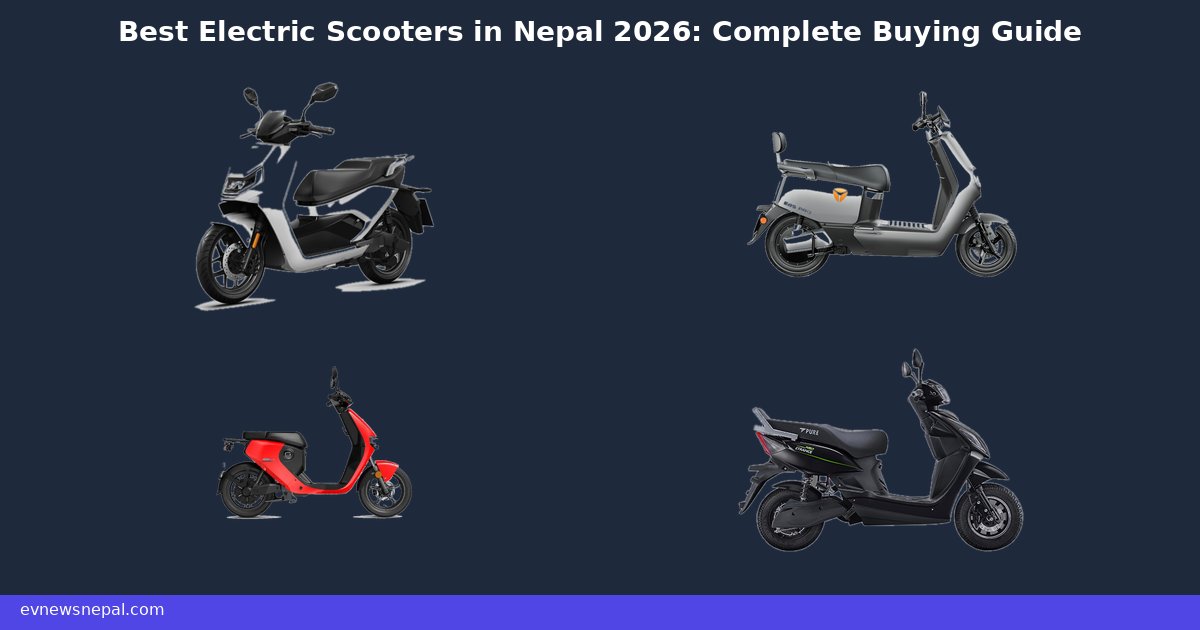
Best Electric Scooters in Nepal 2026: Complete Buying Guide
Key Takeaways
- Nepal's EV market offers scooters from Rs. 1.45L to Rs. 2.76L with ranges up to 150km
- Yadea E8S Pro leads with 150km range and graphene battery for highway performance
- NIU UQim provides budget-friendly accessibility at Rs. 1.45L for short commutes
- Key considerations: hill climbing ability, monsoon readiness, and charging infrastructure
- Government offers 10% VAT exemption on electric scooters to boost adoption
Introduction
Nepal's electric vehicle market is booming, driven by rising fuel prices, growing environmental awareness, and government incentives. The Himalayan nation faces unique challenges - steep terrain, seasonal monsoon rains, and congested urban valleys - making the choice of the right electric scooter critical for practicality and performance. As we step into 2026, the market offers an exciting range of e-scooters tailored for everything from daily commutes in Kathmandu to longer weekend trips into the hills.
This comprehensive guide cuts through the hype to help you find the perfect electric scooter match. We'll break down real-world performance, pricing, and features across the latest models available in Nepal. Whether you're a student on a tight budget or a family seeking reliable transportation, this buying guide gives you the insights needed to make an informed decision in Nepal's dynamic EV landscape.
Quick Summary
| Model | Price (from) | Range | Battery | Best For |
|---|---|---|---|---|
| NIU UQim | Rs. 1,45,000 | 30 km | 0.77 kWh | Budget buyers, short commutes |
| Yadea E8S Pro | Rs. 1,85,000 | 150 km | 2.74 kWh | Long-distance, highway rides |
| Super Soco CU Mini Standard | Rs. 1,89,900 | 60 km | 0.96 kWh | Compact urban riding |
| Pure EV ETrance Plus Standard | Rs. 1,99,999 | 90 km | 2.0 kWh | Families, portability |
| TVS iQube 2.2 | Rs. 2,17,000 | 75 km | 2.2 kWh | Tech-savvy riders |
| Yadea S-Like | Rs. 2,30,000 | 50 km | 1.44 kWh | Style-conscious buyers |
| Yadea EPOC | Rs. 2,35,000 | 125 km | 2.74 kWh | Mixed terrain performance |
| NIU Gova 03 | Rs. 2,55,000 | 65 km | 2.4 kWh | Premium features |
Detailed Reviews
NIU UQim — Rs. 1,45,000 onwards
- Range: 30 km | Battery: 0.77 kWh | Motor: 0.4 kW
- Key highlight: World's most affordable electric scooter
The NIU UQim makes electric mobility accessible to everyone in Nepal. Perfect for short hops around Kathmandu Valley, this lightweight scooter features a portable battery you can remove and charge at home. With LED lighting and a robust design, it handles monsoon rains and narrow streets with ease. While the 30km range limits longer trips, its affordability and simplicity make it ideal for students and first-time EV buyers.
Real-world insight: Owners praise its instant torque and quiet operation, though many recommend carrying a spare battery for extended use.
Yadea E8S Pro — Rs. 1,85,000 onwards
- Range: 150 km | Battery: 2.74 kWh | Motor: 2.0 kW
- Key highlight: Exceptional long-range for Himalayan terrain
For those needing range and performance, the Yadea E8S Pro shines. Its graphene battery delivers 150km on a single charge - enough for Kathmandu-Pokhara round trips. The powerful motor provides smooth acceleration up steep slopes, while three riding modes let you optimize for efficiency or sportiness. With dual disc brakes and 170mm ground clearance, it handles Nepal's challenging roads better than most.
Pro tip: Use Eco mode for mountain commutes to maximize range.
Super Soco CU Mini Standard — Rs. 1,89,900 onwards
- Range: 60 km | Battery: 0.96 kWh | Motor: 0.6 kW
- Key highlight: Ultra-compact design for tight spaces
This miniature electric scooter proves big performance comes in small packages. The Super Soco CU Mini's compact footprint navigates Kathmandu's chaotic traffic with ease, while its removable battery offers flexible charging options. Though limited to 60km range, it's perfect for valley commutes where charging infrastructure is improving.
City rider favorite: Its folding handlebars make it easy to carry onto public transport or store in small apartments.
Pure EV ETrance Plus Standard — Rs. 1,99,999 onwards
- Range: 90 km | Battery: 2.0 kWh | Motor: 2.2 kW
- Key highlight: Portable battery freedom
The Pure EV ETrance Plus solves Nepal's charging access issues with its removable battery. Carry the 2.0kWh pack to your office, home, or even a remote village with basic charging points. The motor provides adequate power for hills, and the low-speed mode is perfect for crowded urban areas.
Family choice: Parents appreciate the stable riding position and reliable stopping power for safety.
TVS iQube 2.2 — Rs. 2,17,000 onwards
- Range: 75 km | Battery: 2.2 kWh | Motor: 3.0 kW
- Key highlight: Premium tech and performance
TVS brings Indian engineering excellence to Nepal with the iQube 2.2. The 3.0kW motor delivers strong acceleration, while regenerative braking extends range. Its 5-inch TFT screen offers navigation and smartphone connectivity - rare in Nepal's EV market. With 157mm ground clearance and robust suspension, it handles potholes and monsoon roads confidently.
Tech highlight: Q-Park Assist simplifies parallel parking in tight Kathmandu streets.
Price Comparison
| Model | Price (from) |
|---|---|
| NIU UQim | Rs. 1,45,000 |
| Yadea E8S Pro | Rs. 1,85,000 |
| Super Soco CU Mini Standard | Rs. 1,89,900 |
| Pure EV ETrance Plus Standard | Rs. 1,99,999 |
| TVS iQube 2.2 | Rs. 2,17,000 |
| Yadea S-Like | Rs. 2,30,000 |
| Yadea EPOC | Rs. 2,35,000 |
| NIU Gova 03 | Rs. 2,55,000 |
Which One Should You Buy?
By Budget
- Under Rs. 25L: NIU UQim - Perfect entry point
- Rs. 25-40L: Yadea E8S Pro or Super Soco CU Mini - Balance of range and affordability
- Rs. 40-60L: Pure EV ETrance Plus or TVS iQube - Feature-rich options
- Rs. 60L+: Yadea EPOC or NIU Gova 03 - Premium performance
By Use Case
- City Commuting: Super Soco CU Mini or NIU UQim
- Highway/Distance: Yadea E8S Pro or Yadea G6
- Family Transport: Pure EV ETrance Plus or TVS iQube
Buying Tips for Nepal
- Terrain readiness: Test ride up local hills - Kathmandu valley has average 8-12% gradients
- Monsoon preparation: Prioritize models with >=150mm ground clearance and robust waterproofing
- Charging strategy: Consider home charging setup (NEA rates Rs. 10-12/kWh) vs public stations
- After-sales support: Verify service center availability in your region
- Battery warranty: Look for minimum 3-year coverage on cells
Plan Your EV Road Trip
Get a personalized route with charging stops, battery estimates, and costs for your specific EV.
Frequently Asked Questions
Q: What is the charging cost for electric scooters in Nepal?
A: At NEA rates, a 2kWh charge costs Rs. 200-240. Private fast chargers charge Rs. 15-20/kWh, so a full charge may cost Rs. 400-600. Home charging remains most economical.
Q: Can these scooters handle Nepal's hilly terrain?
A: Models with >=2kW motors and >=150mm ground clearance (like Yadea E8S Pro) perform best on hills. Lower-powered models work within Kathmandu valley but struggle on steep climbs.
Q: How long does a full charge take?
A: Most scooters charge in 6-10 hours on standard outlets. Fast-charging options (where available) can reach 80% in 30 minutes, though this costs more per kWh.
Q: What safety features should I prioritize?
A: Look for CBS (Combi Brake System), regenerative braking, and LED lighting. Models with anti-theft systems offer extra security in urban areas.
Q: Are there government incentives for buying electric scooters in Nepal?
A: Nepal offers 10% VAT exemption on electric scooters, plus potential subsidies for businesses. Check current policies at the Department of Transport.
NIU UQim | Yadea E8S Pro | TVS iQube 2.2 | Compare EVs | Used EVs