BYD Dolphin vs MG Comet EV: Price, Range & Features Compared in Nepal (2025)
Quick Comparison
- BYD Dolphin starts at {{vehicle:byd-dolphin:formattedPrice}} with {{vehicle:byd-dolphin:range.claimed}} claimed range and DC fast charging; MG Comet starts at {{vehicle:mg-comet-pace:formattedPrice}} as a budget-first city EV
- Real-world range in Nepal: ~278 km for the Dolphin vs ~188 km for the Comet in mixed driving conditions
- Dolphin supports DC fast charging (10–80% in ~38 min); Comet is AC-only at 3.3 kW — suitable for overnight home charging
- BYD Dolphin leads significantly on ADAS, comfort tech, and in-car connectivity; Comet covers core urban safety essentials
- Choose the Dolphin for versatile all-round use; choose the Comet for budget-priority urban commuting within the Kathmandu valley
The BYD Dolphin is the stronger all-round EV for most Nepali buyers — but if budget is your primary concern, the MG Comet makes a compelling case for urban commuters.
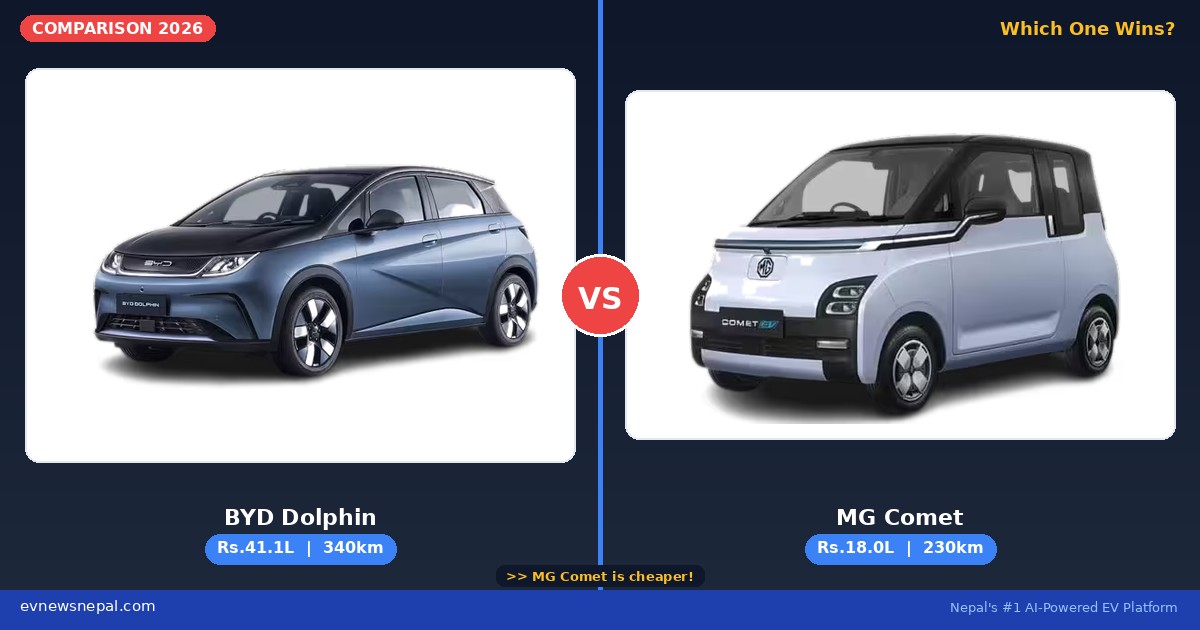
These two compact EVs occupy very different ends of the spectrum. The BYD Dolphin, starting at Rs. 41,15,000, is a full-featured hatchback built around a 44.9 kWh battery and 340 km of claimed range — designed to handle everything from daily Kathmandu commutes to weekend drives beyond the valley. The MG Comet Pace, at Rs. 18,75,000, is a compact microcar with a 17.3 kWh battery optimised specifically for short urban trips.
The choice ultimately comes down to how and where you drive. Do you need a versatile EV that handles mixed terrain and occasional highway runs, or a no-fuss city car built purely for point-to-point commuting? This comparison breaks down both vehicles across range, charging, features, and real-world value — so you can decide with confidence.
At a Glance
| Spec | BYD Dolphin | MG Comet Pace |
|---|---|---|
| Price | Rs. 41,15,000 | Rs. 18,75,000 |
| Battery | 44.9 kWh | 17.3 kWh |
| Range (claimed) | 340 km (WLTP) | 230 km (ARAI) |
| Motor Power | 70 kW | 31.3 kW |
| Torque | 180 Nm | 110 Nm |
| Fast Charging | 10-80% in 38 min | Not supported (AC only, 3.3 kW max) |
| Top Speed | 150 km/h | 100 km/h |
| Ground Clearance | 175 mm | 165 mm |
| V2L | No | No |
Price Breakdown
| Variant | Price | Battery | Range |
|---|---|---|---|
| BYD Dolphin | Rs. 41,15,000 | 44.9 kWh | 340 km |
| MG Comet Pace | Rs. 18,75,000 | 17.3 kWh | 230 km |
| MG Comet Play | Rs. 21,50,000 | 17.3 kWh | 230 km |
Range: Real World vs Claimed
| Metric | BYD Dolphin | MG Comet Pace |
|---|---|---|
| Claimed range | 340 km (WLTP) | 230 km (ARAI) |
| Est. real-world (Nepal, mixed) | ~278 km | ~188 km |
| Est. real-world (highway, hilly) | ~255 km | ~172 km |
The BYD Dolphin's 340 km claimed range (WLTP) gives it a clear edge for buyers who venture beyond city limits. In Nepal's mixed conditions — stop-and-go valley traffic, steep uphill climbs, and AC use during warmer months — real-world figures drop to around 278 km. On sustained highway and hilly routes, expect closer to 255 km. That's still a practical buffer for intercity trips within the mid-hills.
The MG Comet's 230 km claimed range is measured under ARAI conditions, which tend to be more optimistic than on-road results in Nepal's terrain. In realistic Kathmandu mixed driving, the Comet returns approximately 188 km, falling to around 172 km on hilly highway routes. For a daily school-to-office-to-market loop within the valley, this is workable — but longer excursions will require advance planning around charging availability.
Charging Speed and Monthly Cost
| Spec | BYD Dolphin | MG Comet Pace |
|---|---|---|
| DC Fast Charge | 10-80% in 38 min | Not supported (AC only, 3.3 kW max) |
| AC Home Charge | 0-100% in 6.5 hours | 0-100% in 7 hours (3.3 kW AC) |
| Full charge cost (home, Rs.11/kWh) | ~Rs. 493 | ~Rs. 190 |
| Est. monthly cost (30km/day) | ~Rs. 1307/month | ~Rs. 744/month |
The BYD Dolphin's DC fast charging capability is one of its most practical advantages. A 10–80% top-up takes around 38 minutes, which meaningfully reduces range anxiety on longer drives and makes Nepal's slowly expanding DC fast-charger network more useful. At home on AC, a full 0–100% charge completes in approximately 6.5 hours — perfectly timed for an overnight plug-in, which is how most Nepali EV owners charge anyway.
The MG Comet is an AC-only vehicle, maxing out at 3.3 kW, with a full charge taking around 7 hours from home. For a car designed around short urban hops, this is rarely a bottleneck — plug in at night, wake up to a full battery. Nepal's public fast-charging infrastructure is still developing, so valley-based Comet owners won't feel the gap as acutely day-to-day. The bigger consideration is monthly running cost: with a smaller battery, the Comet costs significantly less per full charge, as the table above shows.
Features Face-Off
| Feature | BYD Dolphin | MG Comet Pace |
|---|---|---|
| Airbags | 6 | N/A |
| ABS + EBD + ESP + TCS | Yes | Yes |
| TPMS | Yes | Yes |
| ISOFIX | Yes | Yes |
| Hill Hold | Yes | No |
| Hill Descent Control | No | No |
| Auto Hold | No | No |
| AEB (Emergency Braking) | Yes | No |
| Adaptive Cruise Control | Adaptive Cruise Control (ACC) | No |
| Lane Keep Assist | LKA + LDW | No |
| Blind Spot Detection | Yes | No |
| Rear Cross Traffic Alert | Yes | No |
| 360-degree Camera | No | No |
| Rear Camera | Yes | No |
| Parking Sensors | Front and Rear | Front and Rear |
| Panoramic Sunroof | Panoramic sunroof | No |
| Heated/Ventilated Seats | Heated | No |
| Wireless Phone Charging | Yes | No |
| V2L (Vehicle-to-Load) | No | No |
| Touchscreen | 12.8-inch Touchscreen | N/A |
| Digital Instrument Cluster | 5" Digital | N/A |
| Apple CarPlay / Android Auto | Apple CarPlay + Android Auto | No |
| Connected Car / App | Yes | No |
| Head-Up Display | No | No |
| Ambient Lighting | No | No |
| Sound System | 6-speaker sound system | N/A |
Compare side-by-side: BYD Dolphin vs MG Comet — full specs, features & price comparison tool.
The BYD Dolphin arrives with a broad suite of active safety, driver assistance, and interior tech features that put it among the better-equipped compact EVs available in Nepal. It leads noticeably in ADAS technology and cabin comfort — spanning multiple layers of passive safety, active driver aids, and connected car functionality. Refer to the Features Face-Off table above for the complete breakdown by category.
The MG Comet takes a more focused approach, covering the core safety essentials expected of a modern urban EV without the premium feature stack. This keeps the package light and the price competitive — the right trade-off for buyers who prioritise low cost of entry over a feature-rich cabin. Both vehicles meet the fundamental safety baseline; the divergence becomes most apparent when comparing ADAS capability and in-car technology, as the table above details.
How Much Will You Save Going Electric?
Use our free EV vs Petrol Cost Calculator to compare total cost of ownership.
Explore these vehicles:
Pros and Cons
BYD Dolphin
Pros:
- Larger 44.9 kWh battery delivers 340 km claimed range — genuinely versatile for city and beyond
- DC fast charging support makes top-ups quick and highway trips viable
- Comprehensive ADAS suite with active driver assistance and passive safety hardware
- Feature-rich interior including premium comfort, connectivity, and entertainment tech
- Higher top speed of 150 km/h — more confident on Nepal's expanding highway network
- Stronger long-term resale and brand recognition as BYD expands its Nepal service footprint
Cons:
- Considerably higher starting price at Rs. 41,15,000
- Larger dimensions may feel less nimble in tight Kathmandu lanes and multi-storey parking
- Higher monthly charging cost relative to the Comet given its bigger battery
MG Comet
Pros:
- Accessible entry price at Rs. 18,75,000 — among the most affordable EVs in Nepal
- Ultra-compact footprint makes it ideal for dense valley traffic and tight urban parking
- Low day-to-day running costs — one of the cheapest EVs to charge in Nepal
- Available in two variants (Pace and Play) to suit different budgets
- Covers essential safety features for everyday city commuting
- Simple, low-maintenance ownership profile well-suited to first-time EV buyers
Cons:
- AC-only charging with no DC fast charge support limits flexibility on longer trips
- Shorter real-world range makes it unsuitable for regular drives outside the valley
- Feature set is minimal compared to rivals at higher price points
- Lower top speed of 100 km/h reduces highway comfort
Our Verdict: Which Should You Buy?
The BYD Dolphin is the better EV for most buyers in Nepal. Its 340 km claimed range, DC fast charging, and comprehensive feature set make it a genuinely versatile vehicle — capable of handling both daily Kathmandu commuting and occasional drives to Pokhara, Chitwan, or beyond. At Rs. 41,15,000, it represents strong value for a well-equipped, future-proof compact EV.
Choose the MG Comet if budget is the deciding factor and your driving is almost entirely urban. At Rs. 18,75,000 for the Pace variant, it brings EV ownership within reach for buyers who might otherwise consider a used petrol car. If your daily commute stays within the Kathmandu valley, the Comet's low running costs and easy city maneuverability make a strong practical case.
The simplest way to decide: estimate your weekly mileage and whether you ever need to leave the valley. If the answer is yes — even occasionally — the Dolphin is the smarter long-term investment. If you're a committed city commuter looking for the lowest possible entry cost into EV ownership, the Comet delivers exactly what it promises.
Frequently Asked Questions
Q: What is the price of the BYD Dolphin in Nepal?
A: The BYD Dolphin is priced at Rs. 41,15,000 in Nepal. It comes with a 44.9 kWh battery and 340 km of claimed WLTP range. For the latest pricing and full variant details, visit the BYD Dolphin price page.
Q: What is the price of the MG Comet in Nepal?
A: The MG Comet is available in two variants. The Pace starts at Rs. 18,75,000 and the Play is priced at Rs. 21,50,000. Both variants share the same 17.3 kWh battery and 230 km claimed range. See the MG Comet Pace price page for full details.
Q: Which EV has better real-world range in Nepal — BYD Dolphin or MG Comet?
A: The BYD Dolphin delivers significantly more real-world range. In mixed Nepal driving — Kathmandu valley traffic plus hilly terrain — expect around 278 km from the Dolphin versus approximately 188 km from the MG Comet. Both figures are lower than official claims due to Nepal's stop-and-go conditions and elevation changes. The Dolphin is the clear choice for buyers who travel outside the valley.
Q: Does the MG Comet support DC fast charging in Nepal?
A: No, the MG Comet supports AC charging only, with a maximum charge rate of 3.3 kW. A full 0–100% charge takes approximately 7 hours. For buyers who need rapid top-ups or plan longer drives, the BYD Dolphin — which supports DC fast charging at 10–80% in around 38 minutes — is the stronger choice.
Q: Which compact EV is better for daily commuting in Kathmandu?
A: Both are well-suited to Kathmandu valley commuting, but they serve different profiles. The MG Comet's smaller footprint is particularly agile in tight city lanes and crowded parking areas, and its low running cost keeps daily expenses minimal. The BYD Dolphin is slightly larger but adds the benefit of a longer range and a richer feature set — ideal for buyers who want city practicality with the option to drive further when needed.
Q: Is the BYD Dolphin worth the extra cost over the MG Comet in Nepal?
A: For most buyers, yes. The BYD Dolphin at Rs. 41,15,000 offers significantly more range, fast charging capability, and a far more comprehensive feature set compared to the MG Comet at Rs. 18,75,000. If your driving is strictly within Kathmandu and budget is tight, the Comet makes sense. But for buyers who want an EV they won't outgrow quickly, the Dolphin is the stronger long-term investment. Use the comparison tool to weigh the full specs side by side.