Cherry iCAUR V23 Review Nepal 2026: Price, Range, Off-Road Capability & Should You Buy It?
Key Takeaways
- Priced at Rs. 49,99,000, the Cherry iCAUR V23 is Nepal's first retro-styled electric off-roader with a 43-degree approach angle and 210 mm ground clearance.
- The 59.93 kWh LFP (CATL) battery delivers ~300–330 km real-world range; a full home charge on NEA rates costs just Rs. 600–720.
- A Qualcomm Snapdragon 8155-powered 15.4-inch 2.5K touchscreen with wireless Apple CarPlay sets a high tech benchmark for this price bracket.
- V2L external power output, 360-degree camera, AEB, Adaptive Cruise Control, and full parking assist are all standard — with no expensive options list.
- Best suited for adventure-oriented buyers and urban families in the 40–60L bracket who want genuine off-road credentials combined with EV running costs.
Nepal's electric vehicle revolution has quietly crossed a tipping point. In fiscal year 2024–25, an astonishing 73% of all newly imported four-wheeler passenger vehicles in Nepal were electric — a figure that would have seemed absurd just five years ago. The government held EV-friendly tax policies steady for FY2025–26, the charging network has grown past 1,200 stations nationwide, and buyers are now spoilt for choice across every budget bracket. Into this energised market steps a vehicle that looks like it was custom-built for Nepal's terrain: the Cherry iCAUR V23.
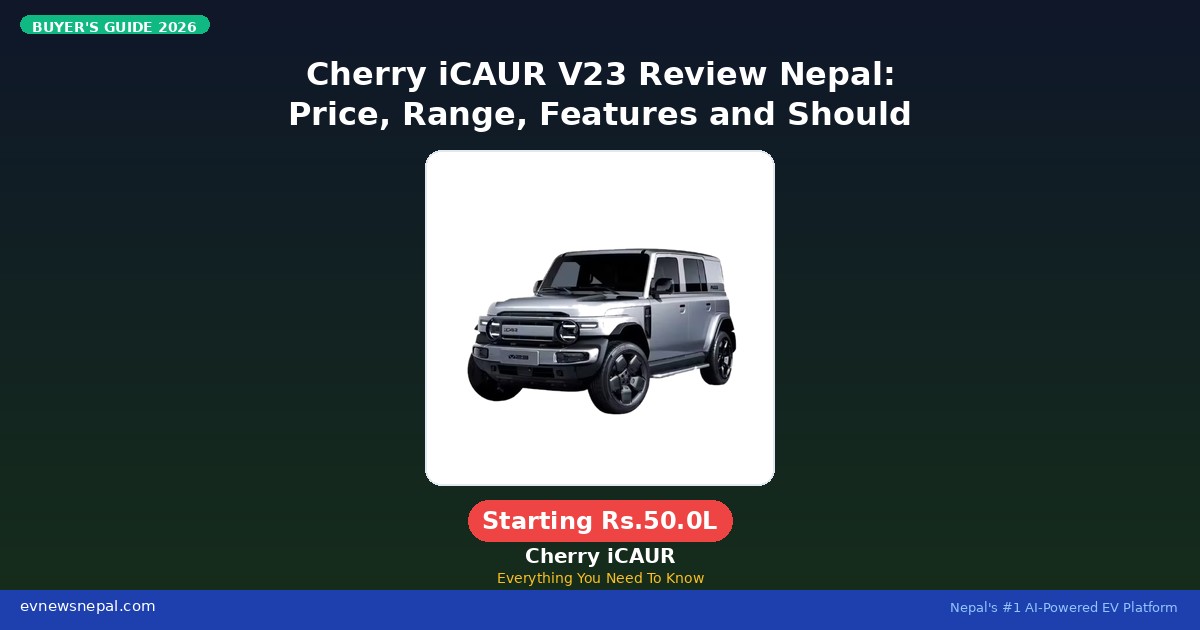
The iCAUR V23 is not just another crossover wearing an electric badge. It is a purpose-built, retro-styled electric SUV with genuine off-road credentials — a 43-degree approach angle, 210 mm of ground clearance, and what international test drivers confirmed is a 600 mm water wading depth (double the Suzuki Jimny's figure, for context). The styling channels classic Land Rover Defender energy, right down to the clamshell bonnet, round LED headlights, and flared arches. SPG Automobiles — the same distributor behind Jaecoo and Omoda in Nepal — brought this machine to market at Rs. 49,99,000, and it is generating real excitement among Nepal's growing EV buyer base.
This review is your complete guide: real range expectations for Nepal's roads, what charging actually costs, how the technology holds up in daily use, and — most importantly — whether you should be writing that cheque.
Quick Summary
| Model | Price (from) | Range | Battery | Best For |
|---|---|---|---|---|
| Cherry iCAUR V23 RWD | Rs. 49,99,000 | 400 km (CLTC) | 59.93 kWh LFP | Off-road adventures, urban families, SUV upgraders |
Detailed Review
Cherry iCAUR V23 RWD — Rs. 49,99,000
- Range: 400 km (CLTC) | Battery: 59.93 kWh LFP | Motor: 100 kW / 180 Nm
- Charging: 30–80% in 30 min (85 kW DC fast) | 0–100% in 8 hrs (home AC) | Top Speed: 140 km/h
- Dimensions: 4,220 × 1,915 × 1,845 mm | Wheelbase: 2,735 mm | Seats: 5
- Nepal's first retro-styled electric off-roader with Defender-like presence and genuine trail credentials
Design and Road Presence
The iCAUR V23 makes an immediate impression. At 4,220 mm long, 1,915 mm wide, and 1,845 mm tall with a 2,735 mm wheelbase, this is a properly substantial SUV — larger and more commanding in person than photographs suggest. The boxy silhouette, hidden door handles, aluminium alloy side steps, and round LED headlamp clusters give it a retro-adventurer character that stands out on Kathmandu's streets. Six colour options are available — Black, Gray, Green, Orange, Silver, and White — and the Green and Orange shades look spectacular against Nepal's mountain backdrops. International reviewers have consistently praised the build quality as punching above its price point, and first impressions from Nepal market unveilings echo that sentiment.
The off-road specification is the real talking point for Nepali buyers. The 43-degree approach angle and 210 mm of ground clearance mean the V23 handles the kind of broken, potholed, and unpaved surfaces that are simply everyday reality outside the Kathmandu ring road. Whether you are navigating Sindhupalchok's hill roads, rutted village tracks in Kaski, or a flooded crossing during monsoon season, this vehicle is engineered to cope where most EVs would hesitate. That 600 mm water wading depth figure becomes very real when the monsoon arrives.
Interior and Technology
Open the door and the V23's interior immediately justifies its price. The centrepiece is a 15.4-inch 2.5K central touchscreen powered by a Qualcomm Snapdragon 8155 chipset — the same processor found in flagship Android smartphones from a couple of years ago, delivering genuinely fluid, lag-free performance. Wireless Apple CarPlay connects seamlessly, and voice control works in real time. Critically, physical rotary knobs are retained for climate and audio volume — a small but deeply practical decision that makes the V23 far easier to use while navigating traffic than rivals that buried everything inside menus.
The 360-degree camera system proves invaluable in Kathmandu's narrow galis and congested market zones. The ADAS suite is comprehensive for this price bracket: Automatic Emergency Braking (AEB), Lane Keeping Assist, Adaptive Cruise Control, Blind Spot Monitoring, Traffic Jam Assist, and both Automatic and Remote Parking Assist are all standard. The V2L (Vehicle-to-Load) external power output is a standout feature for Nepal specifically — whether you are camping in the hills, at a picnic site without grid access, or dealing with a power outage, the iCAUR V23 can run external appliances directly from its battery. For adventure-oriented buyers, this is genuinely transformative technology.
Range, Performance, and Charging Costs
The 59.93 kWh LFP battery supplied by CATL is one of the smartest choices Cherry made for Nepal's conditions. Lithium Iron Phosphate chemistry is more thermally stable than NMC alternatives, handles cold mountain temperatures better, tolerates regular full charges without accelerating degradation, and has a longer cycle life overall. In practical terms: charge to 100% every night without worry, and the battery will hold its capacity for many more years than a comparable NMC pack. The official 400 km CLTC range will translate to approximately 300–330 km in real-world Nepali driving — factoring in valley stop-start traffic, air conditioning, and the additional energy demand of hill climbs. For a daily commuter doing 30–40 km around Kathmandu, a single charge comfortably covers more than a week.
The 100 kW motor producing 180 Nm of torque accelerates the V23 from 0–100 km/h in 8.5 seconds and tops out at 140 km/h. Not thrilling by sports car standards, but deeply satisfying on mountain roads: EV torque is instantaneous from zero rpm, meaning where a petrol SUV must downshift and strain on a steep pass, the iCAUR simply pulls — smoothly, silently, and without drama. Charging on Nepal's actual electricity rates breaks down as follows:
| Charging Scenario | Cost per kWh | Full Charge (~60 kWh) | Notes |
|---|---|---|---|
| Home (NEA domestic) | Rs. 10–12 | ~Rs. 600–720 | Overnight, 8 hrs; cheapest option |
| NEA public station | Rs. 6–10.5 | ~Rs. 360–630 | Variable by location |
| Private fast charger | Rs. 15–20 | ~Rs. 900–1,200 | 30–80% in 30 min (85 kW DC) |
At home charging rates, running the iCAUR V23 costs roughly Rs. 2.0–2.5 per km — versus Rs. 12–15 per km for a petrol SUV of equivalent size. For a buyer commuting 35 km daily, monthly energy costs work out to approximately Rs. 1,500–2,000 — a fraction of what they would spend at a petrol pump.
Price Comparison
The iCAUR V23 is currently available in a single RWD variant in Nepal. Here is the full ownership cost picture:
| Cost Item | Detail |
|---|---|
| Ex-showroom price | Rs. 49,99,000 |
| Home wall charger installation (one-time) | Rs. 30,000–50,000 |
| Full charge at home (NEA rate) | ~Rs. 600–720 |
| Full charge at fast charger | ~Rs. 900–1,200 |
| Monthly running cost (35 km/day) | ~Rs. 1,500–2,000 |
| Estimated annual fuel saving vs petrol SUV | Rs. 1,50,000–2,00,000+ |
Pro tip: Installing a dedicated 7 kW home wall charger is the single best investment you can make alongside the iCAUR V23. NEA domestic rates make home charging 3–4× cheaper than private fast-charging stations. Your monthly EV energy bill will feel like a rounding error compared to what you used to spend on petrol.
Before finalising your decision, it is worth comparing EVs available in Nepal to ensure the V23 is the right match for your budget and use case.
Which One Should You Buy?
Under 40L
The iCAUR V23 is outside this budget bracket. Explore the used EV market in Nepal or consider lower-priced new EV options for this range.
40–60L — The iCAUR V23's Sweet Spot
This is where the V23 makes its strongest case. City commuters will love the low running costs, tech-loaded cabin, and the SUV presence that makes navigating Kathmandu feel effortless. Adventure buyers will find nothing else at this price with comparable off-road geometry, ground clearance, and the reassurance of LFP battery chemistry in varied temperatures. Family buyers get five seats, comprehensive safety tech, V2L power for road trips, and a stable, well-built platform. If your budget sits in this bracket and you want an EV that genuinely handles Nepal's terrain, the iCAUR V23 deserves serious consideration.
60L+
If you have 60L+ to spend and specifically want dual-motor AWD or maximum range, note that the more powerful iWD variant (81.8 kWh, dual motor, available in Malaysia) has not been officially confirmed for Nepal at the time of writing. For now, the single RWD specification is what is on offer.
By use case:
- Daily Kathmandu commute: Excellent — a week of commuting on one charge, low running costs, premium tech
- Hill and off-road travel: Outstanding — the standout EV choice for buyers who regularly leave the valley
- Highway intercity (Kathmandu–Pokhara, etc.): Good — the 300+ km real-world range is adequate; plan one fast-charge stop each way
- Remote rural routes: Requires careful planning — charging infrastructure outside major corridors is still developing
Buying Tips for Nepal
-
Ask about current promotional pricing. The iCAUR V23 launched with an introductory booking price of Rs. 47,99,000. Always ask SPG Automobiles about current deals, accessory bundles, or extended warranty packages before signing.
-
Budget for a home charger from day one. A 7 kW AC wall charger costs Rs. 30,000–50,000 installed. It pays for itself within months through savings versus public fast-charging rates.
-
Plan your charging route before highway trips. The Kathmandu–Pokhara and Kathmandu–Hetauda corridors have reasonable DC fast-charging coverage. For remote hill districts, map your stops in advance. The real-world range of 300–330 km gives a comfortable buffer with proper planning.
-
Charge LFP to 100% regularly. Unlike NMC batteries that benefit from staying at 80–90%, LFP chemistry (as in the V23) is designed for regular full charges. Plug in every night and charge to full — it is actually good for this battery type.
-
Verify service network before buying. Confirm SPG Automobiles' service centre locations and spare parts availability for the iCAUR in your city or region. After-sales support is a critical factor for any new brand entering the Nepal market.
How Much Will You Save Going Electric?
Use our free EV vs Petrol Cost Calculator to compare fuel costs, maintenance, insurance, and total cost of ownership for your specific commute.
Plan Your EV Road Trip
Get a personalized route with charging stops, battery estimates, and costs for your specific EV.
Frequently Asked Questions
Q: What is the price of the Cherry iCAUR V23 in Nepal?
A: The Cherry iCAUR V23 RWD is officially priced at Rs. 49,99,000 (ex-showroom Nepal), distributed by SPG Automobiles. An introductory booking price of Rs. 47,99,000 was offered at launch — confirm current pricing directly with the dealer.
Q: What is the real-world range of the Cherry iCAUR V23 in Nepal?
A: The official CLTC-rated range is 400 km. In real-world Nepali driving — combining Kathmandu valley traffic, air conditioning use, and uphill terrain — expect approximately 300–330 km per charge. For daily commuters doing 30–40 km/day, a single charge lasts well over a week.
Q: How much does it cost to charge the Cherry iCAUR V23 in Nepal?
A: Charging at home on NEA domestic rates (Rs. 10–12/kWh) costs approximately Rs. 600–720 for a full charge (59.93 kWh). At a private fast-charging station (Rs. 15–20/kWh), a full charge costs Rs. 900–1,200. The 85 kW DC fast charger brings the battery from 30–80% in just 30 minutes.
Q: Is the Cherry iCAUR V23 good for Nepal's hilly and off-road terrain?
A: Yes — this is arguably its greatest strength for Nepal buyers. With 210 mm of ground clearance, a 43-degree approach angle, and an off-road-tuned chassis, the V23 handles rough tracks, river crossings, and mountain passes far more capably than standard crossover EVs. The instant low-speed torque of the electric motor is particularly well-suited to steep hill climbs.
Q: Does the Cherry iCAUR V23 support fast charging in Nepal?
A: Yes. The V23 supports 85 kW DC fast charging, achieving 30–80% charge in approximately 30 minutes. Home slow charging (0–100%) takes about 8 hours using an AC charger — ideal for overnight charging.
Q: What is V2L and does the iCAUR V23 have it?
A: V2L stands for Vehicle-to-Load — it allows the car's battery to power external appliances and devices directly. The iCAUR V23 includes V2L as standard, making it useful for camping, remote areas without grid power, or as emergency backup electricity at home during outages.
Q: Does the Cherry iCAUR V23 have Apple CarPlay?
A: Yes. The V23 features wireless Apple CarPlay and Android Auto through its 15.4-inch 2.5K central touchscreen, powered by a Qualcomm Snapdragon 8155 chipset. Voice control is also standard.