EV Brand Reputation Rankings in Nepal (2026): Who Leads the Market?
Key Takeaways
- BYD leads Nepal’s EV brand reputation rankings with a perfect 10/10 score, backed by 18 dealerships, 8 DC fast chargers, and 2,436 units sold in 2025.
- Tata Motors (9/10) is the fastest-growing brand with 46% YoY growth, while Hyundai (9/10) remains a trusted pioneer with over 1,000 cumulative Kona units.
- MG Motor earned an 8/10 rating after its MG S5 became a breakout hit with 1,052 units imported in 2025.
- Tesla received only 4/10 despite global brand power, having zero service track record since its February 2025 Nepal entry.
- Buyers should prioritize dealer network strength and spare parts availability over brand novelty when choosing an EV in Nepal.
EV Brand Reputation Rankings in Nepal (2026): Who Leads the Market?
Nepal has cemented its position as one of the most electrified vehicle markets in the world. With approximately 73% of all new car imports now being electric vehicles, Nepal ranks second globally in EV market share — trailing only Norway. But with dozens of brands now competing for Nepali buyers, a crucial question emerges: which EV brand can you actually trust?
Brand reputation is not just about sales numbers. It encompasses the entire ownership experience — from the moment you walk into a dealership to the years of after-sales support that follow. In a market as young and rapidly evolving as Nepal’s, choosing the wrong brand can mean orphaned vehicles, non-existent spare parts, and service nightmares.
This analysis, compiled by EVNews Nepal’s expert analysis team, evaluates every major EV brand operating in Nepal across five critical dimensions.
Methodology: How We Score Brands
Our Brand Reputation Score (1-10) weighs five factors equally:
- Dealer Network & Accessibility — Number of showrooms, service centers, and geographic coverage across Nepal
- Sales Volume & Market Confidence — Units sold, market share, and growth trajectory
- After-Sales Support — Spare parts availability, service turnaround times, and warranty honoring
- Customer Satisfaction — Owner feedback, complaint resolution, and community sentiment
- Market Presence & Longevity — Years active in Nepal, consistent model availability, and brand investment
Each factor is scored 1-10, and the overall score is the weighted average.
The Rankings: Nepal’s Most Trusted EV Brands
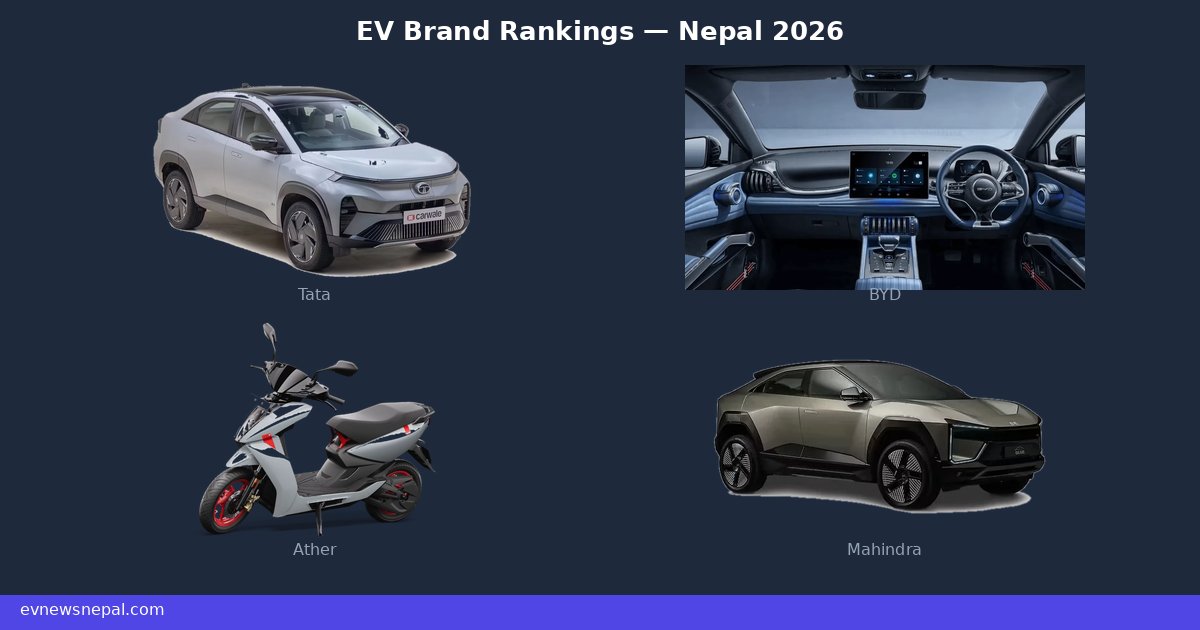
| Rank | Brand | Score | Market Share | Key Strength |
|---|---|---|---|---|
| 1 | BYD | 10/10 | 18.61% | Largest dealer network, dominant sales |
| 2 | Tata | 9/10 | 15.31% | Fastest growth, most affordable entry |
| 3 | Hyundai | 9/10 | 12.62% | Pioneer brand, proven reliability |
| 4 | MG | 8/10 | 8.79% | Breakout model success |
| 5 | Mahindra | 7/10 | ~4% | Strong regional service backbone |
| 6 | Bajaj (2W) | 7/10 | — | Massive existing dealer network |
| 7 | BMW | 7/10 | ~2% | Premium segment leader |
| 8 | Suzuki | 7/10 | ~1% | Largest ICE footprint transitioning to EV |
Top Brands: Detailed Analysis
BYD — 10/10: The Undisputed Market Leader
BYD’s dominance in Nepal is no accident. Backed by Cimex Inc as their authorized dealer, BYD has built the most comprehensive EV ecosystem in the country. With 18 dealerships and service centers spread across Nepal and 8 DC fast charging stations of their own, BYD has invested more in infrastructure than any other brand.
The numbers speak for themselves: 2,436 units imported in 2025 alone, commanding an 18.61% market share — the single largest share of any brand. Models like the Atto 3, Seal, and Dolphin have become household names. BYD’s vertical integration (they manufacture their own batteries, chips, and motors) gives them a cost and supply chain advantage that directly benefits Nepali consumers through competitive pricing and parts availability.
Tata Motors — 9/10: The People’s Champion
Tata has emerged as Nepal’s fastest-growing EV brand, recording a staggering 46% year-over-year growth. Distributed by Sipradi Trading, one of Nepal’s most established automotive groups, Tata benefits from decades of trust built through their commercial and passenger vehicle lines.
The Tata Tigor EV holds the distinction of being the single highest-imported EV model in Nepal with 1,146 units in 2025. Meanwhile, the Tiago EV has become the most affordable electric car available, making EV ownership accessible to a broader segment of Nepali buyers. Tata’s 15.31% market share and Sipradi’s extensive service network across the Terai and hill regions make this brand a reliable choice.
Hyundai — 9/10: The Pioneer That Still Delivers
Hyundai was among the first brands to bring mainstream EVs to Nepal. The Kona Electric, distributed by Laxmi Intercontinental, has accumulated over 1,000 cumulative units — a milestone that speaks to both the model’s reliability and the brand’s staying power.
With a 12.62% market share and the recent introduction of the IONIQ 5, Hyundai offers a range from practical daily drivers to premium performance EVs. Laxmi Intercontinental’s established service infrastructure and genuine parts pipeline ensure that Hyundai owners rarely face the service anxiety that plagues smaller brands.
MG Motor — 8/10: The Breakout Story
MG, distributed by Paramount Motors, has written one of Nepal’s great EV success stories. The MG S5 — also known as the MG4 in global markets — became a breakout hit with 1,052 units imported in 2025, making it one of the top-selling models of the year.
With an 8.79% market share and an expanding dealer network, MG has proven that a relatively new entrant can build trust quickly through competitive pricing and strong product-market fit. The brand loses a point primarily because its service network is still maturing compared to established players.
Mahindra — 7/10: Quiet Confidence
Distributed by the Agni Group, Mahindra brings the weight of one of India’s largest automotive conglomerates to Nepal. The XUV400 and the upcoming BE 6 represent Mahindra’s serious push into the EV space.
Mahindra’s score reflects its solid but not spectacular position: good vehicles, reliable dealer (Agni Group is well-established), and the advantage of sharing service infrastructure with the massive Indian Mahindra network. Parts availability is generally good, though the EV-specific service expertise is still developing.
Bajaj (Two-Wheelers) — 7/10: Legacy Meets Electric
In the two-wheeler segment, Bajaj stands out with the Chetak electric scooter. Bajaj’s greatest asset in Nepal is its enormous existing dealer and service network built over decades of ICE motorcycle sales. Nearly every town in Nepal has a Bajaj service point.
This infrastructure advantage means Chetak buyers have service confidence that most EV two-wheeler brands simply cannot match. The score reflects strong infrastructure but limited EV model range.
BMW — 7/10: Premium Done Right
For buyers in the premium segment, BMW — distributed by the Dugar Group — offers the iX series and other electrified models. BMW’s reputation for build quality and driving dynamics translates well to their EV lineup.
The 7/10 score reflects excellent product quality and reliable dealer support, tempered by a limited market share (the premium segment is inherently smaller) and higher maintenance costs.
Suzuki — 7/10: The Sleeping Giant Awakens
Suzuki has the largest ICE vehicle footprint in Nepal. Their transition to EVs, starting with the e Vitara, leverages an unmatched service and parts network. While Suzuki is a late entrant to the EV space, their existing infrastructure gives them a significant head start over brands building from scratch.
Brands Facing Challenges
Kia — 4/10: Global Giant, Local Struggles
Kia may be a global EV powerhouse, but in Nepal, the story is different. EV sales have slowed significantly, and the brand has struggled to maintain momentum after initial interest. Service network gaps and inconsistent model availability have eroded buyer confidence.
Tesla — 4/10: All Hype, No Track Record (Yet)
Tesla officially entered Nepal in February 2025 with a showroom in Baluwatar, Kathmandu. While the brand carries enormous global cachet, it currently has zero service track record in Nepal. No established parts pipeline, no proven after-sales support, and no charging infrastructure of their own. The 4/10 score may improve over time, but today, buying a Tesla in Nepal is a leap of faith.
XPeng — 3/10: Fading Presence
With only 139 total units imported, XPeng has failed to build the critical mass needed for a sustainable presence. Limited dealer support and declining import numbers suggest the brand is losing momentum in Nepal.
Skywell — 2/10: Effectively Dormant
Skywell imported just 32 units of the ET5 and has been effectively dormant for over 10 months. No new models, minimal dealer activity, and virtually no after-sales infrastructure. Existing Skywell owners face a genuinely difficult situation with parts and service.
Key Takeaways for Buyers
If you are in the market for an EV in Nepal, here is what our brand reputation analysis suggests:
-
Prioritize dealer network over flashy specs. A car is only as good as the service behind it. BYD, Tata, and Hyundai lead here.
-
Check the brand’s import trajectory. Growing import numbers signal commitment to the market. Declining numbers are a red flag.
-
Ask about spare parts availability. Before buying, visit the service center and ask how long common parts take to arrive. Brands with Indian manufacturing bases (Tata, Mahindra, Hyundai) often have faster parts pipelines.
-
Consider resale value. Brands with larger installed bases (BYD, Tata, Hyundai) will hold value better than niche players.
-
Don’t chase novelty. Being the first to own a new brand feels exciting — until you need service. Let others be the guinea pigs.
Explore More on EVNews Nepal
For detailed EV import statistics, market share data, and historical trends, visit our EV Statistics Nepal page.
Want to see how individual models rate? Check out our Expert Analysis ratings on every vehicle listing — we score each EV on value, range, performance, features, and brand reliability.
This analysis is based on import data from the Department of Customs, dealer network surveys, and community feedback collected through March 2026. Brand scores are updated quarterly.