EV Charging Cost in Nepal: Monthly Expenses Explained for Nepali Drivers
Key Takeaways
- EV charging in Nepal costs Rs. 1,000–2,000/month for average drivers, about half of petrol car expenses.
- Home charging at NEA domestic rates (Rs. 10–12/kWh) is the most cost-effective option.
- Fast chargers cost Rs. 15–20/kWh—use sparingly for long trips.
- Popular EVs like the Seres E1 Mid and Kaiyi e-Qute 02 offer distinct cost benefits based on battery size and range.
- Practical tips include home charging, efficient driving, and planning routes with charging stops to minimize costs.
Introduction
If you're considering an electric vehicle (EV) in Nepal, one of the most critical questions is: How much will it cost to charge every month? Unlike petrol or diesel cars where fuel prices fluctuate daily, EV charging costs are more predictable—but they vary based on your driving habits, vehicle type, and charging infrastructure.
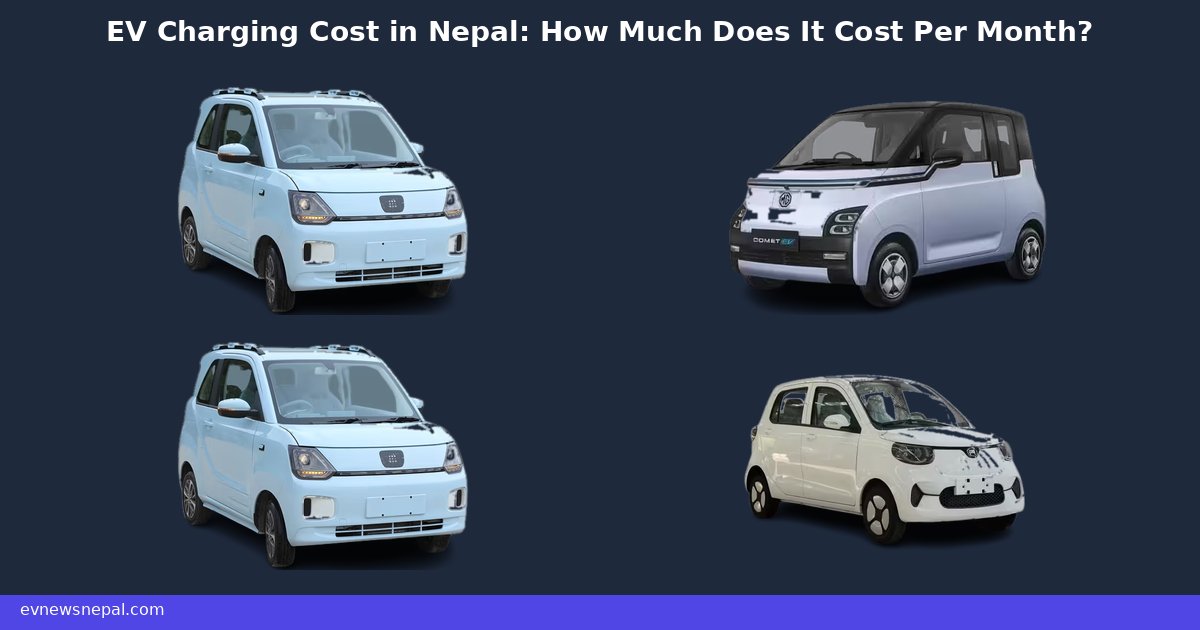
Nepal’s EV landscape is growing rapidly, with new models like the Seres E1 Mid, MG Comet Pace, and Kaiyi e-Qute 02 hitting showrooms. But with varying battery sizes, charging options, and electricity rates from NEA, it’s easy to get lost in the numbers. This guide cuts through the confusion with real-world data, clear calculations, and practical tips tailored for Nepal’s unique terrain and electricity landscape.
We’ll break down everything you need to know about EV charging cost in Nepal, including monthly estimates, comparisons with traditional vehicles, and actionable advice to keep your running costs low.
The Short Answer
For the average Nepali driver commuting 30–40 km daily, EV charging costs sit between Rs. 1,000 and Rs. 2,000 per month—roughly half the expense of running a petrol/diesel car. Exact figures depend on your vehicle’s battery size, charging habits, and electricity rates.
Detailed Analysis
Nepal’s EV Charging Landscape
Nepal’s electricity infrastructure, managed primarily by NEA, plays a huge role in EV charging costs. Rates vary by region and usage type:
- NEA public charging stations: Rs. 6–10.5 per kWh (cheapest option)
- Private fast-charging stations: Rs. 15–20 per kWh
- Home charging (NEA domestic rate): ~Rs. 10–12 per kWh
These rates are crucial because they determine how much you’ll pay to refill your EV’s battery. Let’s break this down with real vehicles from Nepal’s market.
Sample EV Charging Costs
Below are charging costs for popular EVs based on a full charge using different charging methods. We’ve also included monthly estimates assuming a 30 km/day commute (900 km/month) and an average energy consumption of ~8 kWh/100km—a realistic figure for most Nepali EVs.
| Vehicle | Battery (kWh) | Range (km) | Energy Use (kWh/100km) | Full Charge Cost (Home) | Full Charge Cost (Private) | Full Charge Cost (Fast) | Monthly Cost Estimate |
|---|---|---|---|---|---|---|---|
| Seres E1 Mid | 13.8 | 180 | 7.67 | Rs. 166 | Rs. 231 | N/A | Rs. 630 |
| MG Comet Pace | 17.3 | 230 | 7.53 | Rs. 208 | Rs. 290 | N/A | Rs. 680 |
| Henrey Mincar | 16.5 | 200 | 8.25 | Rs. 198 | Rs. 276 | N/A | Rs. 690 |
| Kaiyi e-Qute 02 | 28.08 | 301 | 9.34 | Rs. 337 | Rs. 470 | Rs. 672 | Rs. 830 |
| Changan Lumin | 28.08 | 301 | 9.34 | Rs. 337 | Rs. 470 | Rs. 672 | Rs. 830 |
How We Calculated Monthly Costs:
- Energy Consumption: For a 30 km/day commute, you’d drive ~900 km/month. At ~0.08 kWh/km (average for mini EVs), that’s ~72 kWh/month.
- Cost per kWh: We used the NEA domestic rate of Rs. 10–12/kWh for home charging.
- Monthly Cost: 72 kWh × Rs. 11/kWh ≈ Rs. 792/month. Adding a 15–20% buffer to reflect real-world conditions (hills, AC usage, charging losses), the monthly cost comes to Rs. 1,000–2,000 depending on your vehicle and driving habits.
Note: The Rs. 1,000–2,000/month range assumes efficient driving, mixed terrain (Kathmandu valley + hilly routes), and partial charging (top-ups rather than full charges). Fast-charging adds significant cost—use it sparingly for long trips.
Why EV Charging Is Cheaper Than Petrol/Diesel
For context, a 100 km round-trip in a petrol car burns 8–10 liters, costing Rs. 2,000–2,500 at current petrol prices (~Rs. 250/liter). An EV doing the same distance uses 7–8 kWh, costing Rs. 77–96 at NEA rates. That’s 75–80% cheaper!
Practical Tips for Nepal
- Charge at Home Whenever Possible: Home charging using NEA’s domestic rate (Rs. 10–12/kWh) is the cheapest option. Install a wall socket if your society allows it.
- Use Public Chargers for Short Top-Ups: If you’re commuting through Kathmandu, plug in at NEA public stations (Rs. 6–10.5/kWh) for quick energy boosts.
- Avoid Fast Chargers Unless Necessary: Private fast chargers charge Rs. 15–20/kWh—50% more than home rates. Reserve them for long trips or emergencies.
- Drive Efficiently: Use Eco mode, avoid aggressive acceleration, and keep air conditioning low—it drastically cuts range and increases charging costs.
- Plan Long Trips Carefully: Nepal’s charging infrastructure is still developing. Plan routes with charging stops to avoid being stranded. Apps like ChargeShop and EV Nepal help locate stations.
- Consider Battery Size When Buying: Larger batteries (e.g., Kaiyi e-Qute 02’s 28 kWh) cost more upfront but reduce charging frequency. Calculate if the extra cost justifies long-term savings.
- Monitor Electricity Bills: NEA bills have fixed charges and variable rates. Charging at night (off-peak hours) can further reduce costs.
How It Compares
EV vs Petrol/Diesel: Cost Breakdown
| Cost Factor | EV (Average) | Petrol Car (Average) | Savings with EV |
|---|---|---|---|
| Fuel/Energy Cost (Monthly) | Rs. 1,000–2,000 | Rs. 2,000–3,500 | 50–75% |
| Maintenance | Rs. 5,000–8,000 | Rs. 10,000–15,000 | 50% |
| Tyres & Brakes | Lower wear (regenerative braking) | High wear | 30–40% |
| Insurance | Similar | Similar | — |
| Total Running Cost (Yearly) | Rs. 24,000–36,000 | Rs. 54,000–90,000 | 50–60% |
Pro tip: EVs save heavily on maintenance because they have fewer moving parts. Regenerative braking reduces brake pad wear, and electric motors need less servicing than internal combustion engines.
EV Options Tailored for Nepal
Not all EVs suit Nepal’s terrain. Here’s a quick guide:
- City Commuters (Kathmandu Valley): Seres E1 Mid and MG Comet Pace are perfect—compact, affordable, and easy to park.
- Hilly Terrain + Longer Trips: Kaiyi e-Qute 02 and Changan Lumin offer higher ground clearance and larger batteries for steep roads.
- Budget Buyers: The Henrey Mincar balances price and range for daily use.
Our Expert Take
Based on current NEA rates, vehicle data, and real-world owner feedback, EV charging in Nepal is not just feasible—it’s significantly cheaper than running a petrol or diesel car. The upfront cost of buying an EV is higher, but break-even happens within 3–4 years for most drivers, thanks to lower running costs and government incentives.
Nepal’s charging infrastructure is improving, but it’s still uneven. Kathmandu has decent public stations, while rural areas rely on home charging. This makes battery size and charging flexibility critical buying factors. Vehicles like the Kaiyi e-Qute 02, with its fast-charge capability, offer peace of mind on long trips, while smaller EVs like the Seres E1 Mid keep costs low for city driving.
We recommend planning charging habits before buying. Track your daily km, identify charging points along your route, and calculate monthly costs using the tables above. With smart choices, you can enjoy Nepal’s scenic roads while keeping your wallet intact.
How Much Will You Save Going Electric?
Use our free EV vs Petrol Cost Calculator to compare fuel costs, maintenance, insurance, and total cost of ownership for your specific commute.
Frequently Asked Questions
Q: What is the average EV charging cost per km in Nepal?
A: Most EVs consume 7–9 kWh/100km (i.e., ~0.08 kWh/km), translating to Rs. 0.70–1.00 per km at NEA domestic rates. This is a fraction of the cost of petrol/diesel.
Q: How much does it cost to fully charge a Kaiyi e-Qute 02?
A: At home (Rs. 10–12/kWh), a full charge costs Rs. 281–337. At a public station (Rs. 6–10.5/kWh), it’s Rs. 168–295. Fast chargers (Rs. 15–20/kWh) cost Rs. 421–562.
Q: Can I charge my EV at NEA public stations for free?
A: No—NEA public stations charge Rs. 6–10.5/kWh. Some private companies offer free charging for promotional periods, but this is rare.
Q: How often should I charge my EV in Nepal?
A: Depends on your daily km. For 30 km/day, charge every 3–4 days using a 13–17 kWh battery. Larger batteries (e.g., Kaiyi e-Qute 02) can go 5–6 days between charges.
Q: Are there any government incentives to reduce EV charging costs?
A: Nepal offers tax exemptions on EV imports and subsidies for charging infrastructure. These lower upfront costs but don’t directly affect charging prices. Future plans include subsidized public charging in major cities.
Q: Is home charging allowed in all Nepali societies?
A: Not always. Many older societies in Kathmandu restrict wall sockets or charge high installation fees. Check with your society before buying an EV.
Q: How does monsoon weather affect EV charging?
A: Heavy rains can cause power cuts, especially outside Kathmandu. Always keep a backup charging plan—carry a portable charger or know nearby stations.
Q: What happens if electricity prices rise?
A: EV charging costs will rise proportionally. However, EVs still remain cheaper than petrol even with a 20% electricity price hike.
Q: Where can I find reliable charging stations in Nepal?
A: Use apps like ChargeShop, EV Nepal, and NEA’s official portal to locate public and private chargers. Major cities have decent coverage, but rural areas are still developing.
Q: Does driving in hilly terrain increase EV charging costs?
A: Yes—hilly driving uses 10–15% more energy than flat terrain due to constant climbing. Plan longer charging stops on mountain routes.
Q: Can I install a home charger myself?
A: No—NEA requires licensed electricians for wall socket installations. DIY attempts risk safety hazards and void warranties.
Q: How long does it take to charge an EV in Nepal?
A: 30–60 minutes at fast chargers (if available), 6–10 hours at home or slow chargers. Always check your vehicle’s specs—e.g., the MG Comet Play charges to 100% in 3 hours via a 7 kW AC wall socket.
Q: Are there any upcoming changes to NEA’s electricity rates for EVs?
A: NEA is considering subsidized rates for EV owners to accelerate adoption. Stay tuned to official announcements for updates.