EV Maintenance Cost vs Petrol Car: Nepal Cost Comparison 2026
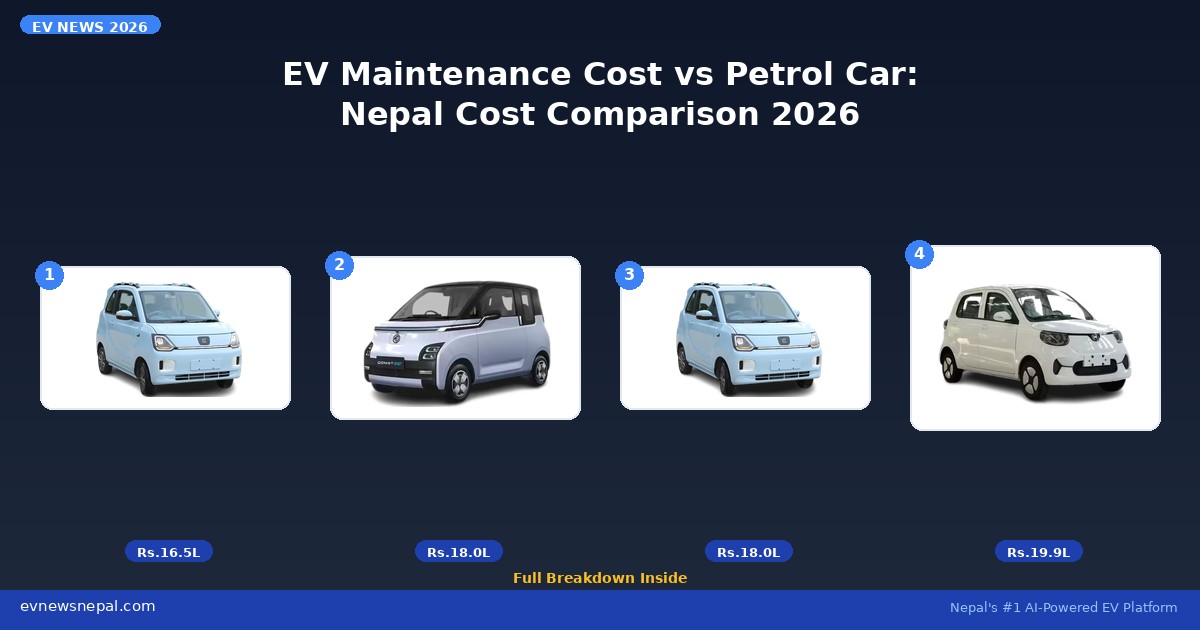
Key Takeaways
- EVs save Rs. 1,20,000-1,60,000 annually on fuel and maintenance vs petrol cars in Nepal
- EV annual maintenance costs Rs. 15,000-25,000 vs Rs. 25,000-50,000 for petrol cars — no oil changes, spark plugs, or clutch repairs needed
- Home charging a mini EV costs Rs. 1,000-2,000/month vs Rs. 11,000-15,000/month in petrol for the same commute
- Over 5 years, total EV ownership saves Rs. 10-16 lakhs compared to an equivalent petrol hatchback
- LFP batteries in popular Nepal EVs last 8-15 years, and cumulative savings far exceed eventual replacement costs
If you're thinking about buying your first car in Nepal right now, there's one question that probably keeps coming up: will an electric vehicle actually save me money on maintenance and running costs, or is it all hype?
It's a fair question — especially with petrol prices hitting Rs. 202 per liter in Kathmandu as of April 2026 (the third price hike in just one month). Meanwhile, affordable mini EVs like the Seres E1 and MG Comet are now available for under Rs. 20 lakhs. But the real savings story isn't just about the sticker price — it's about what happens after you drive off the showroom floor.
We've crunched the numbers using real Nepal market data, current electricity rates, and actual ownership costs to give you a clear, honest comparison. Let's break it down.
The Short Answer
EVs cost 60-75% less to maintain and 80-85% less to fuel compared to equivalent petrol cars in Nepal. On a typical 10,000 km/year driving pattern, you'll save approximately Rs. 1,20,000 to Rs. 1,60,000 annually on fuel and maintenance combined. Over 5 years, that's Rs. 6-8 lakhs back in your pocket.
Detailed Analysis
Fuel/Energy Cost: The Biggest Difference
This is where EVs absolutely dominate, and it's not even close.
Petrol car (small hatchback in Kathmandu):
- Petrol price: Rs. 202/liter (April 2026, Kathmandu)
- Real-world mileage in Kathmandu traffic: 12-15 km/liter
- Cost per km: Rs. 13-17 per km
Electric vehicle (mini EV like Seres E1 or MG Comet):
- Home charging cost: Rs. 10-12 per kWh (NEA domestic rate)
- Real-world efficiency: ~8-10 kWh per 100 km (city driving)
- Cost per km: Rs. 0.80-1.20 per km
That's roughly a 12-15x difference in running cost per kilometer.
| Scenario (10,000 km/year) | Petrol Car | Electric Vehicle | Annual Savings |
|---|---|---|---|
| Fuel/Electricity cost | Rs. 1,35,000 - Rs. 1,70,000 | Rs. 8,000 - Rs. 12,000 | Rs. 1,27,000 - Rs. 1,58,000 |
| Cost per km | Rs. 13.5 - Rs. 17.0 | Rs. 0.80 - Rs. 1.20 | Rs. 12.3 - Rs. 15.8 |
| Monthly fuel/charge bill | Rs. 11,250 - Rs. 14,167 | Rs. 667 - Rs. 1,000 | Rs. 10,583 - Rs. 13,167 |
Real-world example: A Seres E1 Mid with its 13.8 kWh battery costs roughly Rs. 140-165 to fully charge at home and delivers about 140-150 km of real-world range in Kathmandu. That same 150 km in a petrol Alto would cost around Rs. 2,000-2,500 in fuel.
Maintenance Costs: What You Actually Pay
This is where many buyers underestimate the EV advantage. A petrol car has over 2,000 moving parts in its engine and drivetrain. An EV motor? About 20.
Petrol car annual maintenance (typical small hatchback):
| Service Item | Frequency | Annual Cost |
|---|---|---|
| Engine oil + filter change | Every 5,000 km | Rs. 5,000 - Rs. 7,000 |
| Air filter replacement | Every 10,000 km | Rs. 1,500 - Rs. 2,500 |
| Spark plug replacement | Every 20,000 km | Rs. 1,500 - Rs. 3,000 |
| Coolant top-up/flush | Annual | Rs. 2,000 - Rs. 3,000 |
| Brake pads (front) | Every 25,000-30,000 km | Rs. 2,000 - Rs. 4,000 |
| Clutch plate/adjustment | Every 40,000-50,000 km | Rs. 1,500 - Rs. 3,000 |
| Timing belt/chain check | As needed | Rs. 2,000 - Rs. 5,000 |
| General servicing + labor | 2x per year | Rs. 6,000 - Rs. 10,000 |
| Total annual estimate | Rs. 25,000 - Rs. 50,000 |
EV annual maintenance (mini EV):
| Service Item | Frequency | Annual Cost |
|---|---|---|
| Tire rotation/check | Every 10,000 km | Rs. 2,000 - Rs. 3,000 |
| Brake fluid check | Annual | Rs. 1,000 - Rs. 2,000 |
| Cabin air filter | Annual | Rs. 1,500 - Rs. 2,500 |
| Battery health check | Annual | Rs. 2,000 - Rs. 5,000 |
| Coolant system (if applicable) | Annual | Rs. 2,000 - Rs. 4,000 |
| Wiper blades, washer fluid | As needed | Rs. 500 - Rs. 1,500 |
| General checkup + labor | 1x per year | Rs. 3,000 - Rs. 5,000 |
| Total annual estimate | Rs. 15,000 - Rs. 25,000 |
Notice what's missing from the EV list: no oil changes, no spark plugs, no exhaust system repairs, no clutch replacement, no timing belt, no fuel injector cleaning. These are the items that really add up over years of petrol car ownership.
Brake Pads: The Hidden EV Advantage
One often-overlooked benefit is that EVs like the MG Comet Play and Kaiyi e-Qute 02 use regenerative braking — the electric motor slows the car while recovering energy back to the battery. This means the physical brake pads are used far less frequently. In practice, EV brake pads last 2-3 times longer than those on petrol cars, saving you Rs. 3,000-6,000 every couple of years.
The Big Question: Battery Replacement
This is the concern we hear most often. Here's the reality:
- Modern EV batteries (especially LFP batteries used in the Seres E1, Changan Lumin, and Kaiyi e-Qute 02) are rated for 8-15 years or 1,500-3,000+ charge cycles
- Battery replacement cost in Nepal: Rs. 80,000 - Rs. 3,00,000 depending on brand, model, and battery size
- Most manufacturers offer 5-8 year battery warranties
- LFP (Lithium Iron Phosphate) batteries degrade slower than older lithium-ion chemistries, especially in Nepal's moderate climate
Even if you factor in a battery replacement at year 10, the cumulative fuel and maintenance savings by that point (Rs. 12-16 lakhs on a 10,000 km/year pattern) far outweigh the battery cost.
5-Year Total Cost of Ownership
Let's put it all together for a realistic comparison — a budget petrol hatchback vs an affordable EV, both driven 10,000 km per year in Kathmandu.
| Cost Category (5 Years) | Petrol Hatchback | Mini EV (e.g., Seres E1 Mid) |
|---|---|---|
| Purchase price | Rs. 22,00,000 - Rs. 28,00,000 | Rs. 16,49,000 - Rs. 22,96,000 |
| Fuel/Electricity (5 yrs) | Rs. 6,75,000 - Rs. 8,50,000 | Rs. 40,000 - Rs. 60,000 |
| Maintenance (5 yrs) | Rs. 1,25,000 - Rs. 2,50,000 | Rs. 75,000 - Rs. 1,25,000 |
| Insurance (5 yrs) | Rs. 75,000 - Rs. 1,00,000 | Rs. 60,000 - Rs. 80,000 |
| Total 5-year cost | Rs. 30,75,000 - Rs. 40,00,000 | Rs. 18,24,000 - Rs. 25,61,000 |
| Savings with EV | — | Rs. 10,00,000 - Rs. 16,00,000 |
Bottom line: Even with the most conservative estimates, an EV saves you Rs. 10-16 lakhs over 5 years compared to a petrol car in Nepal. And with petrol prices trending upward (three hikes in March-April 2026 alone), that gap is only widening.
Practical Tips for Nepal
-
Charge at home overnight whenever possible. Home charging at NEA domestic rates (Rs. 10-12/kWh) is the cheapest option. A full charge for a mini EV like the Seres E1 Mid costs under Rs. 170 and takes just 4.5 hours.
-
Use regenerative braking aggressively. In Kathmandu's stop-and-go traffic and on downhill stretches, regen braking recovers energy and saves your brake pads. Most EVs in our database — including the Jinpeng Lingbox EC01 and Henrey Volts Model C Pro — have regenerative braking built in.
-
Stick to the annual checkup schedule. Even though EVs need less maintenance, don't skip the annual battery health check and tire rotation. Nepal's roads are tough on tires and suspension regardless of powertrain.
-
Consider LFP battery models for longevity. LFP batteries handle Nepal's temperature range well and degrade slower. Models like the Seres E1 (LFP), Changan Lumin (LFP), and Kaiyi e-Qute 02 (LFP) are good choices for long-term ownership.
-
Plan your fast-charging stops on highway trips. NEA has expanded to over 200 charging stations nationwide. Models with DC fast charging like the Kaiyi e-Qute 02 (30-80% in 30 minutes) and Henrey Volts Model C Pro (20-80% in 40 minutes) make highway trips practical.
-
Keep an eye on tire wear. EVs deliver instant torque, which can wear front tires faster — especially on Nepal's uneven roads. Rotate tires every 8,000-10,000 km and check alignment regularly.
-
Budget Rs. 1,500-2,500/month for all EV running costs. That covers electricity, basic maintenance amortized monthly, and the occasional tire or wiper replacement. Compare that to Rs. 12,000-16,000/month for a petrol car.
How It Compares
Here's a side-by-side monthly cost comparison for three real scenarios in Nepal:
| Monthly Cost Breakdown | Petrol Hatchback | Mini EV (Home Charging) | Mini EV (Public Charging) |
|---|---|---|---|
| Fuel/Electricity | Rs. 11,250 | Rs. 700 | Rs. 1,200 |
| Maintenance (amortized) | Rs. 2,500 - Rs. 4,000 | Rs. 1,250 - Rs. 2,000 | Rs. 1,250 - Rs. 2,000 |
| Total monthly cost | Rs. 13,750 - Rs. 15,250 | Rs. 1,950 - Rs. 2,700 | Rs. 2,450 - Rs. 3,200 |
And here's how popular affordable EVs in Nepal compare on running costs:
| Model | Battery | Range | Home Charge Cost | Cost per km | Monthly Running Cost |
|---|---|---|---|---|---|
| Seres E1 Mid | 13.8 kWh LFP | 180 km | ~Rs. 150 | ~Rs. 0.83 | ~Rs. 1,500 |
| MG Comet Pace | 17.3 kWh Li-ion | 230 km | ~Rs. 190 | ~Rs. 0.75 | ~Rs. 1,400 |
| Seres E1 Top | 16.8 kWh LFP | 220 km | ~Rs. 185 | ~Rs. 0.84 | ~Rs. 1,500 |
| Kaiyi e-Qute 02 | 28.08 kWh LFP | 301 km | ~Rs. 310 | ~Rs. 0.93 | ~Rs. 1,700 |
| Changan Lumin | 28.08 kWh LFP | 301 km | ~Rs. 310 | ~Rs. 0.93 | ~Rs. 1,700 |
| Henrey Volts Model C Pro | 25 kWh | 300 km | ~Rs. 275 | ~Rs. 0.83 | ~Rs. 1,500 |
Running cost estimates based on 30 km/day average, home charging at Rs. 11/kWh, with 80% real-world range efficiency.
You can also compare these EVs head-to-head on our comparison tool, or browse used EVs in Nepal if you're looking for an even more budget-friendly entry point.
Our Expert Take
The maintenance cost advantage of EVs over petrol cars in Nepal is not marginal — it's massive. And it's getting bigger every month as petrol prices climb (Rs. 202/liter and counting) while electricity rates remain stable.
For the average Kathmandu commuter driving 25-40 km daily, a mini EV like the Seres E1 Mid at Rs. 16.49 lakhs or the MG Comet Pace at Rs. 17.99 lakhs isn't just cheaper to maintain — it's cheaper to buy, cheaper to run, and cheaper to own over its entire lifetime compared to a similarly-sized petrol car.
The only legitimate concern — battery replacement — is becoming less relevant as LFP battery technology improves and prices drop. With most batteries lasting 8-15 years and the cumulative savings easily exceeding Rs. 10 lakhs over 5 years, the math is overwhelmingly in favor of EVs.
Nepal's unique situation makes this even more compelling: the country generates almost all its electricity from hydropower (clean and cheap), while every liter of petrol is imported (expensive and getting more so). Choosing an EV in Nepal isn't just a personal financial decision — it's also aligned with the country's energy independence.
If you're still driving a petrol car and spending Rs. 12,000-15,000 per month on fuel alone, it's time to seriously consider making the switch.
How Much Will You Save Going Electric?
Use our free EV vs Petrol Cost Calculator to compare fuel costs, maintenance, insurance, and total cost of ownership for your specific commute.
Frequently Asked Questions
Q: How much does it cost to maintain an EV per year in Nepal?
A: The average annual maintenance cost for an EV in Nepal ranges from Rs. 15,000 to Rs. 25,000 for mini EVs and up to Rs. 34,000 for larger models. This covers tire rotation, brake fluid checks, cabin air filter, battery health monitoring, and general inspections. Compare this to Rs. 25,000-50,000 for a petrol car that needs regular oil changes, filter replacements, spark plugs, and more.
Q: Do EVs need oil changes?
A: No. Electric vehicles do not have an internal combustion engine, so there is no engine oil, oil filter, or oil change required — ever. This alone saves Rs. 5,000-7,000 per year compared to a petrol car. Some EVs have gearbox fluid that may need checking every few years, but this is minimal.
Q: How much does it cost to charge an EV at home in Nepal?
A: At NEA domestic electricity rates of Rs. 10-12 per kWh, a full home charge for a mini EV costs approximately Rs. 140-340 depending on battery size. For example, the Seres E1 Mid (13.8 kWh battery) costs about Rs. 150, while the Kaiyi e-Qute 02 (28.08 kWh) costs about Rs. 310. For a typical daily commute of 30 km, expect to spend Rs. 1,000-2,000 per month on charging.
Q: How long does an EV battery last in Nepal?
A: Modern EV batteries, particularly LFP (Lithium Iron Phosphate) types used in models like the Seres E1 and Changan Lumin, are designed to last 8-15 years or 1,500-3,000+ charge cycles. Nepal's moderate climate (compared to extreme heat in other South Asian countries) actually helps preserve battery health. Most manufacturers offer 5-8 year battery warranties.
Q: Is the EV battery replacement cost worth worrying about?
A: Battery replacement in Nepal costs between Rs. 80,000 and Rs. 3,00,000 depending on the vehicle. However, by the time you need a replacement (8-15 years), your cumulative savings on fuel and maintenance will be Rs. 15-25 lakhs compared to a petrol car. The savings far outweigh the replacement cost. Battery prices are also dropping globally each year.
Q: What about EV maintenance during monsoon season in Nepal?
A: EVs actually handle monsoon conditions well. Batteries are sealed with IP67 ratings (like the MG Comet), meaning they're waterproof. You won't face issues like flooded engines or wet spark plugs that plague petrol cars. The main monsoon maintenance for EVs is the same as any car: check wipers, tires (tread depth matters more), and ensure your cabin air filter is clean. No additional monsoon-specific EV maintenance costs.
Q: Are spare parts for EVs easily available in Nepal?
A: Availability has improved significantly as Nepal's EV market has grown — nearly 75% of new cars sold in Nepal are now electric. Common consumables (tires, brake pads, wiper blades, cabin filters) are standard automotive parts. For EV-specific components (motor, battery, controller), authorized service centers from brands like MG, Seres, and Changan maintain stock. The parts you need most frequently (tires, brakes) are the same ones used on any car.