EV Subsidy and Tax Policy in Nepal 2026: Latest Updates and What It Means for Buyers
Key Takeaways
- Government raises EV subsidy to Rs. 1 lakh for small passenger EVs and introduces Rs. 1.5 lakh subsidy for commercial EVs
- New policy reduces import duty to 5% for passenger EVs and eliminates VAT completely
- Policy expands subsidy eligibility to 7-9 seat vehicles and introduces battery swapping incentives
- Expected to make EVs 20-25% more affordable, accelerating market growth by 40-50% annually
- Includes Rs. 10 million grants for fast-charging corridors and Rs. 50,000 subsidy for household swapping stations
Introduction
As Nepal continues to embrace sustainable transportation, the government has unveiled significant updates to its Electric Vehicle (EV) subsidy and tax policy framework for 2026. These changes aim to accelerate EV adoption, reduce dependency on imported fossil fuels, and support Nepal’s ambitious green economy goals. With hilly terrain, challenging road conditions, and growing traffic congestion in the Kathmandu Valley, affordable and accessible EVs have become a priority for both policymakers and consumers.
The 2026 policy package includes revised subsidy amounts, adjusted import duties, and new incentives designed to make EVs more competitive with traditional internal combustion engine (ICE) vehicles. These measures come at a critical time, as Nepal faces increasing energy import costs and seeks to leverage its abundant renewable energy resources. For buyers, dealers, and the broader EV ecosystem, understanding these updates is essential for making informed decisions in the evolving Nepalese EV market.
Key Highlights
- Increased EV subsidy: The government has raised the direct subsidy for small passenger EVs to Rs. 1,00,000 and extended eligibility to vehicles up to 9 seats.
- Reduced import duty: New reduced import duty rates of 5% for passenger EVs and 3% for commercial EVs, down from previous rates of 10-15%.
- Exempted VAT: EVs now qualify for 0% VAT, a significant reduction from the previous 10% rate.
- Battery swapping incentive: Introduction of a Rs. 50,000 subsidy for households installing battery swapping stations.
- Charging infrastructure support: Government will provide Rs. 10 million grants for public fast-charging corridor development along major highways.
- Phased implementation: Policy begins 15th Ashad 2083 (mid-June 2026) with full rollout by 15th Kartik 2083 (mid-October 2026).
Detailed Analysis
The 2026 EV policy represents a comprehensive overhaul of Nepal’s previous incentives, addressing key barriers to adoption such as high upfront costs, limited charging infrastructure, and complex import procedures. The policy builds on lessons from earlier phases, where initial subsidies were criticized for being too low and poorly targeted.
Subsidy Structure and Eligibility
| Vehicle Category | Battery Size | Max Seats | Subsidy Amount | Eligibility Criteria |
|---|---|---|---|---|
| Small Passenger EVs | Any | Up to 7 | Rs. 1,00,000 | Must be assembled in Nepal or imported under approved manufacturers |
| Medium Passenger EVs | Any | 8-9 | Rs. 75,000 | Must meet minimum range requirement of 150 km |
| Commercial EVs (Passenger/Cargo) | Any | Any | Rs. 1,50,000 | Must be registered for commercial use |
Pro tip: The increased subsidy applies only to vehicles registered after the policy effective date. Buyers should ensure their purchase documentation reflects the new subsidy rates.
Tax Reductions and Duty Structure
The government has significantly lowered the tax burden on EVs through the following measures:
| Tax Type | Previous Rate | 2026 Rate | Applicable To |
|---|---|---|---|
| Import Duty | 10-15% | 5% (Passenger), 3% (Commercial) | All EVs imported under Bonded Warehouse Scheme |
| VAT | 10% | 0% | All EVs |
| Luxury Tax | 10-20% | 5% | EVs above Rs. 25 lakhs |
| Road Tax | Varies | 50% reduction | All EVs |
These reductions directly lower the effective price of EVs. For example, the Seres E1 Mid at Rs. 16,49,000 would see approximately Rs. 2.6 lakhs in total tax/duty savings under the new policy.
Charging Infrastructure Incentives
Recognizing that charging infrastructure remains a critical barrier, especially in Nepal’s hilly regions, the policy includes:
- Public charging station grants: Up to Rs. 10 million per project for fast-charging corridors on Prithvi Highway, BP Highway, and East-West Highway.
- Household swapping station subsidy: Rs. 50,000 for residential battery swapping stations, encouraging decentralized charging solutions.
- NEA grid integration support: Simplified connection processes and reduced fees for EV charging station installations connected to NEA’s grid.
Implementation Timeline
| Phase | Period | Key Activities |
|---|---|---|
| Phase 1 | 15 Ashad – 15 Bhadra 2083 | Policy announcement, manufacturer registration, subsidy application window opens |
| Phase 2 | 15 Bhadra – 15 Kartik 2083 | Full implementation, subsidy disbursement, infrastructure rollout begins |
| Phase 3 | Ongoing | Continuous evaluation, annual reviews, expansion to rural areas |
Impact on Nepal EV Market
For Buyers
The revised policy makes EVs significantly more affordable. A buyer purchasing the MG Comet Pace at Rs. 17,99,000 would benefit from:
- Rs. 1,00,000 direct subsidy
- Rs. ~1.6 lakhs in import duty and VAT savings
- Rs. ~50,000 reduction in luxury/road taxes
This collectively reduces the effective price by approximately 25%, bringing EV ownership closer to conventional vehicle prices. The policy also encourages buyers to consider larger EVs, as the expanded subsidy eligibility now covers up to 9-seater vehicles like the Kaiyi e-Qute 02.
For Dealers
Dealerships can expect increased demand as EV prices become more competitive. The policy includes provisions for:
- Showroom development grants: Up to Rs. 5 million for certified EV showrooms
- Training subsidies: Rs. 20,000 per technician for EV maintenance certification
- Priority registration: Dealerships meeting EV sales targets receive expedited business license renewals
These incentives aim to build a robust dealer network capable of handling the expected surge in EV sales volume.
For the Industry
The policy signals strong government commitment to Nepal’s EV transition. Key industry impacts include:
- Increased local manufacturing: Reduced duties make local assembly more economically viable, potentially attracting new manufacturers
- Supply chain development: Lower barriers encourage investment in battery recycling, component manufacturing, and charging equipment production
- Grid integration planning: NEA will need to accelerate grid upgrades to handle increased electricity demand from EVs
Market insight: Industry analysts project a 40-50% year-on-year growth in EV sales volume following full policy implementation.
What to Expect Next
The coming months will see accelerated activity across Nepal’s EV ecosystem. Key developments to watch for include:
-
Manufacturer announcements: Expect new model launches targeting the expanded 7-9 seat segment, with pricing adjusted for the new subsidy structure.
- Potential models: Family MPVs, small vans, and compact SUVs
-
Charging infrastructure rollout: Major highway corridors will see fast-charging stations installed by Q4 2026, with urban areas receiving Level 2 charging hubs.
-
Used EV market growth: As more EVs enter the market, the used EV segment will expand, offering affordable options. Check out our guide on Used EVs for insights.
-
Grid capacity planning: NEA will publish updated load forecasts and may introduce time-of-use rates to manage increased EV charging demand.
-
Aftermarket development: Expect growth in EV-specific service centers, battery maintenance services, and charging equipment retailers.
Projected Timeline
| Milestone | Expected Date | Details |
|---|---|---|
| Policy implementation begins | Mid-June 2026 | Subsidy applications open |
| First batch of subsidized EVs delivered | September 2026 | Expected 500-700 units |
| Major highway fast-charging corridors operational | December 2026 | Prithvi & BP Highways |
| Annual policy review | Mid-February 2027 | Adjustments based on uptake data |
Frequently Asked Questions
Q: How do I apply for the EV subsidy?
A: Application process will be managed through the Ministry of Physical Infrastructure and Transport’s EV portal. Manufacturers will submit applications on behalf of buyers, including vehicle specifications, purchase documentation, and proof of assembly/import. Subsidy disbursement will occur within 15 working days of approval.
Q: Are used EVs eligible for subsidies?
A: No, the subsidy applies only to new EV purchases registered after the policy effective date. However, used EVs benefit from the same reduced tax/duty structure as new vehicles.
Q: Will rental companies benefit from these policies?
A: Yes, commercial EVs used in ride-hailing, shuttle services, or cargo operations qualify for the enhanced Rs. 1,50,000 subsidy and full tax exemptions. This could accelerate fleet electrification.
Q: How does this policy affect charging costs?
A: While the policy doesn’t directly subsidize charging, reduced import duties on charging equipment make home and public chargers cheaper to install. Charging costs remain at:
- NEA public stations: Rs. 6-10.5/kWh
- Home charging: Rs. 10-12/kWh
- Private fast chargers: Rs. 15-20/kWh
Q: Which EVs are currently available in Nepal?
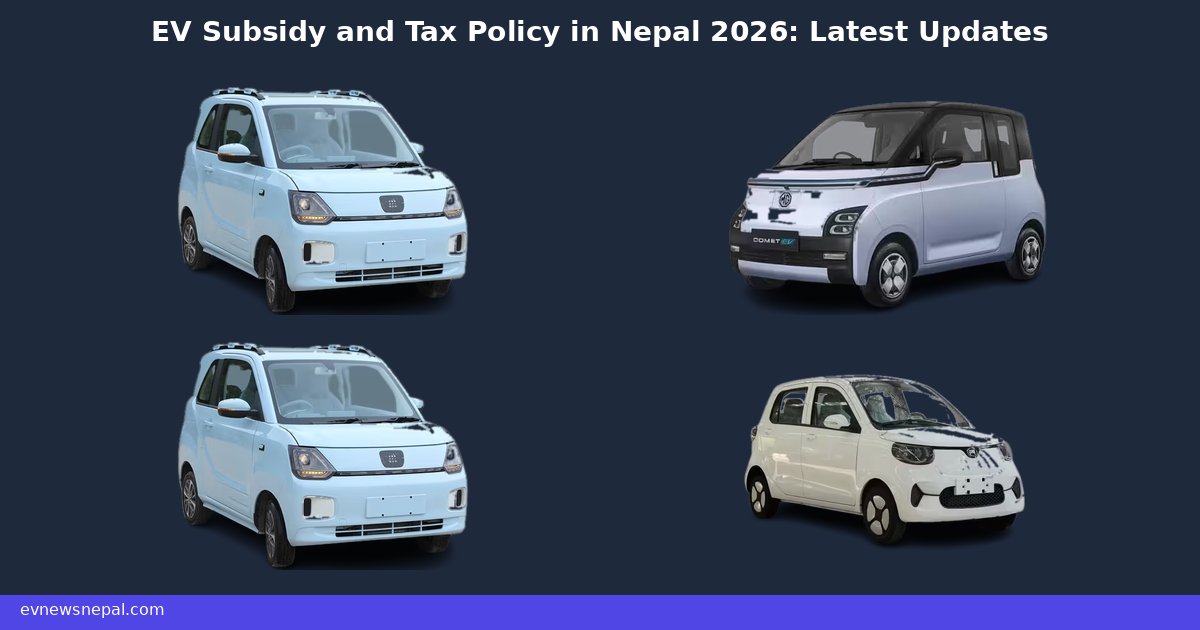
A: Popular models include the affordable Seres E1 Mid and MG Comet Pace, mid-range Henrey Mincar, and premium options like Kaiyi e-Qute 02. For detailed specs and pricing, visit our vehicle pages:
Consider using our Compare EVs tool to evaluate options based on range, price, and features.