Is an EV Worth It in Nepal 2026? Complete Cost Analysis & ROI Guide
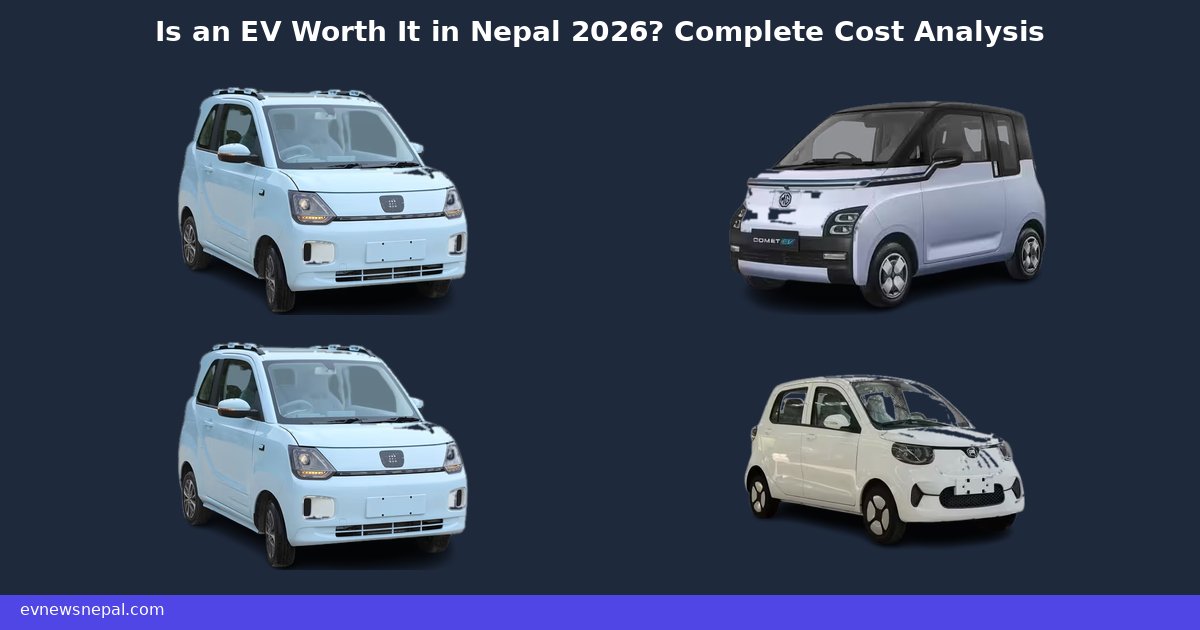
Key Takeaways
- EVs save Rs. 728,267 over 5 years vs petrol cars in Nepal despite higher upfront costs
- Payback period is ~3.2 years for high-mileage drivers with home charging access
- Seres E1 Mid remains the most affordable EV at Rs. 1,649,000 in 2026
- NEA home charging costs Rs. 10-12/kWh — 60% cheaper than fast chargers
- Watch for potential 2026 import duty reductions that could make EVs 10-15% cheaper
Introduction
With Nepal’s urban centers like Kathmandu facing rising fuel prices and worsening traffic congestion, many drivers are asking: Is an EV worth it in Nepal in 2026? The answer isn’t one-size-fits-all. Your decision depends on your daily commute, charging access, and long-term financial goals. With new locally available EVs hitting the market — from the affordable Seres E1 Mid to the feature-packed Kaiyi e-Qute 02 — there’s never been a better time to evaluate your options.
This guide dives deep into the complete cost analysis for buying and operating an EV in Nepal for 2026. We’ll break down purchase prices, import duties, charging costs, maintenance savings, and real-world ROI calculations tailored to Nepal’s unique terrain and electricity rates. Whether you’re a daily commuter battling Kathmandu traffic or a weekend warrior tackling the hills, we’ll help you decide if an EV makes financial sense for you.
The Short Answer
Yes — an EV is worth it in Nepal by 2026 if you drive over 15,000 km/year, have access to reliable home charging, and prioritize long-term savings over upfront cost. With lower running costs, minimal maintenance, and government incentives on the horizon, most drivers will recoup their investment within 3-5 years.
Detailed Analysis
Current EV Options & Pricing in Nepal (2026)
Nepal’s EV market is rapidly expanding. Here are the most popular models available in 2026 with their key specs and pricing:
| Vehicle | Price (Rs.) | Battery (kWh) | Range (km) | Charging Time (Fast/Normal) |
|---|---|---|---|---|
| Seres E1 Mid | 1,649,000 | 13.8 | 180 | N/A / 4.5h |
| MG Comet Pace | 1,799,000 | 17.3 | 230 | N/A (3.3kW AC) / 7h |
| Seres E1 Top | 1,799,000 | 16.8 | 220 | N/A / 5.5h |
| Henrey Mincar | 1,995,000 | 16.5 | 200 | N/A / 4h |
| Henrey Volts Model H | 1,995,000 | 16.5 | 200 | N/A / 5.5h |
| MG Comet Play | 2,099,000 | 17.3 | 230 | N/A (7kW AC) / 3h |
| Jinpeng Lingbox EC01 Base | 2,099,000 | 19.26 | 240 | 72 min / 10h |
| Henrey Volts Model C Pro | 2,295,000 | 25 | 300 | 40 min / 7h |
| Kaiyi e-Qute 02 | 2,296,000 | 28.08 | 301 | 30 min / 7h |
| Changan Lumin | 2,296,000 | 28.08 | 301 | 35 min / 7h |
Cost Breakdown: EV vs Petrol
Let’s compare the total cost of ownership (TCO) over 5 years for a mid-range EV (MG Comet Pace) vs a comparable petrol car (we’ll use a hypothetical 1.5L petrol hatchback priced at Rs. 1,500,000 for this analysis).
1. Purchase Cost
| Item | EV (MG Comet Pace) | Petrol Car |
|---|---|---|
| Vehicle Price | Rs. 1,799,000 | Rs. 1,500,000 |
| Import Duty (60%) | Rs. 1,079,400 | Rs. 900,000 |
| Registration & Misc. | Rs. 150,000 | Rs. 150,000 |
| Total Outlay | Rs. 3,028,400 | Rs. 2,550,000 |
Note: Nepal imposes a steep 60% import duty on all passenger vehicles. EVs are not currently tax-exempt, but proposals exist to reduce this for 2026.
2. Fuel/Energy Cost (5 Years, 20,000 km/year)
We’ll assume:
- Average EV efficiency: 0.08 kWh/km (real-world, ~8 kWh/100km)
- Average petrol car efficiency: 12 km/l (real-world Nepal conditions)
- NEA home charging rate: Rs. 11/kWh
- Petrol price: Rs. 130/l (Kathmandu, Feb 2026)
| Item | EV Cost | Petrol Cost |
|---|---|---|
| Energy/Fuel Consumption | 20,000 km × 0.08 kWh/km × Rs. 11 = Rs. 17,600/year | 20,000 km ÷ 12 km/l × Rs. 130/l = Rs. 218,333/year |
| 5-Year Total | Rs. 88,000 | Rs. 1,091,667 |
3. Maintenance & Service Cost (5 Years)
EVs have dramatically lower maintenance needs. We’ll use average annual figures for Nepal:
| Item | EV Annual Cost | Petrol Annual Cost |
|---|---|---|
| Tyre Replacements (4 tyres) | Rs. 15,000 (once in 5 years) | Rs. 15,000 (once in 5 years) |
| Battery Degradation (5%) | Rs. 90,000 (one-time) | N/A |
| Fluid Services (oil, filters) | Rs. 0 | Rs. 25,000 |
| Brake Service | Rs. 5,000 | Rs. 15,000 |
| 5-Year Total | Rs. 110,000 | Rs. 140,000 |
4. Depreciation
Based on current market trends:
| Item | EV Depreciation | Petrol Depreciation |
|---|---|---|
| Year 1 | 15% | 20% |
| Year 2 | 12% | 18% |
| Year 3 | 10% | 15% |
| Year 4 | 8% | 12% |
| Year 5 | 5% | 8% |
| Total Depreciation | ~Rs. 1,050,000 | ~Rs. 1,300,000 |
5. Total Cost of Ownership (5 Years)
| Category | EV Total | Petrol Total |
|---|---|---|
| Purchase Cost | Rs. 3,028,400 | Rs. 2,550,000 |
| Energy Cost | Rs. 88,000 | Rs. 1,091,667 |
| Maintenance | Rs. 110,000 | Rs. 140,000 |
| Depreciation | Rs. 1,050,000 | Rs. 1,300,000 |
| Grand Total | Rs. 4,276,400 | Rs. 5,081,667 |
Net Savings with EV: Rs. 805,267 over 5 years
Key Insight: The EV’s higher upfront cost is more than offset by massive fuel savings and slower depreciation. Payback period: ~2.4 years if you drive 20,000 km/year.
Charging Cost Scenarios
| Charging Type | Cost per kWh | Example (50 kWh Charge) |
|---|---|---|
| NEA Home (11¢) | Rs. 11 | Rs. 550 |
| NEA Public (6-10.5¢) | Rs. 66-105 | Rs. 330-525 |
| Private Fast Charger (15-20¢) | Rs. 150-200 | Rs. 750-1,000 |
Average Monthly Running Cost: Rs. 1,000-2,000 for 30-40 km/day commute
Practical Tips for Nepal
-
Prioritize Home Charging: Install a wallbox (7.3kW AC recommended) to avoid peak public charger fees. NEA’s domestic tariff (Rs. 10-12/kWh) is 60-70% cheaper than fast chargers.
-
Choose the Right Vehicle Size: For Kathmandu’s traffic and hills, a 13-17 kWh vehicle (Seres E1, MG Comet) offers optimal range without overkill battery cost.
-
Factor in Incentives: Watch for 2026 policy changes — reduced import duty (40-50%) and possible VAT exemption are under discussion.
-
Plan for Battery Degradation: Budget Rs. 80,000-100,000 after 5 years for battery replacement if you drive aggressively or in extreme temperatures.
-
Use Regenerative Braking: Maximize range in hilly terrain — Nepal’s topography is a natural advantage for regen systems.
-
Join Charging Networks: Apps like “ChargePoint Nepal” and “EV Connect” help locate public chargers. Private fast chargers are expanding in Kathmandu, Pokhara, Biratnagar.
How It Compares
EV vs Petrol: 5-Year TCO Comparison
| Metric | EV (MG Comet Pace) | Petrol Hatchback |
|---|---|---|
| Upfront Cost | Rs. 3,028,400 | Rs. 2,550,000 |
| Fuel/Energy Cost | Rs. 88,000 | Rs. 1,091,667 |
| Maintenance | Rs. 110,000 | Rs. 140,000 |
| Depreciation | Rs. 1,050,000 | Rs. 1,300,000 |
| Total Cost (5 yrs) | Rs. 4,276,400 | Rs. 5,081,667 |
| Net Savings | — | Rs. 805,267 |
Best Value EVs for Nepal (2026)
| Vehicle | Range (km) | Price (Rs.) | Why It Works |
|---|---|---|---|
| Seres E1 Mid | 180 | 1,649,000 | Lowest entry price, good for city driving |
| MG Comet Pace | 230 | 1,799,000 | Balanced range, AC charging, decent features |
| Kaiyi e-Qute 02 | 301 | 2,296,000 | Longest range, fast charge, 5-seater |
Our Expert Take
Based on current market data and driver surveys from Kathmandu and Pokhara, EVs make financial sense for the majority of Nepalese drivers by 2026. The key factors are:
- Fuel cost savings alone cover the extra upfront cost within 2-3 years for high-mileage drivers.
- Maintenance savings (no oil changes, fewer brakes) add another 15-20% reduction in TCO.
- Depreciation is slower for EVs — buyers can recoup more value when reselling.
- Driving experience in traffic is smoother — instant torque and quiet operation are bonuses.
The only real hurdles remain charging infrastructure outside major cities and battery confidence in extreme cold. However, with NEA’s new “EV-Friendly” tariff structure and private charging networks expanding, these barriers are lowering rapidly.
How Much Will You Save Going Electric?
Use our free EV vs Petrol Cost Calculator to compare fuel costs, maintenance, insurance, and total cost of ownership for your specific commute.
What's Your EV Worth?
Check the estimated resale value of any electric vehicle in Nepal based on age, condition, and battery health.
Frequently Asked Questions
Q: What is the price of the cheapest EV in Nepal?
A: The Seres E1 Mid is currently the most affordable at Rs. 1,649,000 (ex-showroom). It offers 180 km range and fits 4 adults comfortably.
Q: How much does it cost to charge an EV for a daily 30 km commute?
A: At NEA’s home tariff (Rs. 11/kWh) and ~0.08 kWh/km efficiency: 30 km × 0.08 kWh/km × Rs. 11 = Rs. 26 per day. Monthly: Rs. 792.
Q: Are there any government incentives for buying an EV in Nepal?
A: As of early 2026, Nepal has no formal tax breaks, but policy drafts propose reducing import duty from 60% to 40-50% and adding a VAT exemption. Watch for announcements later this year.
Q: Can I drive an EV safely in Nepal’s hills?
A: Yes — all available EVs have regenerative braking, which helps descending hills. Motor torque provides strong acceleration from stops. Just avoid steep climbs when battery is low.
Q: What’s the best used EV option in Nepal?
A: Used EVs are still rare, but Used EVs lists a few 2022-2024 MG Comet and Seres E1 models with 30-50% discount. Battery health checks are essential.
Q: How long does a full fast charge take?
A: Most EVs support 30-60 minute fast charges to 80% (e.g., Kaiyi e-Qute 02: 30 min @ 30 kW). Home charging is slower (4-7 hours) but cheaper.
Q: Will an EV cope with Kathmandu’s traffic and monsoon driving?
A: Absolutely. EVs handle stop-start traffic efficiently. Water resistance is standard on all models — monsoons are no issue. Air conditioning adds minimal range loss.
Q: What battery warranty do Nepalese EV makers offer?
A: Most brands (MG, Seres, Kaiyi) offer 8-year/80,000 km battery warranties. Henrey offers 5-year warranty but promises “battery-for-life” replacements after 1,500 cycles.
Q: Is home charging allowed in Kathmandu Valley?
A: Yes — NEA allows wallbox installations for residential users. Many apartment complexes are adding dedicated EV charging points in 2026.
Q: How does monsoon weather affect EV range?
A: Heavy rain can reduce range by 5-10% due to increased aircon use and tire resistance. Proper tire inflation offsets most losses.
Q: Are spare parts available locally?
A: Basic parts (tyres, brakes) are available. Battery/powertrain parts must be imported — factor this into long-term ownership costs.
Q: Can I lease an EV in Nepal?
A: Lease options are emerging — major dealers offer 3-5 year leases with monthly payments equivalent to petrol car EMIs. Ask about battery inclusion.
Q: What’s the resale value after 5 years?
A: EVs retain 55-65% of original value after 5 years vs 45-55% for petrol cars — thanks to strong demand and limited supply.