NIU N Qi GT vs Yadea G5 vs Super Soco CUx: Budget Electric Scooter Comparison Nepal 2026
Quick Comparison
- NIU N Qi GT offers the longest real-world range (~73 km) and NIU App connectivity at a higher upfront price
- Yadea G5 Standard is the most affordable option with monthly running costs of approximately Rs. 316 at 30 km/day
- Super Soco CUx targets style-driven urban riders — see the Price Breakdown table for its specs and pricing
- Home charging for either main contender costs under Rs. 35 per full charge at NEA residential rates
- NIU N Qi GT's 180 mm ground clearance and stronger motor give it a practical edge on Nepal's hilly terrain
If you're choosing between budget electric scooters in Nepal in 2026, the NIU N Qi GT is the stronger all-rounder for longer daily commutes, while the Yadea G5 Standard offers the most accessible entry point into electric riding. The Super Soco CUx rounds out this comparison as the style-forward option for urban riders who prioritise design.
The Yadea G5 Standard starts at Rs. 3,30,000 and comes equipped with a 1.92 kWh battery delivering 80 km of claimed range — making it one of the most affordable electric scooters currently available in the Nepali market. The NIU N Qi GT, priced at Rs. 4,45,000, steps up with a 3.12 kWh battery and 100 km of ARAI-certified claimed range, plus smartphone connectivity via the NIU App. The Super Soco CUx Standard occupies its own niche — see the Price Breakdown table for its exact figures.
All three scooters target the growing wave of Kathmandu commuters switching away from petrol, but they take meaningfully different approaches to value. Understanding those differences — in range, charging economics, and feature set — is what this comparison is built to help you with.
At a Glance
| Spec | Yadea G5 Standard | NIU N Qi GT Sport / GT |
|---|---|---|
| Price | Rs. 3,30,000 | Rs. 4,45,000 |
| Battery | 1.92 kWh | 3.12 kWh |
| Range (claimed) | 80 km () | 100 km (ARAI) |
| Motor Power | 1.2 kW | 3 kW |
| Torque | 130 Nm | None Nm |
| Fast Charging | ||
| Top Speed | 60 km/h | 80 km/h |
| Ground Clearance | 160 mm | 180 mm |
| V2L | No | No |
Price Breakdown
| Variant | Price | Battery | Range |
|---|---|---|---|
| Yadea G5 Standard | Rs. 3,30,000 | 1.92 kWh | 80 km |
| NIU N Qi GT Sport / GT | Rs. 4,45,000 | 3.12 kWh | 100 km |
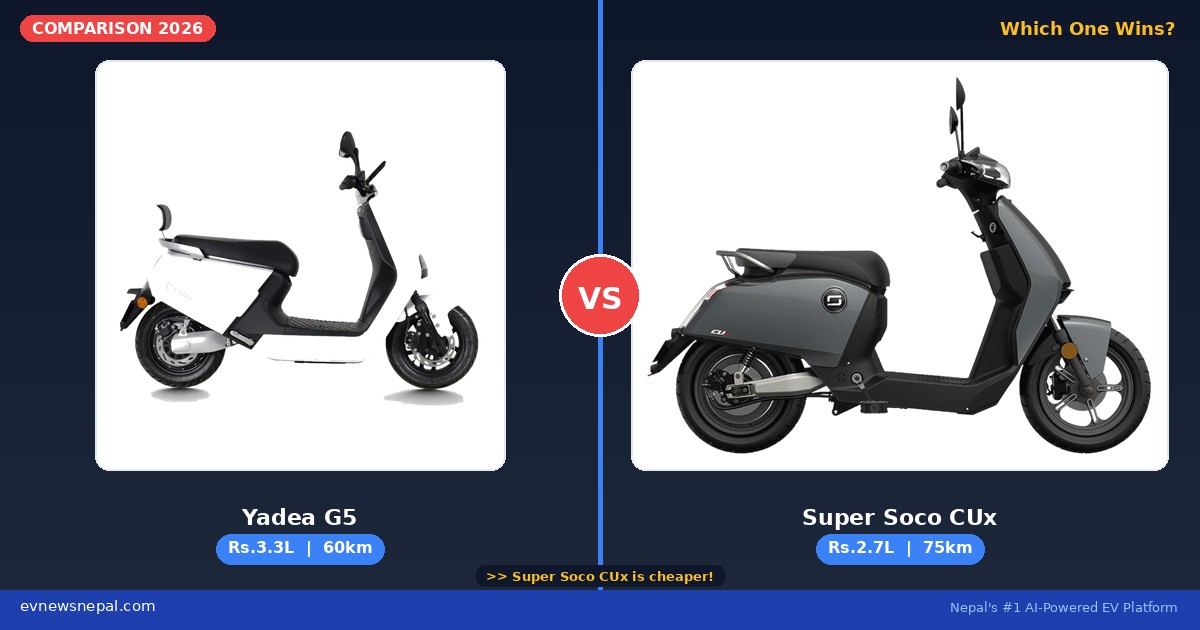
| Super Soco CUx Standard | Rs. 2,69,900 | 1.8 kWh | 56 km |
Range: Real World vs Claimed
| Metric | Yadea G5 Standard | NIU N Qi GT Sport / GT |
|---|---|---|
| Claimed range | 60 km () | 90 km (ARAI) |
| Est. real-world (Nepal, mixed) | ~49 km | ~73 km |
| Est. real-world (highway, hilly) | ~45 km | ~67 km |
The NIU N Qi GT's 100 km ARAI-certified claimed range leads this comparison on paper, and real-world estimates of approximately 73 km on mixed Kathmandu terrain confirm it as the clear choice for longer daily commutes. The Yadea G5's 80 km claimed range translates to around 49 km in real-world mixed use — perfectly adequate for inner-valley errands and short commutes, but potentially tight if your daily round trip regularly exceeds 40 km.
Nepal's hilly topography is a factor both scooters must contend with. Sustained climbs through areas like Baneshwor, Koteshwor, or routes up toward the valley rim drain the battery considerably faster than flat city riding, and can trim real-world range by 10–15% against certified figures. Stop-and-go Kathmandu traffic actually helps, since regenerative braking partially recovers energy during deceleration. Riders planning routes with significant elevation gain should lean toward the higher-range option and plan charging stops accordingly.
Charging Speed and Monthly Cost
| Spec | Yadea G5 Standard | NIU N Qi GT Sport / GT |
|---|---|---|
| DC Fast Charge | ||
| AC Home Charge | ||
| Full charge cost (home, Rs.11/kWh) | ~Rs. 21 | ~Rs. 34 |
| Est. monthly cost (30km/day) | ~Rs. 316/month | ~Rs. 343/month |
Both scooters rely on AC home charging, which remains the most practical solution given Nepal's still-developing public fast-charging network for two-wheelers. At NEA's approximate residential rate of Rs. 11/kWh, a full charge costs roughly Rs. 21 for the Yadea G5 and Rs. 34 for the NIU N Qi GT — negligible running costs by any measure. At a typical commute of 30 km per day, monthly electricity spend comes to approximately Rs. 316 for the Yadea G5 and Rs. 343 for the NIU N Qi GT; the Rs. 27 monthly gap between them is essentially immaterial.
A standard 5A home socket is sufficient for overnight charging on both scooters, requiring no special electrical installation — an important practical consideration for riders in rented apartments or shared housing. Refer to the Charging Speed table above for full charge time details. Until a robust public charging network expands across the Kathmandu valley and major highway corridors, building the habit of plugging in each night is the most reliable strategy. Riders without access to private parking should verify charging access before committing to either model.
Features Face-Off
| Feature | Yadea G5 Standard | NIU N Qi GT Sport / GT |
|---|---|---|
| Airbags | N/A | N/A |
| ABS + EBD + ESP + TCS | Yes | Yes |
| TPMS | No | No |
| ISOFIX | No | No |
| Hill Hold | No | No |
| Hill Descent Control | No | No |
| Auto Hold | No | No |
| AEB (Emergency Braking) | No | No |
| Adaptive Cruise Control | No | No |
| Lane Keep Assist | No | No |
| Blind Spot Detection | No | No |
| Rear Cross Traffic Alert | No | No |
| 360-degree Camera | No | No |
| Rear Camera | No | No |
| Parking Sensors | No | No |
| Panoramic Sunroof | No | No |
| Heated/Ventilated Seats | No | No |
| Wireless Phone Charging | No | No |
| V2L (Vehicle-to-Load) | No | No |
| Touchscreen | N/A | N/A |
| Digital Instrument Cluster | LCD Digital | LCD Digital |
| Apple CarPlay / Android Auto | No | NIU App + Bluetooth |
| Connected Car / App | No | No |
| Head-Up Display | No | No |
| Ambient Lighting | No | No |
| Sound System | N/A | N/A |
Compare side-by-side: Yadea G5 vs NIU N Qi GT — full specs, features & price comparison tool.
Both the Yadea G5 and NIU N Qi GT come equipped with LCD digital instrument clusters and electronic safety systems appropriate for their price segment — refer to the Features Face-Off table above for the complete category-by-category breakdown. The clearest differentiator between the two is connectivity: the NIU N Qi GT pairs with the NIU App via Bluetooth, giving riders access to ride statistics, vehicle diagnostics, and anti-theft alerts from their smartphone. The Yadea G5 takes a no-frills approach with no app integration, which appeals to riders who prefer uncomplicated, low-maintenance ownership.
On the safety and comfort front, both scooters offer a comparable suite for the budget segment — neither targets the premium end of the market, and feature expectations should be calibrated accordingly. The Super Soco CUx brings its own feature set to the table; while it doesn't appear in every comparison table here, its pricing and fundamentals are captured in the Price Breakdown above. For riders placing particular weight on any specific safety or tech feature, the Features Face-Off table above is the definitive reference.
How Much Will You Save Going Electric?
Use our free EV vs Petrol Cost Calculator to compare total cost of ownership.
Explore these vehicles:
Pros and Cons
Yadea G5 Standard
Pros:
- Priced at Rs. 3,30,000 — one of the most affordable electric scooters in Nepal
- Full home charge costs approximately Rs. 21, with monthly running costs of ~Rs. 316 at 30 km/day
- Yadea's well-established service and spare-parts network across Nepal
- Compact, lightweight form factor suited to congested urban lanes
- Straightforward, app-free ownership with minimal tech dependency
- 1.92 kWh battery provides reliable coverage for typical in-valley commutes
Cons:
- 80 km claimed range (~49 km real-world mixed) may feel limiting for longer daily routes
- No smartphone app integration or connected features
- Lower ground clearance compared to the NIU N Qi GT — a consideration on rougher or unpaved Kathmandu roads
NIU N Qi GT Sport / GT
Pros:
- 100 km ARAI-certified claimed range — the best in this comparison (~73 km real-world mixed)
- NIU App + Bluetooth connectivity for ride data, diagnostics, and remote features
- 3.12 kWh battery with a strong range-to-charging-cost ratio
- 180 mm ground clearance for better handling on uneven Nepal road surfaces
- 3 kW motor output for confident acceleration and hill climbing
- Sporty GT styling with premium build quality for its price class
Cons:
- Priced at Rs. 4,45,000 — a meaningfully higher upfront cost than the Yadea G5
- NIU's after-sales service network in Nepal is less widespread than Yadea's
- Full charge cost (~Rs. 34) is higher, though monthly running cost difference versus the Yadea G5 is minimal
Our Verdict: Which Should You Buy?
For most Nepali commuters shopping in this segment, the decision hinges on one key question: how far do you ride each day? The NIU N Qi GT, at Rs. 4,45,000, earns its price premium with 100 km of certified claimed range, NIU App connectivity, and 180 mm of ground clearance — a well-rounded package for riders whose daily commute stretches beyond 40 km round-trip or who regularly navigate hilly terrain outside the inner valley.
Choose the Yadea G5 Standard if your daily commute is moderate, you ride primarily within the Kathmandu ring road, and you value upfront affordability and a mature local service network over connected tech features. At Rs. 3,30,000, it delivers solid fundamentals with rock-bottom running costs.
Choose the NIU N Qi GT if range anxiety is a real concern for your commute, you want smartphone integration and remote diagnostics, and you're prepared to invest slightly more upfront for a larger range buffer and better ground clearance. The Super Soco CUx is a credible third option for style-driven buyers — consult the Price Breakdown table for a direct spec comparison before ruling it out.
Frequently Asked Questions
Q: What is the price of Yadea G5 Standard in Nepal?
A: The Yadea G5 Standard is priced at Rs. 3,30,000 in Nepal (2026). It comes with a 1.92 kWh battery and 80 km of claimed range. It is one of the most competitively priced electric scooters currently available in the Nepali market.
Q: What is the price of NIU N Qi GT in Nepal?
A: The NIU N Qi GT Sport/GT is priced at Rs. 4,45,000 in Nepal (2026). It features a 3.12 kWh battery, 100 km of ARAI-certified claimed range, and NIU App + Bluetooth connectivity for ride tracking and vehicle diagnostics.
Q: Which electric scooter has the best real-world range in Nepal — Yadea G5 or NIU N Qi GT?
A: The NIU N Qi GT leads with 100 km of ARAI-certified claimed range, which translates to approximately 73 km in real-world mixed Kathmandu riding. The Yadea G5 offers 80 km claimed, with an estimated real-world mixed range of approximately 49 km. On hilly or highway terrain, both figures drop by roughly 10–15%.
Q: How much does it cost to charge a Yadea G5 or NIU N Qi GT at home in Nepal?
A: At NEA's approximate residential electricity rate of Rs. 11/kWh, a full charge costs roughly Rs. 21 for the Yadea G5 and Rs. 34 for the NIU N Qi GT. At a typical daily commute of 30 km, monthly electricity costs come to approximately Rs. 316 and Rs. 343 respectively — both far lower than the equivalent petrol cost.
Q: Which scooter is better for Kathmandu's hilly roads?
A: The NIU N Qi GT has a practical advantage on hilly terrain: its 180 mm ground clearance (vs. 160 mm on the Yadea G5) and stronger motor output of 3 kW provide more confident performance on steep or uneven roads. Its larger 3.12 kWh battery also gives a wider range buffer when elevation gain is a consistent factor in your commute.
Q: Is the Super Soco CUx available in Nepal, and how does it compare?
A: Yes, the Super Soco CUx Standard is available in Nepal in 2026. Its price, battery capacity, and claimed range are listed in the Price Breakdown table in this article. The CUx is best suited to urban riders who prioritise distinctive retro-modern styling; on raw value metrics like range-per-rupee, the Yadea G5 and NIU N Qi GT generally lead. Visit the Super Soco CUx Standard page for the latest pricing and full specifications.