Seres E1 vs Henrey Mincar: Cheapest EVs in Nepal Compared (2025)
Quick Comparison
- The Seres E1 Mid offers a stronger passive safety package including airbags; the Henrey Mincar prioritises ground clearance and a larger infotainment screen instead.
- Neither EV supports DC fast charging — overnight AC home charging is the practical routine for both, with full charges taking under 4.5 hours.
- Estimated real-world range in Nepal sits between 135–165 km for both cars, comfortably covering a typical Kathmandu daily commute on one charge.
- The Henrey Mincar's 165 mm ground clearance is a meaningful advantage over the Seres E1 Mid's 135 mm on Nepal's uneven and potholed roads.
- Monthly electricity costs for either car stay well under Rs. 900 at NEA domestic rates — a fraction of equivalent petrol running costs.
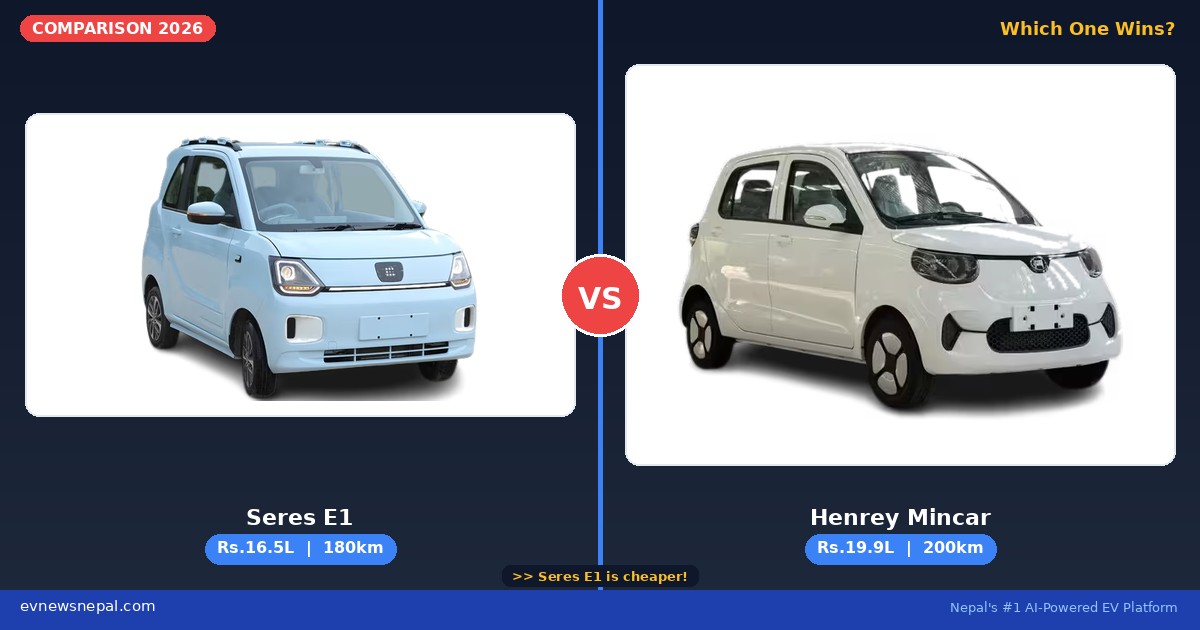
If you are shopping for the most affordable electric car in Nepal right now, the Seres E1 Mid and the Henrey Mincar are the two names at the top of the list — and choosing between them is less about price and more about what you value most in a first EV. The Seres E1 Mid, starting at Rs. 16,49,000, leads on passive safety credentials, while the Henrey Mincar at Rs. 19,95,000 answers with a larger touchscreen, higher ground clearance, and a slightly faster charging time.
Both cars are built for Nepal's urban reality: short daily commutes, overnight home charging, stop-and-go Kathmandu traffic, and NEA electricity rates that make running costs remarkably low. Neither is designed for long highway touring — they are city-first machines that happen to be the most accessible entry point into electric mobility available in Nepal today.
The decision between them is genuinely close, which is why this head-to-head exists. Below, we break down range, charging, features, and real-world ownership context so you can walk into a showroom knowing exactly which one suits your life.
At a Glance
| Spec | Seres E1 Mid | Henrey Mincar |
|---|---|---|
| Price | Rs. 16,49,000 | Rs. 19,95,000 |
| Battery | 13.8 kWh | 16.5 kWh |
| Range (claimed) | 180 km (WLTP) | 205 km (NEDC) |
| Motor Power | 25 kW | 35 kW |
| Torque | 100 Nm | 102 Nm |
| Fast Charging | Not Available | Not Available |
| Top Speed | 100 km/h | 100 km/h |
| Ground Clearance | 135 mm | 165 mm |
| V2L | No | No |
Price Breakdown
| Variant | Price | Battery | Range |
|---|---|---|---|
| Seres E1 Mid | Rs. 16,49,000 | 13.8 kWh | 180 km |
| Henrey Mincar | Rs. 19,95,000 | 16.5 kWh | 205 km |
Range: Real World vs Claimed
| Metric | Seres E1 Mid | Henrey Mincar |
|---|---|---|
| Claimed range | 180 km (WLTP) | 200 km (NEDC) |
| Est. real-world (Nepal, mixed) | ~147 km | ~164 km |
| Est. real-world (highway, hilly) | ~135 km | ~150 km |
On paper, the Henrey Mincar claims 205 km under the NEDC test cycle, while the Seres E1 Mid is rated at 180 km under the stricter WLTP standard. Because NEDC figures are typically more optimistic than WLTP, the actual real-world gap between the two cars is narrower than the headline numbers imply — our Nepal-specific estimates put them within 15–20 km of each other in mixed urban driving conditions.
In practice, Nepal's terrain works against any claimed range figure. Kathmandu's uphill gradients toward Lalitpur, Bhaktapur, or Budhanilkantha, combined with pre-monsoon AC usage and heavy stop-and-go traffic, will consistently bring real-world figures below what the manufacturers publish. That said, for a typical daily commute of 25–35 km within the Valley, both cars cover a full day on a single overnight charge with plenty of headroom to spare.
Charging Speed and Monthly Cost
| Spec | Seres E1 Mid | Henrey Mincar |
|---|---|---|
| DC Fast Charge | Not Available | Not Available |
| AC Home Charge | 0-100% in 4.5 hours | 0-100% in 4 hours |
| Full charge cost (home, Rs.11/kWh) | ~Rs. 151 | ~Rs. 181 |
| Est. monthly cost (30km/day) | ~Rs. 759/month | ~Rs. 816/month |
With no DC fast charging support on either model, your daily charging routine will revolve around a standard home AC outlet or a dedicated wallbox. The Henrey Mincar completes a full 0–100% cycle in approximately 4 hours, while the Seres E1 Mid takes around 4.5 hours — a difference small enough that plugging in before bed makes it a non-issue for both. You wake up to a full battery every morning regardless of which one you choose.
Nepal's public fast-charging network is still developing, and outside the Kathmandu Valley the infrastructure remains sparse. For entry-level city EVs like these, that is largely irrelevant — their entire ownership model is built around home charging at NEA domestic rates. At approximately Rs. 11 per kWh, filling either car from empty costs well under Rs. 200, and estimated monthly running costs for a typical commuter stay comfortably below Rs. 900. That is a compelling argument for switching from petrol regardless of which model you choose.
Features Face-Off
| Feature | Seres E1 Mid | Henrey Mincar |
|---|---|---|
| Airbags | 2 | 0 |
| ABS + EBD + ESP + TCS | Yes | Yes |
| TPMS | Yes | No |
| ISOFIX | Yes | No |
| Hill Hold | Yes | Yes |
| Hill Descent Control | No | No |
| Auto Hold | No | No |
| AEB (Emergency Braking) | No | No |
| Adaptive Cruise Control | No | No |
| Lane Keep Assist | No | No |
| Blind Spot Detection | No | No |
| Rear Cross Traffic Alert | No | No |
| 360-degree Camera | No | No |
| Rear Camera | Yes | Yes |
| Parking Sensors | Front and Rear | Rear |
| Panoramic Sunroof | No | No |
| Heated/Ventilated Seats | No | No |
| Wireless Phone Charging | No | No |
| V2L (Vehicle-to-Load) | No | No |
| Touchscreen | 8.8-inch Touchscreen | 10″ touchscreen with Bluetooth & reverse camera |
| Digital Instrument Cluster | 7-inch Digital | N/A |
| Apple CarPlay / Android Auto | No | No |
| Connected Car / App | Yes | Yes |
| Head-Up Display | No | No |
| Ambient Lighting | No | No |
| Sound System | N/A | Basic 2–4 speaker setup |
Compare side-by-side: Seres E1 vs Henrey Mincar — full specs, features & price comparison tool.
From a safety standpoint, the two cars take noticeably different approaches — refer to the Features table above for the complete breakdown, but in broad terms, the Seres E1 Mid offers a more comprehensive passive safety package, while both vehicles share a solid foundation of active safety and stability systems. For buyers with young children or those who prioritise occupant protection, the difference in safety category coverage is worth weighing carefully before deciding.
On the technology and comfort side, the Henrey Mincar's larger touchscreen and audio setup give it an edge for everyday infotainment, while the Seres E1 Mid counters with a dual-screen digital cockpit layout and additional convenience features like TPMS and child-seat anchor points. Neither car is targeting luxury buyers, but both include connected car app functionality and reverse camera support — features that genuinely improve daily usability at this price point.
How Much Will You Save Going Electric?
Use our free EV vs Petrol Cost Calculator to compare total cost of ownership.
Explore these vehicles:
Pros and Cons
Seres E1 Mid
Pros:
- Stronger passive safety package with {{vehicle:seres-e1-mid:standardFeatures.airbags}} airbags — a meaningful differentiator in this budget segment
- WLTP-rated 180 km claimed range reflects more realistic real-world conditions than NEDC figures
- TPMS and ISOFIX child-seat anchors included — practical additions for family buyers
- Front and rear parking sensors for confident city manoeuvring
- Dual-screen cockpit (13.8 kWh battery) with connected car app support
- Hill hold functionality for Kathmandu's steep inclines
Cons:
- Lower ground clearance (135 mm) may feel restrictive on rough or broken road surfaces
- No DC fast charging limits flexibility for occasional longer runs
- Slightly longer home charge time compared to the Henrey Mincar
Henrey Mincar
Pros:
- Priced at Rs. 19,95,000 — competitive entry point for Nepal's budget EV segment
- Higher ground clearance (165 mm) better suited to Nepal's uneven lanes and occasional unpaved stretches
- Larger 10-inch touchscreen with integrated Bluetooth and reverse camera display
- 16.5 kWh battery with 205 km NEDC claimed range
- Slightly faster home charging — 0–100% in approximately 4 hours
- Connected car app functionality included as standard
Cons:
- Passive safety provision is more limited than the Seres E1 Mid — see the Features table for details
- NEDC range figures are typically optimistic; real-world range may feel lower than advertised
- Rear-only parking sensors versus front-and-rear coverage on the Seres E1 Mid
Our Verdict: Which Should You Buy?
These two cars are the most affordable EVs on sale in Nepal, but they make very different cases for your money. The Seres E1 Mid, at Rs. 16,49,000, is the stronger choice for buyers who put occupant safety first. Its {{vehicle:seres-e1-mid:standardFeatures.airbags}} airbags, ISOFIX anchors, TPMS, and front-and-rear parking sensors combine into a safety package that stands out sharply at this price tier — particularly if you regularly carry children or passengers.
The Henrey Mincar, at Rs. 19,95,000, makes its case through ground clearance and practicality. Its 165 mm clearance is a genuine daily advantage on Kathmandu's potholed lanes and the uneven surfaces common on roads leading out of the Valley. Add in the larger infotainment screen and slightly faster charging, and it is a well-rounded package for commuters who are willing to trade passive safety coverage for better road confidence.
Choose the Seres E1 Mid if you have a family, carry passengers regularly, or simply want the most safety-conscious budget EV currently available in Nepal. Choose the Henrey Mincar if your routes include rough or broken road surfaces, you prefer a larger infotainment screen, and you are comfortable prioritising ground clearance and everyday practicality over airbag coverage.
Frequently Asked Questions
Q: What is the price of the Seres E1 Mid in Nepal?
A: The Seres E1 Mid is priced at Rs. 16,49,000 in Nepal. It is one of the most affordable electric cars currently on sale in the country, positioning itself as a city-focused entry-level EV with a 13.8 kWh battery and 180 km of claimed range.
Q: What is the price of the Henrey Mincar in Nepal?
A: The Henrey Mincar is priced at Rs. 19,95,000 in Nepal. It competes directly with the Seres E1 Mid at the budget end of the EV market, offering a 16.5 kWh battery, 205 km claimed range, and a 165 mm ground clearance suited to Nepal's varied road surfaces.
Q: Which has better real-world range — the Seres E1 Mid or the Henrey Mincar?
A: The Henrey Mincar claims 205 km under the NEDC test cycle, and the Seres E1 Mid claims 180 km under the stricter WLTP standard. Because NEDC figures are generally more optimistic, the real-world gap is narrower than it appears — estimates for mixed Nepal driving put both cars in the 135–165 km range. For a typical Kathmandu commute of 25–35 km per day, either car comfortably covers a full day on a single overnight charge.
Q: Do the Seres E1 or Henrey Mincar support fast charging?
A: Neither the Seres E1 Mid nor the Henrey Mincar supports DC fast charging. Both are designed around standard AC home charging. The Henrey Mincar charges from 0–100% in approximately 4 hours, while the Seres E1 Mid takes around 4.5 hours. Overnight home charging at NEA domestic electricity rates keeps monthly fuel costs well under Rs. 900 for a typical commuter.
Q: Which is the safer car — the Seres E1 Mid or the Henrey Mincar?
A: The Seres E1 Mid offers a stronger passive safety package, including {{vehicle:seres-e1-mid:standardFeatures.airbags}} airbags, TPMS, and ISOFIX child-seat anchors — features that the Henrey Mincar does not currently include. Both vehicles share active safety systems such as stability control and hill hold. For buyers who prioritise occupant protection, particularly those travelling with children, the Seres E1 Mid has a clear advantage in this category.
Q: Which EV is better suited to Nepal's roads?
A: The Henrey Mincar's 165 mm ground clearance gives it a practical advantage over the Seres E1 Mid's 135 mm on Nepal's frequently uneven, potholed, or partially unpaved roads. In smooth central Kathmandu conditions, both cars handle daily driving without issue. If your regular routes include rougher suburban roads or areas outside the Valley where road quality varies, the Henrey Mincar's additional clearance is a meaningful real-world benefit.