Suzuki E Vitara Nepal: Price, Range, Features and First Impressions
Key Takeaways
- The Suzuki E Vitara Base is priced at Rs. 49,99,000 as a time-limited introductory offer from CG Motocorp, with bookings open at all Suzuki showrooms in Nepal.
- Its 49 kWh LFP battery delivers 450 km WLTP range; real-world range in Nepal's hilly conditions is approximately 320–390 km per charge.
- Home charging costs just Rs. 490–590 for a full charge at NEA domestic rates, with average monthly running costs of Rs. 1,200–1,500 for a 35 km/day city commuter.
- The 70 kW DC fast-charging speed (45 min for 10–80%) is slower than newer rivals, but manageable for most Nepali driving patterns where home overnight charging is the norm.
- LFP battery chemistry, 300 Nm of hill-climbing torque, and Suzuki's established CG Motocorp dealer network make the E Vitara a reliable long-term bet in Nepal's EV market.
Nepal's electric vehicle market is growing at a pace few anticipated. With over 44,500 EV units imported in 2025 alone — nearly triple the previous year — and a charging network that has expanded to over 1,250 stations nationwide, the infrastructure is finally catching up to buyer appetite. Into this landscape arrives the Suzuki E Vitara: Suzuki's first serious foray into premium electric SUVs, and a vehicle that carries the weight of an established Japanese brand's reputation on its shoulders.
Unveiled and opened for booking at the WADA Auto Show 2026 in Pokhara, the E Vitara is now available through CG Motocorp — Suzuki's authorized distributor in Nepal — at an introductory price of Rs. 49,99,000. That price tag places it above the Chinese EVs that have dominated Nepal's affordable segment, but it comes with something Chinese brands are still building: a trusted name, an established service network, and the engineering pedigree of a Japanese automaker that has been selling cars in Nepal for decades.
So is it worth it? And how does it actually perform on Nepal's mix of Kathmandu valley traffic, hilly terrain, and long intercity highways? Here is everything you need to know.
Quick Summary
| Model | Price (from) | Range | Battery | Best For |
|---|---|---|---|---|
| Suzuki E Vitara Base | Rs. 49,99,000 | 450 km (WLTP) | 49 kWh LFP | City commuters, weekend highway runs, families |
Detailed Review
Suzuki E Vitara Base — Rs. 49,99,000
- Range: 450 km (WLTP) | Battery: 49 kWh Li-ion LFP (400V)
- Motor: 106 kW (142 hp) | Torque: 300 Nm
- Fast Charge (10–80%): ~45 minutes | Top Speed: 180 km/h
- Seating: 5 | Ground Clearance: 180 mm | Dimensions: 4,275 × 1,800 × 1,635 mm, Wheelbase: 2,700 mm
Key highlight: Suzuki's first premium electric SUV for Nepal — Japanese reliability meets modern EV practicality.
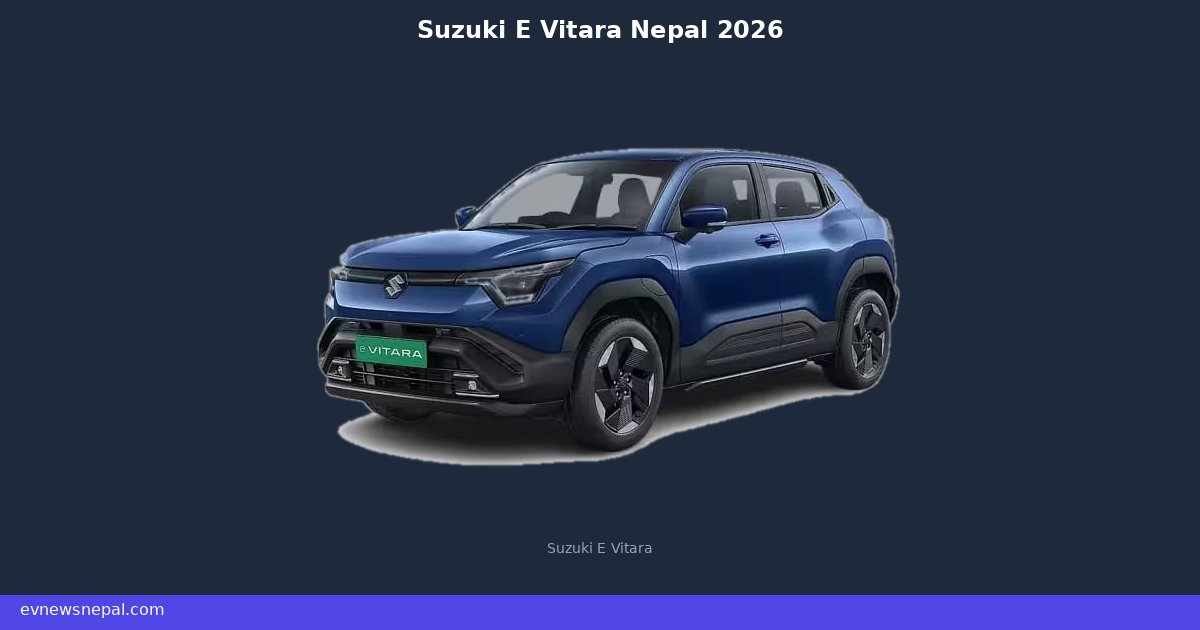
From the outside, the E Vitara looks nothing like the Suzuki you might remember. The tri-slash LED DRLs, 18-inch alloys, roof-end spoiler, and next-generation matrix LED projector headlamps give it a purposeful, premium stance that competes visually with much pricier rivals. At 4,275 mm long, it slots neatly into the compact SUV class without being too large for Kathmandu's narrow lanes — a real-world consideration that buyers in the valley know matters more than most spec sheets let on.
The powertrain is the real story. A 106 kW front-wheel-drive motor produces 300 Nm of torque — that figure is what you feel in daily driving, not horsepower. Three hundred Nm means confident overtakes on the Prithvi Highway, effortless climbing on Nagarkot's switchbacks, and snappy acceleration from traffic lights in Kathmandu. The battery chemistry is equally thoughtful: the 49 kWh pack uses LFP (Lithium Iron Phosphate) cells, which are inherently more thermally stable, longer-lasting, and safer than the NMC chemistry used in many rivals. In a market where long-term reliability and low maintenance costs are priorities — and where EV service expertise is still developing — LFP is a smart choice.
Real-World Range in Nepal
The WLTP figure of 450 km is tested under controlled European conditions. Real-world performance in Nepal will vary: international reviewers typically report 15–30% below official figures depending on speed, elevation, and temperature. For Nepali conditions, expect approximately 320–390 km per charge in mixed use. Kathmandu stop-and-go traffic actually works in the E Vitara's favor — regenerative braking continuously recovers energy that petrol engines waste as heat, and EV motors run most efficiently at low speeds. On a highway run to Pokhara or Chitwan at 80–100 km/h, range will dip more noticeably, but the generous WLTP baseline means the trip remains very achievable with a single planned charging stop.
One point flagged consistently by international reviewers: the E Vitara's maximum DC fast-charging speed is 70 kW, which is slower than newer rivals in the same class. The 10–80% charge in approximately 45 minutes is workable, but premium competitors can do the same in under 30 minutes. For most Nepali buyers who charge at home overnight, this is largely irrelevant — you wake up to a full battery every morning. It only becomes a consideration on long intercity trips where you need a quick top-up.
Running Costs — What It Actually Costs per Month
This is where the E Vitara shines. Charging a full 49 kWh battery at NEA domestic rates (Rs. 10–12/kWh) costs approximately Rs. 490–590. At a public fast-charging station (Rs. 15–20/kWh), a full charge runs Rs. 735–980. For a typical Kathmandu commuter covering 35 km/day:
| Charging Method | Cost per Full Charge | Monthly Cost (35 km/day) |
|---|---|---|
| Home (NEA domestic) | Rs. 490–590 | Rs. 1,200–1,500 |
| Public fast charger | Rs. 735–980 | Rs. 1,800–2,500 |
Compare that to a petrol compact SUV consuming 10–12 litres/100 km at current fuel prices, and the monthly savings are substantial — easily Rs. 8,000–12,000 per month, translating to over Rs. 1,00,000 saved annually on fuel alone.
Pro tip: Install a dedicated home charging point before your E Vitara arrives. NEA's domestic rate (Rs. 10–12/kWh) is far cheaper than public fast chargers (Rs. 15–20/kWh). Overnight charging is the most cost-effective way to own an EV in Nepal.
Cabin and Practicality
The 2,700 mm wheelbase — matching many C-segment sedans — translates to genuine rear legroom for adults. At 1,800 mm wide and 1,635 mm tall, the cabin should feel airy without being impractically large. Five adults can ride comfortably on typical Nepal journeys. The 180 mm ground clearance handles Kathmandu's potholed roads and light gravel tracks without drama, though serious off-road excursions on mountain tracks are beyond its intended remit.
Price Comparison
| Variant | Price | Battery | Range | Motor Power |
|---|---|---|---|---|
| Suzuki E Vitara Base | Rs. 49,99,000 | 49 kWh LFP | 450 km (WLTP) | 106 kW / 300 Nm |
Note: The Rs. 49,99,000 is a time-limited introductory price from CG Motocorp. Prices may be revised after the introductory period ends. Book through an authorized Suzuki showroom to lock in this price.
At just under Rs. 50 lakh, the E Vitara occupies a premium but defensible position in Nepal's EV market. Chinese EVs in the compact SUV segment typically land between Rs. 35–45 lakh, but carry question marks around long-term reliability, local service quality, and resale value. The E Vitara's premium reflects Japanese engineering standards, an established Nepal dealer network through CG Motocorp, and the reassurance of a brand that buyers and mechanics already understand.
For a broader look at how the E Vitara compares against other EVs available in Nepal, visit Compare EVs in Nepal.
Which One Should You Buy?
Under Rs. 25 lakh: The E Vitara is not in this bracket. Check the Used EV market in Nepal for budget-friendly options.
Rs. 25–40 lakh: Still below the E Vitara's price. However, if you can stretch your budget, the jump in build quality, range, and long-term ownership confidence is significant.
Rs. 40–60 lakh — The E Vitara's home bracket: At Rs. 49,99,000, the E Vitara Base is the most compelling case in this price range for buyers who want Japanese reliability, a genuine 450 km WLTP range, LFP battery longevity, and the backing of Nepal's most established automotive distributor.
Rs. 60 lakh+: The E Vitara delivers remarkable value even when compared to pricier rivals. Unless you specifically need AWD or higher-output variants (if introduced later), the Base is hard to argue against.
By Use Case:
- City commuter (Kathmandu valley): Excellent fit. Regenerative braking maximizes efficiency in stop-and-go traffic; compact dimensions ease parking; home overnight charging keeps costs minimal.
- Highway and intercity travel: Very capable. Plan charging stops on longer runs — the 70 kW charging ceiling means roughly 45-minute stops rather than the 20–25 minutes some rivals offer.
- Family use: Practical five-seater with genuine rear legroom and a stable, comfortable ride.
- Hilly terrain: The 300 Nm of torque shines on Nepal's climbs. FWD handles most hill roads confidently.
Buying Tips for Nepal
-
Book early to secure the introductory price. Rs. 49,99,000 is a time-limited offer. Contact any Suzuki/CG Motocorp showroom to place a booking before a price revision.
-
Sort your home charging before delivery. Confirm your home's electrical capacity with your electrician. A dedicated 32A circuit and EV wallbox will charge faster and more safely than a standard socket.
-
Calculate total cost of ownership, not just sticker price. Factor in Rs. 1,200–1,500/month charging (vs. Rs. 10,000–14,000/month in petrol), lower servicing costs (no oil changes, fewer brake replacements due to regen), and better resale retention versus Chinese brands.
-
Plan intercity trips around the charging network. Nepal's network has grown to 1,250+ stations, but coverage varies outside major corridors. Use NEA's charging map to pre-plan stops for Kathmandu–Pokhara or Kathmandu–Chitwan runs.
-
Confirm the service and warranty terms. Ask CG Motocorp specifically about battery warranty duration, OTA software update availability, and the nearest service center capable of handling EV-specific repairs.
How Much Will You Save Going Electric?
Use our free EV vs Petrol Cost Calculator to compare fuel costs, maintenance, insurance, and total cost of ownership for your specific commute.
Plan Your EV Road Trip
Get a personalized route with charging stops, battery estimates, and costs for your specific EV.
What's Your EV Worth?
Check the estimated resale value of any electric vehicle in Nepal based on age, condition, and battery health.
Frequently Asked Questions
Q: What is the price of the Suzuki E Vitara in Nepal?
A: The Suzuki E Vitara Base is priced at Rs. 49,99,000 as a time-limited introductory offer from CG Motocorp, Suzuki's authorized distributor in Nepal. Bookings are open at all Suzuki showrooms nationwide.
Q: What is the real-world range of the Suzuki E Vitara in Nepal?
A: The official WLTP range is 450 km. In real-world Nepal conditions — accounting for hilly terrain, air conditioning use, and highway speeds — expect approximately 320–390 km per charge. City driving with regenerative braking typically delivers better efficiency than highway runs.
Q: How much does it cost to charge the Suzuki E Vitara in Nepal?
A: Charging the full 49 kWh battery at home (NEA domestic rate Rs. 10–12/kWh) costs approximately Rs. 490–590. At a public fast-charging station (Rs. 15–20/kWh), a full charge costs Rs. 735–980. For a typical city commuter doing 35 km/day, monthly charging costs run approximately Rs. 1,200–1,500 when charging at home.
Q: How long does the Suzuki E Vitara take to charge?
A: The E Vitara supports DC fast charging at up to 70 kW, achieving 10–80% in approximately 45 minutes. A full overnight charge via a home AC charger takes 6–10 hours. Note that 70 kW is slower than several newer rivals — plan charging stops accordingly on long intercity trips.
Q: Is the Suzuki E Vitara good for Nepal's hilly roads?
A: Yes, for the vast majority of use cases. The 300 Nm of torque delivers strong hill-climbing performance, and the 180 mm ground clearance handles typical Nepal road surfaces comfortably. The Base variant is FWD and not designed for serious off-roading, but it is well-suited to Kathmandu valley roads and standard mountain highways.
Q: Where can I book the Suzuki E Vitara in Nepal?
A: Bookings are open through CG Motocorp at all authorized Suzuki showrooms across Nepal. The vehicle was officially launched at the WADA Auto Show 2026 in Pokhara in late March 2026.
Q: What makes the LFP battery in the E Vitara special?
A: LFP (Lithium Iron Phosphate) batteries are more thermally stable, have a longer cycle life, and are inherently safer than the NMC chemistry used in many competitors. They also support charging to 100% regularly without significant long-term degradation — unlike NMC cells that benefit from keeping charge between 20–80%. For Nepal's climate and developing service infrastructure, LFP is a practical, long-term advantage.