Ather 450X vs TVS iQube: Which Electric Scooter Should You Buy in Nepal? (2025)
Quick Comparison
- Ather 450X LR delivers ~103 km real-world range vs ~61 km for TVS iQube 2.2 in Nepal's mixed terrain
- TVS iQube 2.2 charges fully at home in just 2 hours — significantly faster than the Ather's 5h 45m full-charge cycle
- Ather's DC fast charging at 1.5 km/min via Ather Grid is a unique advantage no other mass-market Nepal scooter offers
- Monthly running costs actually favour the Ather (~Rs. 227/month) over the iQube (~Rs. 290/month) despite the higher upfront price
- Choose Ather 450X for range, tech, and a future-proof platform; choose TVS iQube for budget, simplicity, and a wide service network
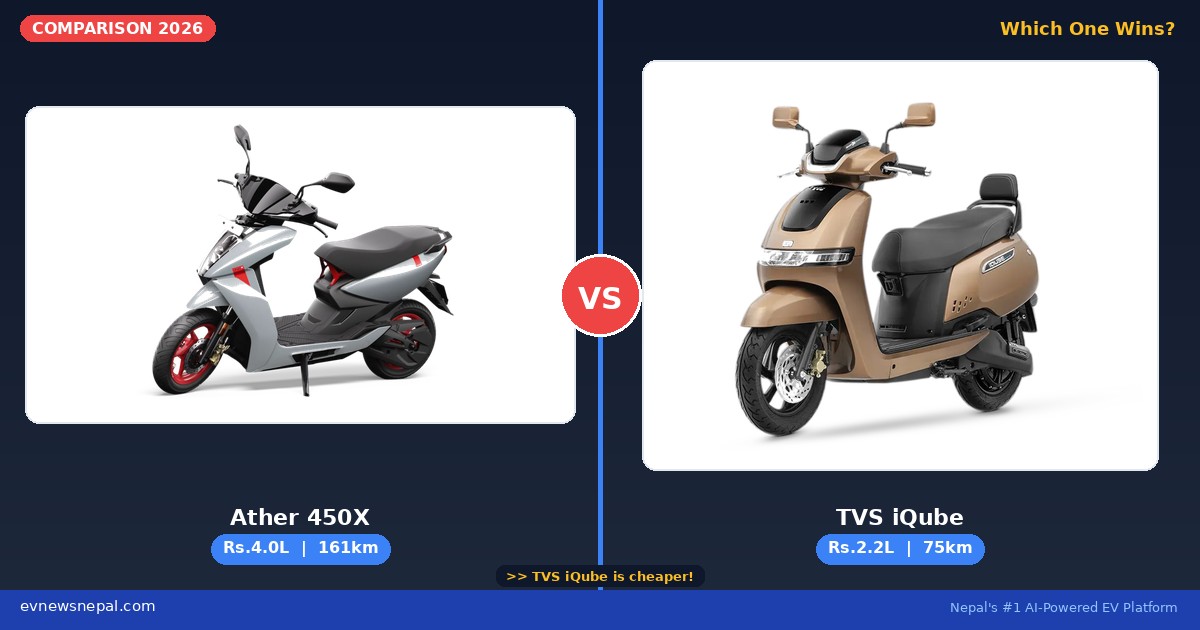
The Ather 450X LR is the stronger all-rounder for tech-savvy riders who prioritize range and connected features — but if budget and simplicity matter more, the TVS iQube 2.2 makes a compelling case. Starting at Rs. 3,64,999, the Ather 450X LR packs a 2.9 kWh battery, 126 km of ARAI-claimed range, and DC fast-charging via the Ather Grid network — advantages that matter greatly on Nepal's hilly, variable terrain. The TVS iQube 2.2, priced at Rs. 2,79,900, counters with a lower entry cost, a 2.2 kWh battery, and one of the fastest home-charge times in the segment.
Both scooters have earned loyal followings in Kathmandu and across Nepal's urban centres, but they serve meaningfully different riders. The Ather leans into technology — large touchscreen, 4G LTE, OTA updates, and a growing fast-charge network — while the iQube focuses on accessible, no-fuss ownership backed by TVS's well-established service presence. Understanding which philosophy fits your daily ride is the key to making the right call.
At a Glance
| Spec | Ather 450X LR | TVS iQube 2.2 |
|---|---|---|
| Price | Rs. 3,64,999 | Rs. 2,79,900 |
| Battery | 2.9 kWh | 2.2 kWh |
| Range (claimed) | 126 km (ARAI) | 95 km () |
| Motor Power | 6.4 kW | 4.4 kW |
| Torque | 26 Nm | 140 Nm |
| Fast Charging | 1.5 km/min via Ather Grid | N/A |
| Top Speed | 90 km/h | 75 km/h |
| Ground Clearance | 170 mm | 157 mm |
| V2L | No | No |
Price Breakdown
| Variant | Price | Battery | Range |
|---|---|---|---|
| Ather 450X LR | Rs. 3,64,999 | 2.9 kWh | 126 km |
| Ather 450X Gen 3 | Rs. 3,99,999 | 3.7 kWh | 146 km |
| Ather 450X HR | Rs. 3,99,999 | 3.7 kWh | 150 km |
| TVS iQube 2.2 | Rs. 2,79,900 | 2.2 kWh | 95 km |
| TVS iQube 3.0 | Rs. 3,14,900 | 3 kWh | 123 km |
| TVS iQube 3.5 | Rs. 3,39,900 | 3.5 kWh | 145 km |
Range: Real World vs Claimed
| Metric | Ather 450X LR | TVS iQube 2.2 |
|---|---|---|
| Claimed range | 126 km (ARAI) | 75 km () |
| Est. real-world (Nepal, mixed) | ~103 km | ~61 km |
| Est. real-world (highway, hilly) | ~94 km | ~56 km |
Nepal's terrain is among the most demanding for electric scooters anywhere — steep valley gradients in Kathmandu, long Tarai highways, and monsoon conditions all chip away at claimed range figures. The Ather 450X LR's 126 km ARAI-claimed range holds up well in the real world, with an estimated ~103 km in mixed city riding and around ~94 km on hilly or highway routes — enough to handle multi-day commutes on a single charge for most Kathmandu riders. The TVS iQube 2.2's 95 km claimed range translates to approximately ~61 km in mixed conditions and ~56 km on hillier stretches — sufficient for a 20–30 km daily commute, but with less margin if your route involves sustained climbs or traffic stops.
Budget 15–20% below the real-world estimates in the table above whenever you're riding in cold mornings, heavy monsoon rain, or back-to-back uphill sections — all of which are everyday realities across Nepal. If your commute regularly exceeds 40 km or you occasionally venture beyond the ring road, the range gap between these two scooters becomes a practical differentiator, not just a spec-sheet number.
Charging Speed and Monthly Cost
| Spec | Ather 450X LR | TVS iQube 2.2 |
|---|---|---|
| DC Fast Charge | 1.5 km/min via Ather Grid | N/A |
| AC Home Charge | 0-80% in 3h 35m, 0-100% in 5h 45m | 0-100% in 2 hours |
| Full charge cost (home, Rs.11/kWh) | ~Rs. 31 | ~Rs. 24 |
| Est. monthly cost (30km/day) | ~Rs. 227/month | ~Rs. 290/month |
The Ather 450X LR's DC fast-charging capability via the Ather Grid at 1.5 km/min is a standout advantage — a short stop during a longer ride can meaningfully top up your range in a way no other mass-market scooter in Nepal currently offers. For daily home charging, the 0–80% cycle completes in around 3h 35m, making an overnight charge well within reach. Despite the larger 2.9 kWh battery, efficiency works in your favour: a full charge costs approximately Rs. 31 at Nepal's NEA rate of Rs. 11/kWh, with estimated monthly running costs of just ~Rs. 227/month for a 30 km/day rider.
The TVS iQube 2.2 takes a different approach — its smaller 2.2 kWh battery completes a full 0–100% home charge in just 2 hours, one of the quickest turnarounds in its class and a genuine convenience for riders who forget to plug in overnight. A full charge costs approximately Rs. 24, though slightly lower efficiency per kilometre means monthly costs run around ~Rs. 290/month for the same 30 km/day usage. Nepal's public charging infrastructure is still maturing, so home charging remains the backbone of ownership for both scooters — the Ather simply adds an important fast-charge option for days when you need it.
Features Face-Off
| Feature | Ather 450X LR | TVS iQube 2.2 |
|---|---|---|
| Airbags | N/A | N/A |
| ABS + EBD + ESP + TCS | Yes | Yes |
| TPMS | Yes | No |
| ISOFIX | No | No |
| Hill Hold | No | No |
| Hill Descent Control | No | No |
| Auto Hold | No | No |
| AEB (Emergency Braking) | No | No |
| Adaptive Cruise Control | Infinite Cruise (OTA) | No |
| Lane Keep Assist | No | No |
| Blind Spot Detection | No | No |
| Rear Cross Traffic Alert | No | No |
| 360-degree Camera | No | No |
| Rear Camera | No | No |
| Parking Sensors | No | No |
| Panoramic Sunroof | No | No |
| Heated/Ventilated Seats | No | No |
| Wireless Phone Charging | No | No |
| V2L (Vehicle-to-Load) | No | No |
| Touchscreen | 7-inch Touchscreen | TFT Display |
| Digital Instrument Cluster | 7-inch TFT Capacitive Touch | 5-inch Digital |
| Apple CarPlay / Android Auto | Ather App + Bluetooth + WiFi + 4G LTE | TVS iQube App + Bluetooth |
| Connected Car / App | Yes | No |
| Head-Up Display | No | No |
| Ambient Lighting | No | No |
| Sound System | N/A | N/A |
Compare side-by-side: Ather 450X vs TVS iQube — full specs, features & price comparison tool.
On technology and connectivity, the Ather 450X LR leads the segment with a deep, software-driven ecosystem — its 7-inch capacitive touchscreen, 4G LTE, Wi-Fi, and over-the-air update capability mean the scooter can gain new features and improvements well after purchase. Safety tech is comprehensive, and the Ather's OTA-delivered Infinite Cruise is the kind of feature that sets it apart from traditionally specced rivals. Refer to the Features Face-Off table above for the complete breakdown of safety, comfort, and tech equipment across both scooters.
The TVS iQube 2.2 covers the essential safety and connectivity bases through its TFT display and TVS app integration — a focused, intuitive setup that many riders will find easier to live with day-to-day. What you gain with the Ather is depth: a platform that grows over time, with richer data, smarter controls, and a broader connected ecosystem. What you gain with the iQube is simplicity: fewer screens to manage, quicker access to what you need, and a familiar ownership experience backed by one of India's largest two-wheeler manufacturers.
How Much Will You Save Going Electric?
Use our free EV vs Petrol Cost Calculator to compare total cost of ownership.
Explore these vehicles:
Pros and Cons
Ather 450X
Pros:
- Best-in-class range: 126 km claimed, with real-world performance of ~103 km in mixed Nepal riding
- DC fast charging at 1.5 km/min via Ather Grid — the only mass-market scooter in Nepal with this capability
- Feature-rich 7-inch capacitive touchscreen with 4G LTE, Wi-Fi, and OTA updates
- Comprehensive safety tech including TPMS and OTA-delivered Infinite Cruise
- Higher ground clearance (170 mm) better suited for Nepal's uneven roads and speed bumps
- Multiple variants (LR, Gen 3, HR) to match different range needs and budgets
Cons:
- Higher entry price at Rs. 3,64,999 compared to the iQube 2.2
- Full home charge takes approximately 5h 45m — the trade-off for a larger battery
- Ather Grid fast-charging coverage remains limited outside Kathmandu and major cities in Nepal
Our Verdict: Which Should You Buy?
Choose the Ather 450X LR if you ride 40 km or more daily, value cutting-edge technology, or occasionally push beyond Kathmandu's ring road. Its 126 km claimed range, DC fast-charging access, and continuously improving software make it the most future-proof electric scooter available in Nepal today. The higher upfront cost at Rs. 3,64,999 pays dividends over time through lower monthly running costs and a platform that genuinely evolves with use.
Choose the TVS iQube 2.2 if your daily route stays within 30–40 km and you want a reliable, accessible electric scooter at Rs. 2,79,900 without the complexity of a tech-heavy platform. Its 2-hour home charge, solid TVS service network, and no-fuss ownership make it an easy first EV for Nepal's growing electric-scooter market. If range becomes a concern later, the iQube 3.0 and 3.5 offer a natural upgrade path within the same family.
For the average Kathmandu valley commuter doing 20–30 km a day, either scooter handles the daily grind comfortably. The real decision is whether you want a smart device on wheels that grows over time — or a dependable, cost-effective tool for beating traffic, priced to get more riders onto electric sooner.
Frequently Asked Questions
Q: What is the price of the Ather 450X in Nepal?
A: The Ather 450X LR is priced at Rs. 3,64,999 in Nepal. Ather also offers the 450X Gen 3 and 450X HR as alternative variants at different price points. Check the latest pricing on evnewsnepal.com for up-to-date figures.
Q: What is the price of the TVS iQube in Nepal?
A: The TVS iQube 2.2 is priced at Rs. 2,79,900 in Nepal. Higher-spec variants — the iQube 3.0 and 3.5 — are also available with larger batteries and longer claimed range. See the full iQube pricing breakdown for the latest figures.
Q: Which electric scooter has better real-world range in Nepal — Ather 450X or TVS iQube?
A: In Nepal's mixed riding conditions, the Ather 450X LR delivers an estimated ~103 km of real-world range, compared to approximately ~61 km for the TVS iQube 2.2. On hilly terrain — a daily reality in Kathmandu — expect figures to dip further. The Ather's larger 2.9 kWh battery gives it a clear advantage for longer or hillier commutes.
Q: Does the Ather 450X support fast charging in Nepal?
A: Yes. The Ather 450X LR supports DC fast charging via the Ather Grid network at 1.5 km/min. For home charging, a 0–80% top-up takes approximately 3h 35m and a full 0–100% charge completes in around 5h 45m. Ather Grid coverage in Nepal is expanding, though home charging remains the primary option for most riders outside Kathmandu's core.
Q: Which scooter costs less to run monthly in Nepal?
A: Despite its larger battery, the Ather 450X LR is estimated to cost around Rs. 227/month for a 30 km/day rider at NEA's Rs. 11/kWh rate — lower than the TVS iQube 2.2's estimated Rs. 290/month for the same usage. The Ather's greater efficiency per kilometre offsets the higher per-charge cost (~Rs. 31 vs ~Rs. 24 for a full charge).
Q: Which scooter is better suited to Kathmandu's hilly roads?
A: The Ather 450X LR has a practical edge on hilly terrain, with higher ground clearance (170 mm vs 157 mm) and stronger real-world range on mixed/hilly routes (~94 km vs ~56 km for the iQube 2.2). Both handle Kathmandu valley gradients capably in daily use, but the Ather offers more flexibility for longer, hillier journeys beyond the valley.