Key Takeaways
- The 28 km Kathmandu–Nagarkot round trip costs just Rs. 40–45 in an EV versus Rs. 800+ in petrol — over 90% savings
- MG MG4 Luxury at Rs. 49,99,000 offers the best value with 450 km range and hill-climbing proven to 4,660 metres
- Mahindra XEV 9e leads with 656 km WLTP range — enough for 11+ Nagarkot round trips on a single charge
- No charging needed for the trip, with 9 backup stations in Bhaktapur along the route
- Leave Kathmandu by 4:30 AM to catch sunrise over eight Himalayan ranges including Everest at Nagarkot viewpoint
Nepal now claims the world's second-highest EV adoption rate, with more than 70 percent of new car sales being electric. The charging network has expanded to over 1,250 stations nationwide, and Kathmandu Valley — with its dense cluster of NEA and private chargers — has become the perfect home base for electric adventures. If you've recently bought an EV or you're shopping for one, there's no better maiden voyage than the classic Kathmandu-to-Nagarkot sunrise trip.
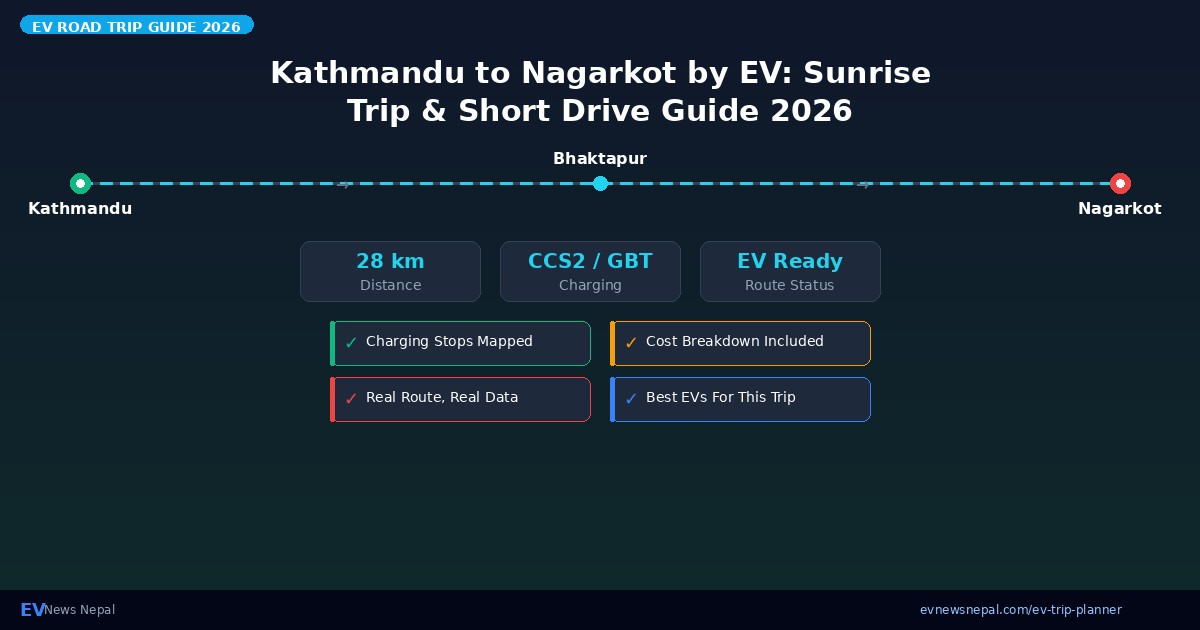
The route is short, sweet, and utterly rewarding. Just 28 kilometres from Kathmandu via Bhaktapur, Nagarkot sits at 2,175 metres on the eastern rim of the valley. The drive takes roughly 60–75 minutes in the pre-dawn quiet — leave by 4:30 AM to catch sunrise around 6:00 AM. On a clear morning, you'll witness a jaw-dropping panorama of eight Himalayan ranges, from Everest and Langtang to Annapurna and Dhaulagiri. The entire 56 km round trip costs approximately Rs. 40–45 in electricity versus Rs. 800+ in petrol — that's over 90% savings. And with the steepest section climbing nearly 800 metres in elevation, it's a genuine test of your EV's torque and regenerative braking on the way back down.
Below, we've picked the best EVs available in Nepal right now for this trip and beyond — from the sporty MG MG4 to the transformer-style Deepal E07. Let's find your perfect sunrise companion.
Route at a glance: Kathmandu → Bhaktapur (15 km) → Nagarkot (13 km) | Total: 28 km one way | Elevation gain: ~800 m | Charging needed: None | Plan your trip
Quick Summary
| Model | Price (from) | Range | Battery | Best For |
|---|---|---|---|---|
| MG MG4 Luxury | Rs. 49,99,000 | 450 km | 64 kWh | Best value, sporty drive |
| Mahindra XEV 9e Pack One | Rs. 67,50,000 | 656 km | 59 kWh | Range on a budget |
| Mahindra XEV 9e Pack Two | Rs. 75,50,000 | 656 km | 59 kWh | Balanced features + range |
| Mahindra XEV 9e Pack Three | Rs. 93,00,000 | 656 km | 79 kWh | Max range, top spec |
| Deepal E07 AWD | Rs. 1,99,99,000 | 490 km | 89.98 kWh | Premium AWD, SUV-pickup hybrid |
Detailed Reviews
MG MG4 Luxury — Rs. 49,99,000 onwards
- Range: 450 km (WLTP) | Battery: 64 kWh NMC | Motor: 99 kW
- Nepal's best-value performance hatchback with proven hill credentials
The MG MG4 Luxury has quickly become one of Nepal's most talked-about EVs, and for good reason. At just under Rs. 50 lakh, it packs a 64 kWh water-cooled NMC battery, 450 km WLTP range, and a punchy motor that makes the Nagarkot hill climb feel effortless. MG proved the MG4's mountain credentials when it completed a trailblazing expedition to Kora-la Pass in Upper Mustang at 4,660 metres — Nagarkot's 2,175 metres is a gentle warm-up by comparison.
What owners love is the driving dynamics. The 5-link rear independent suspension and rear-wheel-drive layout deliver a sporty, planted feel through Bhaktapur's tight corners and Nagarkot's winding ascent. Five driving modes (Eco, Sport, Snow, Custom, Standard) and four levels of regenerative braking let you fine-tune the experience. On the descent, regen braking recovers significant charge — expect to return to Kathmandu with more battery than you'd think.
The cabin features a 10.25-inch touchscreen with Apple CarPlay and Android Auto, V2L capability (handy for powering a kettle at the sunrise viewpoint), and DC fast charging from 10–80% in just 26 minutes at 142 kW. For the Nagarkot trip and daily Kathmandu commuting alike, the MG MG4 Luxury is hard to beat at this price.
Mahindra XEV 9e Pack One — Rs. 67,50,000 onwards
- Range: 656 km (WLTP) | Battery: 59 kWh LFP | Motor: 170 kW
- Longest range in its class at the most accessible XEV 9e price
The Mahindra XEV 9e Pack One enters Nepal's market with a headline-grabbing 656 km WLTP range from just a 59 kWh LFP battery — that's remarkable efficiency. For the Nagarkot trip, you could theoretically do the round trip over 11 times on a single charge. The 170 kW motor produces 380 Nm of instant torque, and owners report that steep, narrow hill roads feel completely effortless with strong regeneration on the way down.
Built on Mahindra's INGLO electric vehicle platform, Pack One comes with a triple 12.3-inch screen setup (driver display, infotainment, and co-driver screen), wireless Android Auto and CarPlay, and connected car technology. The LFP battery chemistry is a bonus for Nepal — it handles temperature extremes better than NMC and offers longer cycle life, meaning less degradation over years of Kathmandu's hot summers and cold winters. Ground clearance of 207 mm is also generous for Nepal's road conditions.
Mahindra XEV 9e Pack Two — Rs. 75,50,000 onwards
- Range: 656 km (WLTP) | Battery: 59 kWh LFP | Motor: 170 kW
- Pack One plus premium audio and comfort upgrades
The Pack Two shares the same 59 kWh battery and 170 kW motor as Pack One but adds Mahindra's premium package — most notably a 16-speaker Harman Kardon audio system, wireless phone charging, and cooled console storage. If you're the type who wants to enjoy crisp music during that early-morning Nagarkot drive with the windows down, the audio upgrade alone makes the Rs. 8 lakh premium over Pack One worthwhile.
Fast charging remains excellent at 175 kW DC, going from 20–80% in just 20 minutes. Not that you'll need it for Nagarkot, but for longer trips like Kathmandu–Pokhara, that charging speed is a genuine game-changer.
Mahindra XEV 9e Pack Three — Rs. 93,00,000 onwards
- Range: 656 km (WLTP) | Battery: 79 kWh LFP | Motor: 210 kW
- Flagship spec with bigger battery and AR heads-up display
The Pack Three is the full XEV 9e experience. It upgrades to a 79 kWh LFP battery and a more powerful 210 kW motor (286 PS), and adds an augmented reality heads-up display, 5G connectivity with built-in Wi-Fi, OTA updates, and even a video calling camera. The 0–100 km/h sprint of 6.8 seconds feels swift, and the extra battery capacity provides a genuine buffer for Nepal's hilly terrain where real-world range typically dips 15–30% below WLTP claims.
For the Nagarkot trip specifically, the AR HUD is a nice-to-have — navigation prompts projected onto the windshield make navigating pre-dawn Bhaktapur streets much easier. But the real value of Pack Three is for buyers who want a long-range, premium EV coupé-SUV that handles everything from daily Kathmandu commutes to ambitious highway road trips.
Deepal E07 AWD — Rs. 1,99,99,000 onwards
- Range: 490 km (WLTP) | Battery: 89.98 kWh NMC | Motor: 440 kW (dual)
- Transformer SUV that converts to a pickup in 10 seconds
The Deepal E07 AWD is in a league of its own. At nearly Rs. 2 crore, it's the most premium option here, but it delivers a genuinely unique proposition — an 800V architecture SUV that transforms into a pickup truck in 10 seconds. The dual-motor AWD setup produces a staggering 440 kW and 645 Nm, launching this 2.4-tonne machine to 100 km/h in just 4.0 seconds.
For the Nagarkot run, the E07 is admittedly overkill — but gloriously so. The AWD system provides supreme confidence on wet or loose road surfaces (crucial during monsoon season), and the air suspension smooths out every rough patch. Real-world energy consumption sits around 14–16 kWh/100 km, which is impressive for its size. The 15.4-inch rotating Snapdragon 8155 touchscreen and 131-litre frunk add to the premium experience.
The transformer capability is where it gets interesting for adventure trips: fold down the rear into pickup mode and you get up to 1,860 litres of flatbed space — perfect for camping gear, photography equipment, or a proper sunrise picnic setup at Nagarkot's viewpoint.
Price Comparison
| Model | Price | Range | Battery | Motor Power |
|---|---|---|---|---|
| MG MG4 Luxury | Rs. 49,99,000 | 450 km | 64 kWh | 99 kW |
| Mahindra XEV 9e Pack One | Rs. 67,50,000 | 656 km | 59 kWh | 170 kW |
| Mahindra XEV 9e Pack Two | Rs. 75,50,000 | 656 km | 59 kWh | 170 kW |
| Mahindra XEV 9e Pack Three | Rs. 93,00,000 | 656 km | 79 kWh | 210 kW |
| Deepal E07 AWD | Rs. 1,99,99,000 | 490 km | 89.98 kWh | 440 kW |
Cost of this trip: At roughly Rs. 0.70–0.80 per km, the 56 km Kathmandu–Nagarkot round trip costs just Rs. 40–45 in any of these EVs. Compare that to Rs. 800+ in a petrol car — over 90% cheaper.
Which One Should You Buy?
Under Rs. 55 Lakh — Best Value The MG MG4 Luxury at Rs. 49,99,000 is the clear winner. It offers 450 km range, 26-minute fast charging, V2L, and proven hill-climbing ability — all at Nepal's most competitive price for a full-featured EV. For the Nagarkot trip and everyday Kathmandu driving, this is the sweet spot.
Rs. 55–80 Lakh — Range & Features The Mahindra XEV 9e Pack One (Rs. 67,50,000) delivers the best km-per-rupee ratio with 656 km range. Step up to Pack Two (Rs. 75,50,000) for premium Harman Kardon audio and wireless charging. Both handle hill driving with ease and offer 207 mm ground clearance for Nepal's roads.
Rs. 80 Lakh – 1 Crore — Premium Choice The Mahindra XEV 9e Pack Three (Rs. 93,00,000) is the flagship pick — bigger 79 kWh battery, AR HUD, 5G, and the most powerful motor in the lineup. Ideal if you want a future-proof premium EV for both city and highway use.
Above Rs. 1 Crore — Ultimate Adventure The Deepal E07 AWD (Rs. 1,99,99,000) is for buyers who want something extraordinary — AWD confidence, 800V fast charging, air suspension, and that unique SUV-to-pickup transformation. It's the most capable all-weather option for serious road trips well beyond Nagarkot.
By Use Case:
| Use Case | Recommended EV |
|---|---|
| Daily city commute + weekend trips | MG MG4 Luxury |
| Maximum highway range | Mahindra XEV 9e Pack One or Two |
| Family comfort + premium tech | Mahindra XEV 9e Pack Three |
| All-weather adventure + off-road | Deepal E07 AWD |
Buying Tips for Nepal
-
Test the hill climb before you buy. Ask your dealer for a Nagarkot test drive — any reputable showroom will oblige. Pay attention to how the car handles the steep gradient and how much regenerative braking recovers on the descent. This 28 km route tells you more about an EV than any showroom visit.
-
Factor in real-world range, not WLTP. Nepal's hilly terrain, temperature swings, and frequent AC or heater use mean real-world range is typically 70–85% of WLTP claims. A 656 km rated car might deliver 460–550 km in practice — still excellent, but plan accordingly for longer trips.
-
Check home charging feasibility. Most EV owners charge at home overnight using NEA domestic rates (~Rs. 10–12 per kWh). A full 60 kWh charge costs roughly Rs. 600–720 at home versus Rs. 900–1,200 at a public fast charger. Make sure your parking spot can accommodate a Level 2 charger installation.
-
Understand LFP vs NMC batteries. LFP batteries (Mahindra XEV 9e) handle Nepal's temperature extremes better and offer more charge cycles. NMC batteries (MG MG4, Deepal E07) pack higher energy density but may degrade slightly faster. Both chemistries are excellent — just know what you're getting.
-
Use the Bhaktapur charging network as backup. The route passes through Bhaktapur, which has 9 charging stations from NEA, MG, TATA, DFSK, and private operators. You won't need them for the Nagarkot trip, but knowing they're there gives peace of mind for longer valley explorations. Compare more EVs or browse Used EVs in Nepal for budget-friendly options.
Recommended Charging Stations Along the Route
| Station | Location | Connector | Open in Maps |
|---|---|---|---|
| Shasheela Motors Charging Station Kalanki | Kathmandu | DC | Directions |
| MAW Vriddhi Balaju Bus Park | Kathmandu | DC | Directions |
| BYD Lalitpur, Eco Drive Automobiles Pvt Ltd | Lalitpur | AC, DC | Directions |
| BYD Park | Kathmandu | DC | Directions |
| MAW Vriddhi Kapan | Kathmandu | DC | Directions |
| MAW Vriddhi Speed Charging | Bhaktapur | DC | Directions |
Pro tip: Use our EV Trip Planner to see all 54+ charging stations along this route, estimated costs, and charging times for your specific EV.
Plan Your Kathmandu to Nagarkot EV Trip
Get a personalized route plan with charging stops, battery estimates, and costs for your specific EV model.
How Much Will You Save Going Electric?
Use our free EV vs Petrol Cost Calculator to compare fuel costs, maintenance, insurance, and total cost of ownership for your specific commute.
Frequently Asked Questions
Q: How far is Kathmandu to Nagarkot by road?
A: The distance is approximately 28 km via Bhaktapur. The drive takes 60–75 minutes under normal conditions, or about 45–50 minutes in the pre-dawn quiet when traffic is minimal. The route passes through Bhaktapur city before climbing to Nagarkot at 2,175 metres elevation.
Q: Do I need to charge my EV on the Kathmandu to Nagarkot trip?
A: No. The round trip is only 56 km, which is well within the range of every EV in this guide. Even the shortest-range option here (MG MG4 at 450 km) can do this trip over 8 times on a single full charge. Bhaktapur has 9 charging stations along the route if you ever need a top-up.
Q: What time should I leave Kathmandu for Nagarkot sunrise?
A: Leave by 4:30 AM to reach Nagarkot comfortably before 6:00 AM sunrise. Head for the Nagarkot View Tower, a short walk above the main village, for the best panoramic views. October to December and March to April offer the clearest Himalayan vistas.
Q: How much does the Kathmandu to Nagarkot trip cost in an EV?
A: The 56 km round trip costs approximately Rs. 40–45 in electricity at average EV running costs of Rs. 0.70–0.80 per km. Compare this to Rs. 800+ for the same trip in a petrol car. Monthly charging costs for an average daily commute of 30–40 km run about Rs. 1,000–2,000.
Q: Which is the cheapest EV for the Nagarkot trip?
A: Among the vehicles in this guide, the MG MG4 Luxury at Rs. 49,99,000 is the most affordable with excellent hill-climbing performance proven up to 4,660 metres in Nepal. For more budget-friendly EV options across all categories, check our full EV price comparison.
Q: Is the road to Nagarkot suitable for electric vehicles?
A: Absolutely. The road is paved throughout, though the final stretch has steep gradients and some rough patches. All EVs handle the climb well thanks to instant torque delivery. Ground clearance ranges from 160 mm (MG MG4) to 207 mm (XEV 9e), which is more than sufficient. During monsoon season (June–September), AWD vehicles like the Deepal E07 offer extra confidence on wet roads.