Key Takeaways
- All five recommended EVs can complete the 199 km Pokhara-to-Lumbini route on a single charge, with the Mahindra XEV 9e capable of the round trip without stopping
- Butwal serves as the primary charging hub with 13 stations, while Bhairahawa adds 6 more — Lumbini charging remains limited
- The one-way EV trip costs just Rs. 140–160 in electricity versus Rs. 1,500–2,000 in petrol — an 80–90% saving
- The MG MG4 Luxury at Rs. 49,99,000 offers the best value entry point, while the Mahindra XEV 9e Pack One at Rs. 67,50,000 delivers unmatched range per rupee
- Monsoon travelers should prioritize ground clearance (207 mm XEV 9e) and AWD capability (Deepal E07) for the Siddhartha Highway's mountain sections
The 199-kilometer stretch from Pokhara to Lumbini via the Siddhartha Highway is one of Western Nepal's most scenic drives — and increasingly, one of its most EV-friendly. Winding through the hilltop charm of Tansen, descending past Palpa's ridgeline panoramas, and flattening out through Butwal and Bhairahawa before arriving at the sacred birthplace of Lord Buddha, this route packs geography, history, and adventure into a single day's drive.
Nepal's EV revolution has been quietly reshaping how we think about road trips. With over 13 charging stations now operational in Butwal alone, six more in Bhairahawa, and the government's ongoing push to develop the Siddhartha Highway into an expressway-grade corridor, the Pokhara–Lumbini route is no longer a range-anxiety gamble — it's a genuine EV touring opportunity. Whether you're a Pokhara local planning a weekend pilgrimage or a Kathmandu driver staging a western loop, 2026 is the year this trip became practical for electric vehicles of nearly every class.
In this guide, we break down the route, the charging infrastructure, and — most importantly — the best EVs to make the journey in. We've selected five models currently available in Nepal that have the range, performance, and ground clearance to handle the Siddhartha Highway's mix of mountain switchbacks and Terai plains. Use our EV Trip Planner to map your exact route and charging stops.
Quick Summary
| Model | Price (from) | Range | Battery | Best For |
|---|---|---|---|---|
| MG MG4 Luxury | Rs. 49,99,000 | 450 km | 64 kWh | Best value for highway touring |
| Mahindra XEV 9e Pack One | Rs. 67,50,000 | 656 km | 59 kWh | Round-trip range without charging |
| Mahindra XEV 9e Pack Two | Rs. 75,50,000 | 656 km | 59 kWh | Premium features + massive range |
| Mahindra XEV 9e Pack Three | Rs. 93,00,000 | 656 km | 79 kWh | Flagship power and range |
| Deepal E07 AWD | Rs. 1,99,99,000 | 490 km | 89.98 kWh | Ultimate performance SUV |
The Route: What to Expect
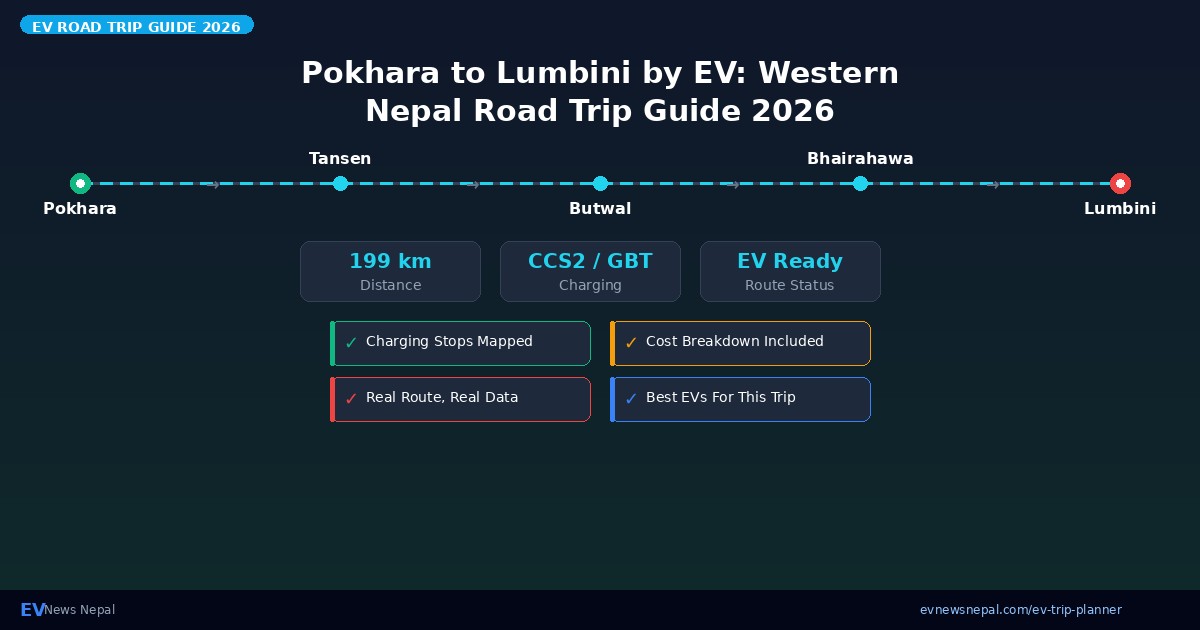
The Siddhartha Highway takes you from Pokhara (elevation ~800m) up through winding mountain roads to Tansen (~1,500m), then drops sharply into the Terai plains toward Butwal (~150m), Bhairahawa, and finally Lumbini (~100m). Expect 5–6 hours of driving with stops.
Pro tip: The descent from Tansen to Butwal is where regenerative braking earns its keep. Expect to recover 5–10% of battery on the long downhill stretches — a meaningful bonus that makes real-world range on this route better than flat-road estimates might suggest.
Key stops along the way:
- Tansen (~90 km): Historic hilltop town with Palpa viewpoints — perfect tea stop
- Butwal (~150 km): Major charging hub with 13 stations (CCS2 and GBT connectors available)
- Bhairahawa (~180 km): 6 charging stations, last reliable charge before Lumbini
- Lumbini (199 km): Sacred garden complex — limited charging, plan accordingly
Detailed Reviews
MG MG4 Luxury — Rs. 49,99,000 onwards
- Range: 450 km (WLTP) | Battery: 64 kWh NMC | Motor: 99 kW
- The most affordable highway-capable EV for this route
The MG4 Luxury is the entry point for serious EV road-tripping in Nepal, and it punches well above its price. With a 64 kWh water-cooled NMC battery delivering 450 km of WLTP range, the one-way Pokhara-to-Lumbini journey of 199 km is comfortably within reach — you'll arrive with well over half your battery remaining even accounting for the Siddhartha Highway's elevation changes. The MG4 famously completed an expedition to Kora-la Pass in Upper Mustang at 4,660 meters, proving its capability on Nepal's toughest roads.
Fast charging at 142 kW DC gets you from 10–80% in just 26 minutes, making Butwal pit stops quick and painless. The V2L (Vehicle-to-Load) feature is a genuine road trip advantage — power a portable cooker or charge devices at the Lumbini Sacred Garden where infrastructure is sparse. The 160 mm ground clearance is adequate for the Siddhartha Highway's current condition, though you'll want to slow down through construction zones near Tansen. Five driving modes including Snow mode give confidence on wet monsoon roads.
Owners consistently praise the smooth acceleration and quiet cabin on highway stretches. The 10.25-inch touchscreen with Apple CarPlay and Android Auto keeps navigation seamless. For the price, no other EV in Nepal offers this combination of range, charging speed, and road-trip readiness.
Mahindra XEV 9e Pack One — Rs. 67,50,000 onwards
- Range: 656 km (WLTP) | Battery: 59 kWh LFP | Motor: 170 kW
- Round-trip range champion at a competitive price
The XEV 9e Pack One is where this road trip gets truly stress-free. With 656 km of WLTP range (real-world tests show approximately 500 km), you can drive from Pokhara to Lumbini and back — a 398 km round trip — on a single charge without stopping to top up. That's a game-changer for weekend travelers who don't want to build charging stops into their itinerary.
Built on Mahindra's INGLO platform with a 59 kWh LFP battery, it offers 170 kW of power and 380 Nm of torque — more than enough to handle the steep climbs out of Butwal toward Tansen without breaking a sweat. The 207 mm ground clearance is the highest among all sedan-type EVs on this list, giving real confidence on the Siddhartha Highway's rougher sections. Ultra-fast charging at 175 kW DC means 20–80% in just 20 minutes if you do need a top-up.
The triple 12.3-inch screen setup is genuinely impressive for a vehicle at this price point, and the 65W USB-C ports front and rear keep everyone's devices charged. If you want the XEV 9e experience at the lowest entry price, Pack One delivers the essentials without compromise on performance or range.
Mahindra XEV 9e Pack Two — Rs. 75,50,000 onwards
- Range: 656 km (WLTP) | Battery: 59 kWh LFP | Motor: 170 kW
- The sweet spot: same range, premium audio upgrade
Pack Two shares the same powertrain and battery as Pack One but adds the 16-speaker Harman Kardon audio system, wireless phone charging, and connected car technology. For the Rs. 8,00,000 premium over Pack One, you get a meaningfully more refined cabin experience — and on a 5–6 hour highway drive through some of Nepal's most beautiful landscapes, that audio system matters more than you'd think.
The driving experience and range figures are identical to Pack One, making this a straightforward comfort upgrade. If your budget stretches to Rs. 75.5 lakh and you value in-car entertainment, Pack Two is the variant to choose.
Mahindra XEV 9e Pack Three — Rs. 93,00,000 onwards
- Range: 656 km (WLTP) | Battery: 79 kWh LFP | Motor: 210 kW
- Maximum range and power with flagship tech
The flagship Pack Three steps up to a 79 kWh battery and a 210 kW motor (286 PS), adding a genuine performance edge for the mountain sections of the Siddhartha Highway. The 0–100 km/h time of 6.8 seconds and 202 km/h top speed are academic on Nepal's roads, but the extra torque translates to effortless overtaking on the highway's single-lane stretches between Tansen and Butwal.
The tech suite is fully loaded: augmented reality heads-up display, 5G connectivity with in-built Wi-Fi, OTA updates, and even a video calling camera. For long-distance touring, the larger battery provides an extra buffer of confidence — especially if you plan to explore beyond Lumbini toward the Indian border towns or loop back via Chitwan.
Deepal E07 AWD — Rs. 1,99,99,000 onwards
- Range: 490 km (WLTP) | Battery: 89.98 kWh NMC | Motor: 440 kW
- The ultimate Western Nepal adventure machine
The Deepal E07 AWD is in a completely different league. With 440 kW (598 PS) from its dual-motor AWD system, 800V architecture enabling 380 kW DC fast charging (10–80% in 20 minutes), and air suspension, this is the most capable EV you can take on the Siddhartha Highway — or anywhere in Nepal, for that matter.
Its signature party trick is the transformer feature: a 10-second conversion from SUV to pickup mode, expanding cargo capacity from 638 liters to a massive 1,860-liter flatbed. Heading to Lumbini with camping gear, photography equipment, or supplies for a multi-day western Nepal tour? No other EV handles logistics like this. The 131-liter frunk adds additional secure storage.
At nearly Rs. 2 crore, the E07 AWD is firmly a luxury purchase. But for those who can afford it, the combination of AWD grip on wet mountain roads, air suspension soaking up highway imperfections, and 490 km of range (with ultrafast charging when needed) makes it the definitive road trip EV. The 15.4-inch rotating Qualcomm Snapdragon touchscreen and 183 mm ground clearance round out a package that's as comfortable cruising Lumbini's peaceful surroundings as it is attacking the Siddhartha's switchbacks.
Price Comparison
| Model | Price | Range (WLTP) | Battery | Fast Charge |
|---|---|---|---|---|
| MG MG4 Luxury | Rs. 49,99,000 | 450 km | 64 kWh | 26 min (10-80%) |
| Mahindra XEV 9e Pack One | Rs. 67,50,000 | 656 km | 59 kWh | 20 min (20-80%) |
| Mahindra XEV 9e Pack Two | Rs. 75,50,000 | 656 km | 59 kWh | 20 min (20-80%) |
| Mahindra XEV 9e Pack Three | Rs. 93,00,000 | 656 km | 79 kWh | 20 min (20-80%) |
| Deepal E07 AWD | Rs. 1,99,99,000 | 490 km | 89.98 kWh | 20 min (10-80%) |
Charging cost for this trip: At an average EV running cost of Rs. 0.70–0.80/km, the one-way Pokhara-to-Lumbini trip costs approximately Rs. 140–160 in electricity. Compare that to Rs. 1,500–2,000 in petrol for an equivalent ICE vehicle. The round trip costs under Rs. 320 in an EV.
Which One Should You Buy?
By Budget:
- Under Rs. 50 lakh: The MG MG4 Luxury is your only option in this range, and it's a great one. The 450 km range handles this route one-way with ease, and fast charging keeps return trips hassle-free.
- Rs. 50–75 lakh: The Mahindra XEV 9e Pack One at Rs. 67.5 lakh is the standout pick. Round-trip capability without charging, 207 mm ground clearance, and 175 kW fast charging make it the most practical highway tourer in this bracket.
- Rs. 75 lakh – 1 crore: Choose between the XEV 9e Pack Two (premium comfort) or Pack Three (maximum power and battery). Pack Three's 79 kWh battery is worth the upgrade if you plan longer western Nepal tours beyond Lumbini.
- Above Rs. 1 crore: The Deepal E07 AWD is in a class of its own — AWD, air suspension, 800V architecture, and transformer cargo mode for serious adventure touring.
By Use Case:
- City + occasional highway trips: MG MG4 Luxury — compact, efficient, easy to park in Pokhara or Bhairahawa
- Regular highway touring: Mahindra XEV 9e Pack One or Two — the range eliminates charging stops entirely on this route
- Family road trips: Mahindra XEV 9e Pack Three — spacious cabin, largest battery, flagship features keep everyone comfortable
- Adventure and all-weather: Deepal E07 AWD — AWD grip, air suspension, and massive cargo flexibility
Not sure which suits you? Use our Compare EVs tool to stack these models side by side.
Buying Tips for Nepal
-
Check charging compatibility before you buy. Butwal and Bhairahawa stations support both CCS2 and GBT connectors, but verify your vehicle's port type. MG and Mahindra use CCS2; Deepal uses GBT. Carry the appropriate adapter if venturing beyond major charging hubs.
-
Factor in real-world range, not WLTP numbers. The Siddhartha Highway's elevation changes reduce range by 15–25% compared to flat-road WLTP figures. A 450 km WLTP car realistically delivers 340–380 km on this route. Plan your charging stops using our EV Trip Planner.
-
Time your trip for charging availability. Public NEA charging stations charge Rs. 6–10.5 per kWh (cheapest option), while private fast chargers run Rs. 15–20 per kWh. A full 64 kWh charge costs approximately Rs. 640–670 at NEA rates versus Rs. 960–1,280 at private stations. Charge at home the night before departure for the lowest cost.
-
Ground clearance matters on the Siddhartha Highway. Road improvement work is ongoing, and monsoon season (June–September) can create temporary rough patches. The MG4's 160 mm clearance is adequate in dry conditions; the XEV 9e's 207 mm and E07's 183 mm provide extra margin during monsoon travel.
-
Consider the used EV market for budget options. If these price points are above your budget, pre-owned EVs with sufficient range for this route are increasingly available in Nepal. Battery health reports are essential — ask for degradation data before purchasing.
Recommended Charging Stations Along the Route
| Station | Location | Connector | Open in Maps |
|---|---|---|---|
| thee GO Charging Station, Daldale | Daldale | DC | Directions |
| CG Motors Charging Station | Pokhara | DC | Directions |
| Yuk Charging Station | Pokhara | DC | Directions |
| MAW Vriddhi Kushma | Kushma | DC | Directions |
| Indreni Multipurpose Cooperative Ltd | Butwal | DC | Directions |
| Hotel Pauwa, Bhairahawa | Siddharthanagar | DC | Directions |
Pro tip: Use our EV Trip Planner to see all 64+ charging stations along this route, estimated costs, and charging times for your specific EV.
Plan Your Pokhara to Lumbini EV Trip
Get a personalized route plan with charging stops, battery estimates, and costs for your specific EV model.
How Much Will You Save Going Electric?
Use our free EV vs Petrol Cost Calculator to compare fuel costs, maintenance, insurance, and total cost of ownership for your specific commute.
Frequently Asked Questions
Q: Can I drive from Pokhara to Lumbini in an EV without charging?
A: Yes — all five EVs in this guide have enough range for the 199 km one-way trip. The MG MG4 Luxury (450 km WLTP) will arrive with roughly 50–60% battery remaining. The Mahindra XEV 9e variants (656 km WLTP) can complete the round trip of 398 km without any charging stop, making them the most convenient choice for a day trip.
Q: Where can I charge my EV between Pokhara and Lumbini?
A: Butwal (~150 km from Pokhara) is the main charging hub with 13 stations supporting CCS2 and GBT connectors. Bhairahawa (~180 km) has 6 additional stations. Lumbini itself has limited charging infrastructure, so plan to charge in Butwal or Bhairahawa if needed for the return journey.
Q: How much does it cost to drive Pokhara to Lumbini in an EV?
A: At an average running cost of Rs. 0.70–0.80 per km, the one-way trip costs approximately Rs. 140–160 in electricity. The round trip comes to under Rs. 320. Compare this to Rs. 1,500–2,000 in fuel for a petrol vehicle — EVs save you roughly 80–90% on fuel costs for this route.
Q: Is the Siddhartha Highway safe for EVs in monsoon season?
A: The highway is drivable year-round, but monsoon season (June–September) brings risks of landslides and road damage in the mountain sections between Pokhara and Tansen. EVs with higher ground clearance (207 mm for XEV 9e, 183 mm for Deepal E07) are better suited for monsoon travel. Check road conditions before departing and allow extra travel time. The Deepal E07's AWD system provides additional traction on wet roads.
Q: How long does the Pokhara to Lumbini drive take in an EV?
A: Expect 5–6 hours of driving time, similar to an ICE vehicle. If you stop for a fast charge in Butwal (20–26 minutes depending on the vehicle), add that to your total. The Mahindra XEV 9e variants can skip charging entirely, making the total drive time shorter. We recommend stopping in Tansen for tea and views regardless — it's half the point of taking this route.