Tata Nexon EV vs Tata Punch EV: Real-World Comparison for Nepal (2025)
Quick Comparison
- Punch EV leads on cabin technology, comfort features, and home AC charging speed (3.5 hrs vs 8.5 hrs)
- Nexon EV offers V2L capability and 205 mm ground clearance — better suited for Nepal's terrain and load-shedding
- Both vehicles deliver near-identical real-world range in Nepal's mixed driving conditions
- Punch EV's 7.2kW onboard charger is a significant practical advantage for urban buyers without overnight charging flexibility
- Choose Nexon EV for versatility and utility; choose Punch EV for maximum features and city commuting value
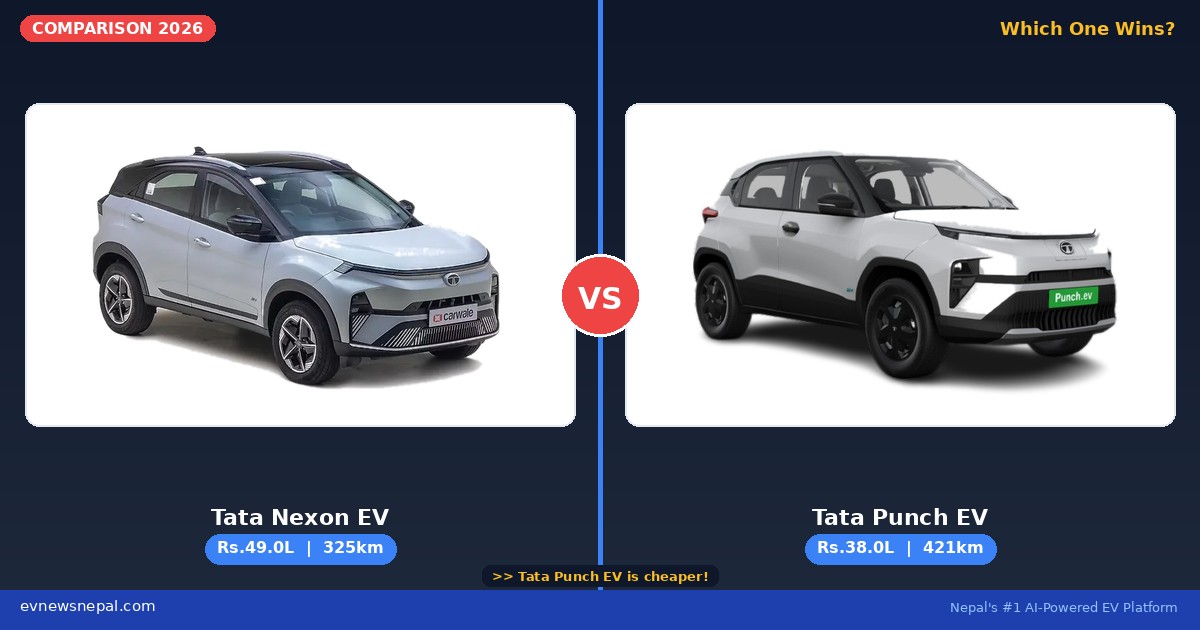
If you are choosing between the two most popular Tata EVs in Nepal, here is the short answer: the Punch EV wins on cabin tech and charging convenience, while the Nexon EV is the stronger pick for buyers who need higher ground clearance, V2L capability, and proven long-distance versatility. Both sit within a competitive price band — the Nexon EV Prime XM starts at Rs. 38,99,000, while the Punch EV Empowered+ S MR is priced at Rs. 34,99,000.
The Nexon EV has been a familiar face on Nepal's roads for years — trusted by families, fleet operators, and highway travellers who value a proven SUV platform with a wide service network. The Punch EV is the newer contender, arriving with a more feature-forward approach and a cabin that feels genuinely premium for its price point. On paper, the two vehicles are nearly identical in range, making the real differentiators the details: how they charge, how they handle Nepal's terrain, and what you get inside.
This comparison breaks down every meaningful difference to help you decide which one is right for your commute, your family, and Nepal's roads.
At a Glance
| Spec | Tata Nexon EV Prime XM | Tata Punch EV Empowered+ S MR |
|---|---|---|
| Price | Rs. 38,99,000 | Rs. 34,99,000 |
| Battery | 30 kWh | 25 kWh |
| Range (claimed) | 312 km (ARAI) | 315 km (ARAI) |
| Motor Power | 95 kW | 48 kW |
| Torque | 215 Nm | 114 Nm |
| Fast Charging | 0-80% in 60 min (50kW) | 10-80% in 50 min |
| Top Speed | 150 km/h | 140 km/h |
| Ground Clearance | 205 mm | 190 mm |
| V2L | Yes | No |
Price Breakdown
| Variant | Price | Battery | Range |
|---|---|---|---|
| Tata Nexon EV Prime XM | Rs. 38,99,000 | 30 kWh | 312 km |
| Tata Nexon EV Prime XZ+ | Rs. 40,99,000 | 30 kWh | 312 km |
| Tata Nexon EV XZ+ Dark Edition | Rs. 41,99,000 | 30 kWh | 312 km |
| Tata Nexon EV Prime XZ+ Lux | Rs. 42,99,000 | 30 kWh | 312 km |
| Tata Nexon EV XZ+ Lux Dark Edition | Rs. 43,99,000 | 30 kWh | 312 km |
| Tata Nexon EV K3 EV | Rs. 48,99,000 | 45 kWh | 325 km |
| Tata Nexon EV XZ+ Lux Max | Rs. 48,99,000 | 30 kWh | 453 km |
| Tata Punch EV Empowered+ S MR | Rs. 34,99,000 | 25 kWh | 315 km |
| Tata Punch EV Empowered LR | Rs. 37,99,000 | 35 kWh | 421 km |
| Tata Punch EV Empowered+ S LR | Rs. 39,99,000 | 35 kWh | 421 km |
Range: Real World vs Claimed
| Metric | Tata Nexon EV Prime XM | Tata Punch EV Empowered+ S MR |
|---|---|---|
| Claimed range | 312 km (ARAI) | 315 km (ARAI) |
| Est. real-world (Nepal, mixed) | ~255 km | ~258 km |
| Est. real-world (highway, hilly) | ~234 km | ~236 km |
The range gap between these two vehicles is negligible on paper — the Nexon EV Prime XM offers 312 km of ARAI-certified claimed range, while the Punch EV Empowered+ S MR claims 315 km. In practice, as the table above shows, both vehicles settle into a similar real-world band once Nepal's driving realities take effect.
Kathmandu valley traffic — with its constant elevation changes, stop-and-go congestion, and AC usage during warmer months — will consistently deliver numbers closer to the mixed estimate than the ARAI figure. Hilly highway runs toward Pokhara, Bandipur, or Dhulikhel push both vehicles toward the lower end of the range estimates in the table. For daily commuters covering 30–50 km, either vehicle offers a comfortable multi-day buffer between charges. The practical advice is simple: if your typical weekend trip extends beyond 200 km and includes significant gradient, plan your charging stops using the hilly-terrain estimates rather than the claimed figures.
Charging Speed and Monthly Cost
| Spec | Tata Nexon EV Prime XM | Tata Punch EV Empowered+ S MR |
|---|---|---|
| DC Fast Charge | 0-80% in 60 min (50kW) | 10-80% in 50 min |
| AC Home Charge | 0-100% in 8.5 hours (3.3kW) | 0-100% in 3.5 hours (7.2kW) |
| Full charge cost (home, Rs.11/kWh) | ~Rs. 330 | ~Rs. 275 |
| Est. monthly cost (30km/day) | ~Rs. 951/month | ~Rs. 785/month |
The most tangible real-world difference between these two vehicles is home charging speed. The Punch EV's 7.2kW AC onboard charger completes a full charge cycle in approximately 3.5 hours — a significant advantage for owners who cannot always charge overnight, or who need a mid-day top-up. The Nexon EV Prime XM's 3.3kW charger takes around 8.5 hours for a full charge, which is perfectly workable on an overnight schedule but offers less flexibility during the day.
For most Nepali households, overnight charging via NEA's grid remains the most practical and economical approach regardless of which vehicle you choose. At approximately Rs. 11/kWh, the monthly cost estimates in the table above illustrate how dramatically cheaper EV ownership is compared to petrol. Nepal's DC fast-charging network is expanding steadily along major corridors, and both vehicles support fast charging — refer to the table above for the specific figures. The charging infrastructure gap that once made long-distance EV travel nerve-wracking in Nepal is narrowing, making either vehicle a viable choice for buyers who travel beyond the valley.
Features Face-Off
| Feature | Tata Nexon EV Prime XM | Tata Punch EV Empowered+ S MR |
|---|---|---|
| Airbags | 2 | 6 |
| ABS + EBD + ESP + TCS | Yes | Yes |
| TPMS | Yes | Yes |
| ISOFIX | Yes | Yes |
| Hill Hold | Yes | Yes |
| Hill Descent Control | Yes | No |
| Auto Hold | No | Yes |
| AEB (Emergency Braking) | No | No |
| Adaptive Cruise Control | No | Standard |
| Lane Keep Assist | No | No |
| Blind Spot Detection | No | No |
| Rear Cross Traffic Alert | No | No |
| 360-degree Camera | No | Yes |
| Rear Camera | Yes | No |
| Parking Sensors | Rear | Front and Rear |
| Panoramic Sunroof | No | Electric sunroof |
| Heated/Ventilated Seats | No | Ventilated |
| Wireless Phone Charging | No | Yes |
| V2L (Vehicle-to-Load) | Yes | No |
| Touchscreen | 7-inch Touchscreen | 10.25-inch Touchscreen |
| Digital Instrument Cluster | Digital | 10.25-inch Digital |
| Apple CarPlay / Android Auto | Apple CarPlay + Android Auto | Wireless Apple CarPlay + Android Auto |
| Connected Car / App | No | No |
| Head-Up Display | No | No |
| Ambient Lighting | No | No |
| Sound System | 4-speaker | 6-speaker |
Compare side-by-side: Tata Nexon EV vs Tata Punch EV — full specs, features & price comparison tool.
The Punch EV takes a clear lead in the comfort and convenience category at this price point. Its larger infotainment display, wireless connectivity, and additional cabin amenities give it a noticeably more premium feel compared to the Nexon EV's XM variant, which keeps the feature set focused on essentials. Both vehicles deliver well in the core safety department — refer to the Features Face-Off table above for the complete breakdown of every passive and active safety item.
Where the two vehicles diverge most sharply is in their driver-assistance and active safety suites — the Punch EV's offering in this category is notably more comprehensive, while the Nexon EV balances its feature set with the practically useful V2L function and Hill Descent Control. For buyers making a decision based on features, it is worth reading through the full table above carefully: the right choice depends on whether you prioritise technology and comfort, or utility and terrain capability.
How Much Will You Save Going Electric?
Use our free EV vs Petrol Cost Calculator to compare total cost of ownership.
Explore these vehicles:
Pros and Cons
Tata Nexon EV
Pros:
- V2L (Vehicle-to-Load) capability — power appliances and devices directly from the battery, invaluable during Nepal's load-shedding episodes
- Higher ground clearance at 205 mm — more confidence on rough rural roads and uneven urban surfaces
- Larger SUV footprint with more interior space — practical for families and luggage-heavy trips
- Hill Descent Control for safer navigation on steep mountain roads
- Established platform with a well-developed service and support network across Nepal
- Wider variant lineup offering multiple entry points across different budgets
Cons:
- Slower AC home charging at 3.3kW — full charge takes approximately 8.5 hours, less convenient for mid-day top-ups
- Entry XM variant's interior is more utilitarian — fewer comfort and tech features compared to the Punch EV at a similar price
- Slightly higher estimated monthly running cost due to larger battery draw per kilometre
Tata Punch EV
Pros:
- Notably feature-rich cabin for the price — larger touchscreen, wireless connectivity, and comfort-focused amenities
- Fast AC home charging at 7.2kW — full charge in approximately 3.5 hours, significantly more flexible
- More comprehensive driver-assistance and active safety suite at this tier
- Strong passive safety specification with a higher airbag count across the cabin
- Lower estimated monthly running costs (see Charging table above)
- Modern, tech-forward interior that feels premium relative to its price point
Cons:
- No V2L support — cannot power external appliances or act as a backup power source
- Lower ground clearance at 190 mm — less ideal for rough terrain or heavy monsoon flooding
- Smaller overall footprint may feel constraining for larger families or on longer road trips requiring significant luggage space
Our Verdict: Which Should You Buy?
Which Should You Buy?
Choose the Tata Nexon EV if your life regularly takes you beyond the Kathmandu valley — whether for weekend trips on hilly roads, travel to rural destinations, or simply routes where road quality is unpredictable. The higher ground clearance, Hill Descent Control, and V2L capability make it the more versatile all-rounder. It is also the better choice if interior space and a spacious boot are non-negotiable for your family.
Choose the Tata Punch EV if you are primarily a city commuter who wants the most feature-packed EV experience for the price. The faster home charging, more advanced driver-assistance package, and tech-rich cabin make it exceptional value for urban buyers — particularly those upgrading from a hatchback or compact car who want a modern EV that does not feel like a compromise.
For pure value in daily Kathmandu use, the Punch EV is difficult to beat. But if versatility across Nepal's diverse terrain matters to you — or if having a V2L backup during power cuts is genuinely useful — the Nexon EV justifies every extra rupee. Both are excellent EVs. The right choice is simply the one that matches how you actually drive.
Frequently Asked Questions
Q: What is the price of Tata Nexon EV in Nepal?
A: The Tata Nexon EV starts at Rs. 38,99,000 for the Prime XM variant in Nepal. Multiple variants are available at different price points — visit the full Nexon EV price page on EVNewsNepal for the complete lineup and the most current pricing.
Q: What is the price of Tata Punch EV in Nepal?
A: The Tata Punch EV is priced at Rs. 34,99,000 for the Empowered+ S MR variant in Nepal. For all available variants and up-to-date pricing, check the Tata Punch EV price page.
Q: Which has better real-world range in Nepal — Nexon EV or Punch EV?
A: Both vehicles deliver comparable real-world range in Nepal's mixed driving conditions. The Nexon EV Prime XM claims 312 km and the Punch EV Empowered+ S MR claims 315 km under ARAI testing. In real-world Nepal conditions — accounting for hilly terrain, traffic, and AC usage — both vehicles settle into a similar band. See the Range table in this article for detailed estimates by driving scenario.
Q: Which Tata EV charges faster at home in Nepal?
A: The Tata Punch EV charges significantly faster at home, completing a full charge in approximately 3.5 hours using its 7.2kW AC onboard charger. The Tata Nexon EV Prime XM uses a 3.3kW charger and takes around 8.5 hours for a full charge. For most owners using NEA home supply overnight, both are practical — but the Punch EV offers much greater flexibility for daytime or quick top-up charging.
Q: Does the Tata Nexon EV support V2L (Vehicle-to-Load) in Nepal?
A: Yes. The Tata Nexon EV supports V2L (Vehicle-to-Load), allowing you to run appliances, charge devices, or power tools directly from the vehicle's battery. This is a genuinely useful feature in Nepal given occasional load-shedding. The Tata Punch EV does not currently offer V2L in the variants available in Nepal — refer to the At a Glance table in this article for a direct comparison.
Q: Which Tata EV is better for Nepal's hilly terrain and rough roads?
A: The Tata Nexon EV has the edge for hilly and rough terrain. It offers 205 mm of ground clearance versus 190 mm on the Punch EV, and includes Hill Descent Control for safer navigation on steep descents. Both vehicles feature Hill Hold assist. For regular travel on mountain routes, rural roads, or areas with poor road surfaces, the Nexon EV's additional clearance and descent control provide meaningful real-world confidence.