Key Takeaways
- Honda Elevate facelift starts at Rs 11.80 lakh in India (ex-showroom), unchanged from the old model
- Top ZX+ Black CVT costs Rs 18.40 lakh, about Rs 1.94 lakh more than before
- New 10.25-inch screen, 360-degree camera, ventilated seats and 8-way power driver seat
- Engine is unchanged: 1.5-litre petrol, 121 PS, manual or CVT, with no hybrid
- Nepal prices are far higher than India's because of duties, so EVs can be much cheaper to buy and run
Honda has launched the Elevate facelift in India with prices starting at Rs 11.80 lakh (ex-showroom, Indian rupees). That entry price is unchanged from the outgoing model. The new top-spec ZX+ Black CVT goes up to Rs 18.40 lakh, about Rs 1.94 lakh more than the old top variant. The update was announced on October 6, 2026.
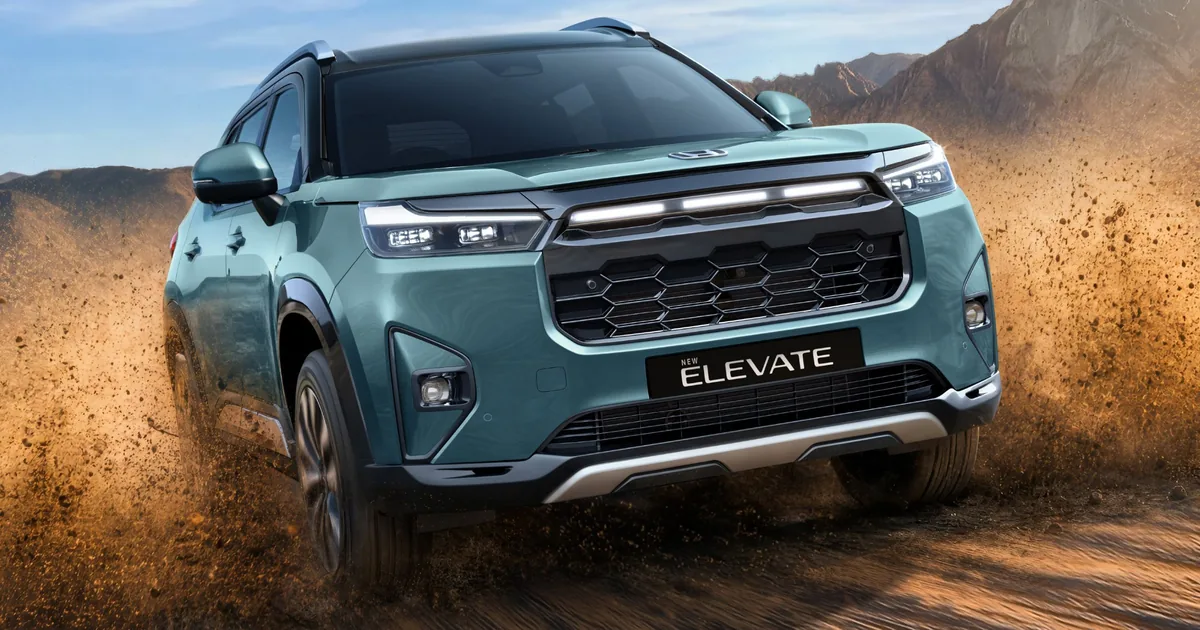
This is a facelift, not a new generation. Honda has kept the 1.5-litre petrol engine and has ruled out a hybrid for now. The money goes into design, comfort and technology: a new front end, a larger touchscreen, ventilated seats and a 360-degree camera.
The Elevate is already sold in Nepal through Honda's distributor, so this launch matters to Nepali buyers too. Note that the Rs 11.80 lakh figure is an Indian ex-showroom price. It is not what you will pay in Kathmandu, where import duties and taxes change the number completely.
Key Highlights
- Starting price: Rs 11.80 lakh in India (ex-showroom), unchanged from before
- Top price: Rs 18.40 lakh for the ZX+ Black CVT, up by about Rs 1.94 lakh
- Trims: SV, V, VX, ZX and the new ZX+, with a Black Edition of the ZX+
- Engine: the same 1.5-litre i-VTEC petrol, 121 PS and 145 Nm
- Gearbox: 6-speed manual or CVT
- New features: 10.25-inch touchscreen, wireless Apple CarPlay and Android Auto, 360-degree camera, ventilated front and rear seats, leather upholstery, 8-way power driver seat
- New colour: Nordic Forest Pearl
- No hybrid or EV version is planned for this update
Detailed Analysis
What changed outside
The facelift keeps the Elevate's boxy, upright SUV shape but sharpens the front and rear:
- A segmented LED DRL strip above the grille
- A new mesh-style grille
- An LED light bar joining the tail-lamps at the rear
- A new Nordic Forest Pearl paint option
- Black Edition styling on the top ZX+ trim
Reports differ on the wheels. Some say the alloy design is unchanged, while others describe new 17-inch diamond-cut alloys. Check the car in person before you decide.
What changed inside
The cabin gets the biggest upgrade. It now uses a dual-tone ivory and black theme. Upper trims add leather upholstery, ventilated front and rear seats and an eight-way power-adjustable driver's seat. In Kathmandu's summer heat and dusty traffic, ventilated seats are a real comfort feature.
The infotainment screen is now 10.25 inches, with wireless Apple CarPlay and Android Auto. The 360-degree surround-view camera helps in tight parking spots and narrow lanes, which are common in the valley.
Engine and drive
The powertrain has not changed:
| Spec | Honda Elevate (facelift) |
|---|---|
| Engine | 1.5-litre i-VTEC petrol |
| Power | 121 PS |
| Torque | 145 Nm |
| Gearbox | 6-speed manual or CVT |
| Hybrid option | Not offered |
The 1.5-litre engine is smooth and easy to live with. It is not a torque-heavy motor, though. On steep climbs such as the roads out of Kathmandu towards Dhunche or Pokhara, a full load will make you work the engine harder than an electric SUV would.
Pricing in India
| Item | Price (India, ex-showroom) |
|---|---|
| Entry price | Rs 11.80 lakh |
| Top ZX+ Black CVT | Rs 18.40 lakh |
| Change at the top end | About Rs 1.94 lakh higher |
Pro tip: Indian prices are in Indian rupees and exclude Nepal's customs duty, excise and VAT. Never compare them directly with a Nepali showroom price in Nepalese rupees.
The Nepal price picture
The Elevate is sold in Nepal by Syakar Trading Company through authorised dealers. Launch reports put the starting price at about Rs. 56,35,000. More recent third-party listings show it from around Rs. 62,54,000, with top variants above Rs. 80,00,000. These figures are not official price lists and they change often, so confirm with the dealer. You can also check the Honda Elevate price in Nepal page for current numbers.
A car that costs under Rs 12 lakh in India can cost five times that in Nepal. That gap is the main reason buyers here are now looking carefully at electric alternatives.
Impact on Nepal EV Market
The Elevate facelift is a petrol SUV, so it competes with EVs only indirectly. It still shapes the market in three ways.
1. It highlights the duty gap. Petrol cars pay heavy import duty in Nepal. Electric vehicles pay much lower duty, which is why many EVs cost less than a petrol compact SUV like the Elevate.
2. It sets a feature benchmark. Ventilated seats, a 360-degree camera and a 10.25-inch screen were once reserved for expensive cars. If a mainstream petrol SUV offers them, EV makers will need to match them at lower prices.
3. Running costs favour EVs. Home charging in Nepal costs about Rs. 10-12 per kWh. That works out to roughly Rs. 0.70-0.80 per km, compared with a much higher per-km cost for petrol. A typical 30-40 km daily commute costs about Rs. 1,000-2,000 per month to charge.
Here is how some listed EVs compare in price and range. They are smaller city cars, so this is a budget comparison and not a like-for-like one with the Elevate:
| EV | Price | Battery | Claimed range |
|---|---|---|---|
| MG Comet Pace | Rs. 18,75,000 | 17.3 kWh | 230 km |
| Seres E1 Mid | Rs. 16,49,000 | 13.8 kWh | 180 km |
| Henrey Mincar | Rs. 19,95,000 | 16.5 kWh | 205 km |
These EVs are four-seat city cars, not family SUVs. They suit Kathmandu valley commuting, but a petrol SUV like the Elevate still wins for five people, luggage and long highway trips. If you want an SUV-sized EV, look at the larger models on the Compare EVs page.
Who should still consider the Elevate?
- Buyers who regularly drive long distances where charging stations are few
- Families who want a five-seat SUV with decent ground clearance
- Anyone who wants a manual gearbox option
Who should look at EVs instead?
- City commuters who drive under 60 km a day and can charge at home
- Buyers who want the lowest running cost
- Buyers who want to avoid petrol price swings
If budget is tight, the Used EVs section is also worth a look.
What to Expect Next
Nepal launch timing. Honda has not announced a date for the facelift in Nepal. Based on how earlier updates reached the market, expect a gap of a few months after India. Treat this as an estimate, not a confirmed schedule.
Pricing. Because the Nepal price is built on top of Indian pricing plus duties, the top-end increase of about Rs 1.94 lakh in India is likely to push Nepal's top variants higher as well. Entry variants may stay closer to current prices.
Powertrain. Honda has said no hybrid is planned for this update. If you want electrified driving in this size of car, the EV market is where the choice will come from.
EV competition. More SUV-sized EVs are lined up for Nepal. Models such as the Tata Sierra EV, with a 75 kWh battery and a brand-claimed range of 665 km, show where the market is heading. The Sierra EV was shown at the NADA Auto Show 2026, and pre-bookings are open with deliveries expected around Dashain. Prices have not been announced.
If you are deciding between petrol and electric, wait for official Nepal pricing on the facelift and compare it with the EVs you are considering.
Explore All EVs Available in Nepal
Compare 200+ electric vehicles with real-time prices, specs, and features.
Frequently Asked Questions
Q: What is the price of the Honda Elevate facelift?
A: In India, the Honda Elevate facelift starts at Rs 11.80 lakh ex-showroom (Indian rupees) and goes up to Rs 18.40 lakh for the ZX+ Black CVT. Nepal prices are much higher because of import duties and taxes. Recent third-party listings show Nepal prices from around Rs. 62,54,000, but you should confirm with the authorised dealer.
Q: What engine does the Honda Elevate facelift use?
A: It uses the same 1.5-litre i-VTEC petrol engine as before, producing 121 PS and 145 Nm. You can choose a 6-speed manual or a CVT automatic. There is no hybrid or electric version in this update.
Q: What new features does the Elevate facelift get?
A: The facelift adds a 10.25-inch touchscreen with wireless Apple CarPlay and Android Auto, a 360-degree camera, ventilated front and rear seats, leather upholstery and an eight-way power driver's seat. The exterior gets a new grille, an LED DRL strip and an LED light bar at the rear.
Q: Is an electric car cheaper to run than the Honda Elevate in Nepal?
A: Yes, in most cases. Home charging costs about Rs. 10-12 per kWh, which works out to roughly Rs. 0.70-0.80 per km. A typical 30-40 km daily commute costs about Rs. 1,000-2,000 per month to charge. A petrol SUV costs noticeably more per km, though an EV only makes sense if you can charge at home or work.
Q: When will the Elevate facelift arrive in Nepal?
A: Honda has not confirmed a Nepal launch date for the facelift. Earlier updates reached Nepal some months after India, so expect a delay, but check with the authorised distributor for the latest information.