Tata Tiago EV vs Tata Punch EV: Best Budget EV in Nepal? (2025 Comparison)
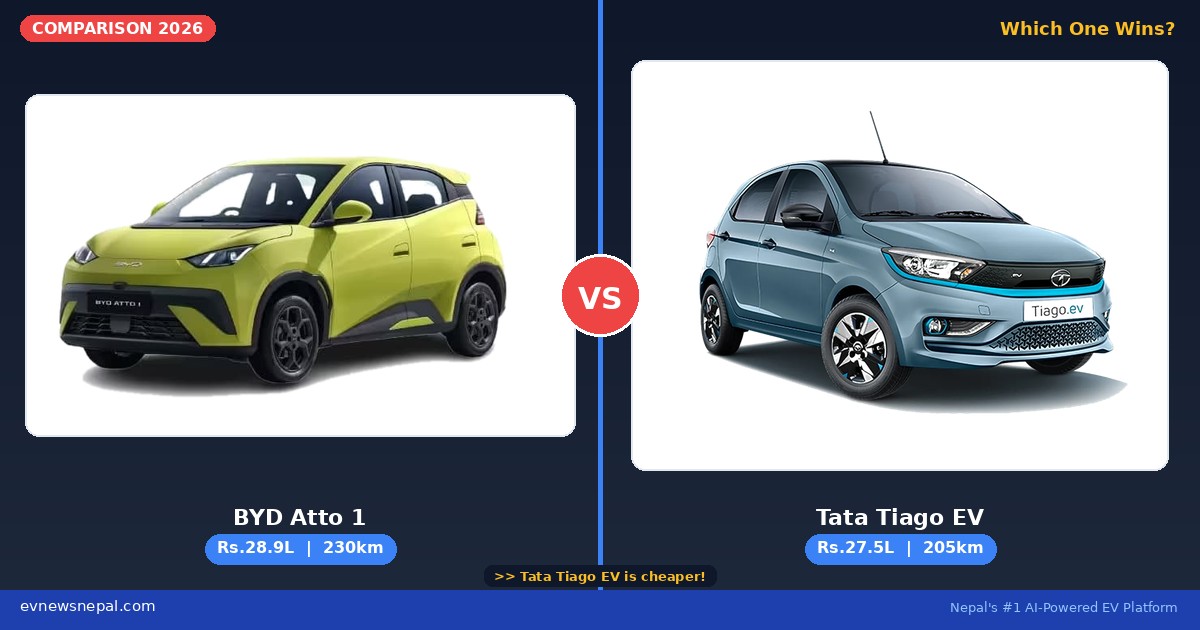
Quick Comparison
- Tiago EV starts at {{vehicle:tata-tiago-ev-xt:formattedPrice}} — Nepal's most affordable EV entry point for city commuters
- Punch EV offers {{vehicle:tata-punch-ev-empowered-s-mr:range.claimed}} claimed range vs Tiago EV's {{vehicle:tata-tiago-ev-xt:range.claimed}} — a meaningful gap for intercity travel
- Punch EV leads in safety features, airbag count, and cabin comfort; refer to the Features Face-Off table for the full comparison
- Both support 7.2kW home charging — full charge costs under Rs. 300 at NEA's domestic electricity rate
- Choose Tiago EV for the lowest-cost urban commute; choose Punch EV for more range, safety, and features
If budget is your top priority, the Tata Tiago EV — starting at Rs. 27,49,000 — is Nepal's most accessible entry into electric driving; but if you want more range, more cabin, and a more rounded feature set, the Tata Punch EV Empowered+ S MR at Rs. 34,99,000 is worth the stretch.
Both are Tata EVs, both target practical Nepali buyers, and both run on the same proven platform — but they serve different needs. The Tiago EV pairs a 24 kWh battery and 315 km of claimed range with a city-sized footprint, making it purpose-built for Kathmandu valley commuting. The Punch EV steps up with a larger battery, 315 km of claimed range, and a more feature-loaded cabin — at a meaningfully higher price.
The decision ultimately comes down to three things: how far you drive daily, how much cabin space and features matter to you, and how you weigh upfront cost against long-term capability. The breakdown below will make that call straightforward.
At a Glance
| Spec | Tata Tiago EV XT | Tata Punch EV Empowered+ S MR |
|---|---|---|
| Price | Rs. 27,49,000 | Rs. 34,99,000 |
| Battery | 24 kWh | 25 kWh |
| Range (claimed) | 315 km (MIDC) | 315 km (ARAI) |
| Motor Power | 55 kW | 48 kW |
| Torque | 114 Nm | 114 Nm |
| Fast Charging | 10-80% in 58 min (25kW) | 10-80% in 50 min |
| Top Speed | 120 km/h | 140 km/h |
| Ground Clearance | 166 mm | 190 mm |
| V2L | No | No |
Price Breakdown
| Variant | Price | Battery | Range |
|---|---|---|---|
| Tata Tiago EV XT | Rs. 27,49,000 | 24 kWh | 315 km |
| Tata Tiago EV XZ+ Tech Lux | Rs. 29,99,000 | 24 kWh | 315 km |
| Tata Punch EV Empowered+ S MR | Rs. 34,99,000 | 25 kWh | 315 km |
| Tata Punch EV Empowered LR | Rs. 37,99,000 | 35 kWh | 421 km |
| Tata Punch EV Empowered+ S LR | Rs. 39,99,000 | 35 kWh | 421 km |
Range: Real World vs Claimed
| Metric | Tata Tiago EV XT | Tata Punch EV Empowered+ S MR |
|---|---|---|
| Claimed range | 205 km (MIDC) | 315 km (ARAI) |
| Est. real-world (Nepal, mixed) | ~168 km | ~258 km |
| Est. real-world (highway, hilly) | ~153 km | ~236 km |
The range gap between these two is significant — and it matters more in Nepal than it would on flat Indian highways. The Tiago EV XT offers 315 km of claimed range under MIDC testing, while the Punch EV Empowered+ S MR claims 315 km under the more optimistic ARAI cycle. As the table above shows, both figures drop noticeably under real-world Nepal conditions.
Routes like Koteshwar–Bhaktapur, Balaju–Budhanilkantha, or any drive beyond the ring road involve sustained climbing that drains batteries faster than flat-road estimates suggest. Factor in AC use during pre-monsoon heat or headlights through monsoon fog, and real-world range settles closer to the mixed-condition estimates listed above. For commuters staying within the valley — typically 30–50 km per day — both vehicles are more than adequate. For intercity trips to Pokhara, Chitwan, or hilly districts, the Punch EV's larger range buffer provides meaningful reassurance.
Charging Speed and Monthly Cost
| Spec | Tata Tiago EV XT | Tata Punch EV Empowered+ S MR |
|---|---|---|
| DC Fast Charge | 10-80% in 58 min (25kW) | 10-80% in 50 min |
| AC Home Charge | 10-100% in 3.6 hours (7.2kW) | 0-100% in 3.5 hours (7.2kW) |
| Full charge cost (home, Rs.11/kWh) | ~Rs. 211 | ~Rs. 275 |
| Est. monthly cost (30km/day) | ~Rs. 927/month | ~Rs. 785/month |
Both vehicles support 7.2kW AC home charging, which for most Nepali buyers is the only charging setup they'll ever need. An overnight plug-in tops either car up comfortably, and the per-charge cost at NEA's domestic rate keeps monthly fuel bills remarkably low — as the table above illustrates. For urban commuters, the practical difference in charging experience between the two cars is minimal.
Public DC fast charging infrastructure in Nepal is expanding but remains concentrated around Kathmandu, with select stations on the Prithvi and BP highways. On this front, the Punch EV's faster DC charging gives it a practical edge for anyone planning intercity travel and relying on public chargers en route. That said, the majority of Nepali EV owners charge exclusively at home, where both vehicles deliver a very similar and cost-effective experience.
Features Face-Off
| Feature | Tata Tiago EV XT | Tata Punch EV Empowered+ S MR |
|---|---|---|
| Airbags | 2 | 6 |
| ABS + EBD + ESP + TCS | Yes | Yes |
| TPMS | No | Yes |
| ISOFIX | Yes | Yes |
| Hill Hold | Yes | Yes |
| Hill Descent Control | No | No |
| Auto Hold | No | Yes |
| AEB (Emergency Braking) | No | No |
| Adaptive Cruise Control | No | Standard |
| Lane Keep Assist | No | No |
| Blind Spot Detection | No | No |
| Rear Cross Traffic Alert | No | No |
| 360-degree Camera | No | Yes |
| Rear Camera | Yes | No |
| Parking Sensors | Rear | Front and Rear |
| Panoramic Sunroof | No | Electric sunroof |
| Heated/Ventilated Seats | No | Ventilated |
| Wireless Phone Charging | No | Yes |
| V2L (Vehicle-to-Load) | No | No |
| Touchscreen | 7-inch Touchscreen | 10.25-inch Touchscreen |
| Digital Instrument Cluster | Digital | 10.25-inch Digital |
| Apple CarPlay / Android Auto | Apple CarPlay + Android Auto | Wireless Apple CarPlay + Android Auto |
| Connected Car / App | Yes | No |
| Head-Up Display | No | No |
| Ambient Lighting | No | No |
| Sound System | 4-speaker | 6-speaker |
Compare side-by-side: Tata Tiago EV vs Tata Punch EV — full specs, features & price comparison tool.
The features gap between these two vehicles is wider than the price gap alone might suggest. In the safety category, the Punch EV carries a substantially stronger suite — including more airbags and broader active safety coverage — which the Features Face-Off table above breaks down in full. For buyers with families or those frequently travelling outside controlled urban environments, that difference carries real weight.
In comfort and cabin technology, the Punch EV again leads across multiple categories — infotainment screen size, connectivity options, and seat comfort features all step up meaningfully. The Tiago EV holds its own in the essentials: it offers solid smartphone integration and connected car functionality that some higher variants of the Punch EV do not match. For a complete side-by-side view across safety, ADAS, comfort, and tech, refer to the Features Face-Off table above — it tells the full story by category.
How Much Will You Save Going Electric?
Use our free EV vs Petrol Cost Calculator to compare total cost of ownership.
Explore these vehicles:
Pros and Cons
Tata Tiago EV
Pros:
- Most affordable EV in Nepal, starting at Rs. 27,49,000 — lowest barrier to EV ownership
- Compact dimensions navigate Kathmandu's narrow lanes and tight parking with ease
- Very low per-charge cost at home using NEA domestic electricity rates
- Connected car app support for remote monitoring and vehicle control
- CarPlay and Android Auto for seamless daily smartphone use
- Ideal monthly running costs for short-range valley commuters
Cons:
- Smaller 24 kWh battery limits flexibility for intercity or hilly routes
- Safety and comfort feature set is more basic relative to the Punch EV — see the Features table for the full comparison
- 315 km claimed range requires planning on longer or hillier drives
- Lower ground clearance (166 mm) is less suited to rough roads outside the valley
Tata Punch EV
Pros:
- Larger 25 kWh battery with 315 km claimed range for genuine intercity confidence
- 190 mm ground clearance handles Nepal's uneven roads and light rough terrain comfortably
- Stronger safety suite with more airbags and a broader set of active safety features
- More premium cabin experience — larger infotainment screen, wireless connectivity, and enhanced comfort features
- Better overall ADAS and convenience package; refer to the Features table for the complete breakdown
- SUV-like stance and greater road presence for buyers wanting something more substantial
Cons:
- Significantly higher upfront cost compared to the Tiago EV
- Larger footprint can feel less agile navigating tight city streets and Kathmandu parking
- Higher per-charge cost, though still far more economical than an equivalent petrol vehicle
- Connected car app functionality differs from what the Tiago EV offers — refer to the Features table for details
Our Verdict: Which Should You Buy?
Choose the Tata Tiago EV if you're a first-time EV buyer commuting within Kathmandu valley, keeping daily distances comfortably within 315 km, and want the lowest possible entry cost into electric driving. It delivers everything an urban commuter needs — low running costs, easy home charging, and a city-friendly size — without the premium you'd pay for features you may not use.
Choose the Tata Punch EV Empowered+ S MR if you want genuine range confidence, a stronger safety spec, and a more complete cabin package. Its 315 km claimed range, higher ground clearance, and broader feature set make it the better fit for buyers who occasionally venture beyond the valley or simply want fewer compromises in their daily driver.
Neither choice is wrong — they're designed for different buyers. The Tiago EV is Nepal's gateway EV: simple, affordable, and effective. The Punch EV is a step up across nearly every dimension. Match the car to your actual driving life, and you'll get excellent value from whichever you choose.
Frequently Asked Questions
Q: What is the price of Tata Tiago EV in Nepal?
A: The Tata Tiago EV XT is priced at Rs. 27,49,000 in Nepal, making it one of the most affordable EVs available in the country. The top variant, Tata Tiago EV XZ+ Tech Lux, is priced at Rs. 29,99,000. Prices may vary — check with authorized dealers or evnewsnepal.com for the latest confirmed pricing.
Q: What is the price of Tata Punch EV in Nepal?
A: The Tata Punch EV Empowered+ S MR is priced at Rs. 34,99,000 in Nepal. Other variants include the Empowered LR at Rs. 37,99,000 and the Empowered+ S LR at Rs. 39,99,000. Visit evnewsnepal.com for up-to-date pricing.
Q: Which has better real-world range in Nepal — the Tiago EV or Punch EV?
A: The Punch EV Empowered+ S MR claims 315 km (ARAI) versus the Tiago EV XT's 315 km (MIDC). In real-world Nepal conditions — accounting for hilly terrain, AC usage, and mixed driving — both figures come down. Estimated real-world mixed range figures for both variants are listed in the Range table in this article. For most Kathmandu valley commutes, both are sufficient; for intercity or hilly routes, the Punch EV's larger buffer is a clear advantage.
Q: How much does it cost to charge the Tiago EV and Punch EV at home in Nepal?
A: At NEA's current domestic electricity rate of approximately Rs. 11/kWh, a full home charge of the Tiago EV XT costs around Rs. 211, while the Punch EV Empowered+ S MR costs around Rs. 275. For a commuter driving 30 km per day, estimated monthly electricity costs are well under Rs. 1,000 for both — significantly cheaper than an equivalent petrol vehicle. Use our EV vs Petrol Cost Calculator to model your own savings.
Q: Is the Tata Punch EV better than the Tiago EV for Nepal's roads?
A: The Punch EV has a ground clearance of 190 mm versus the Tiago EV's 166 mm, giving it a practical edge on the uneven, potholed, or unpaved roads common outside Kathmandu. Its larger range also makes it more viable for intercity travel. The Tiago EV is purpose-built for city use and handles Kathmandu's urban roads very well — but buyers regularly venturing outside the valley will find the Punch EV a more versatile choice.
Q: Which is better value for money in Nepal — Tiago EV or Punch EV?
A: The Tiago EV offers the lowest cost of entry into EV ownership in Nepal and delivers excellent value for daily city commuting. The Punch EV costs more upfront but offers more range, a stronger safety spec, and a more feature-rich cabin — making it better value if you need those capabilities. The right answer depends on your daily use case and budget. Use our EMI Calculator and EV vs Petrol Cost Calculator to compare total cost of ownership for your specific situation.