KIA EV6 vs Hyundai IONIQ 5: Which Premium EV Should You Buy in Nepal? (2025-26)
Quick Comparison
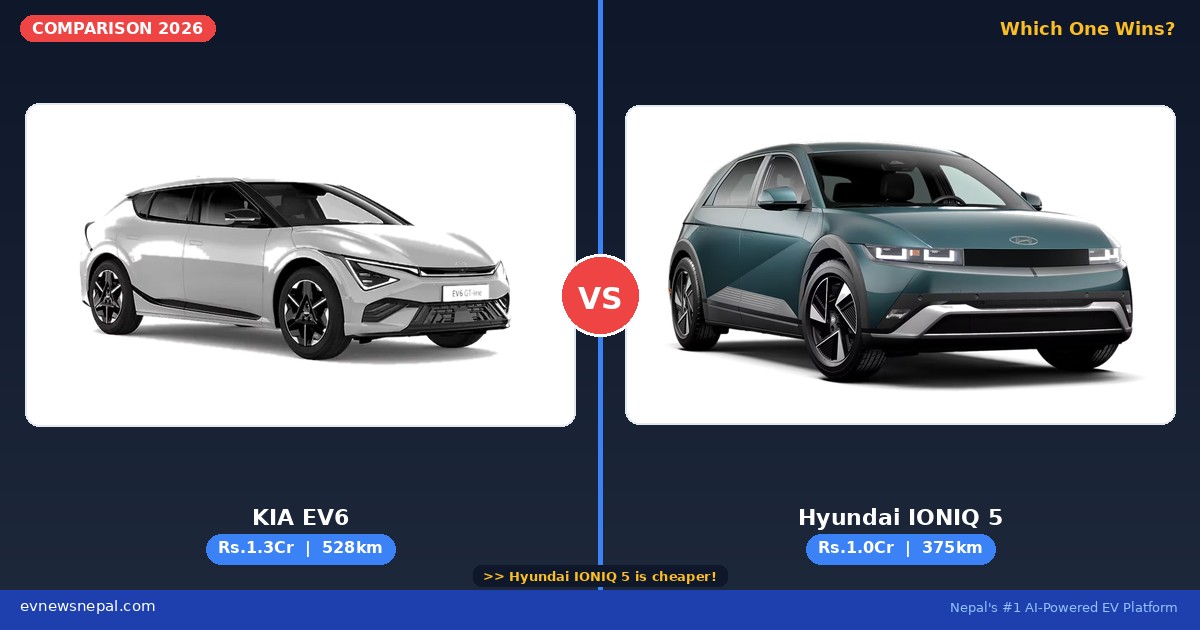
- The KIA EV6 offers substantially more claimed WLTP range than the IONIQ 5 Vision Roof, making it the stronger choice for inter-city and mountain driving in Nepal
- Both cars share Hyundai-Kia's E-GMP platform with 350kW ultra-fast DC charging (10–80% in ~18 min) and V2L capability as standard
- The Hyundai IONIQ 5 Vision Roof charges faster on AC at home (11kW vs 7.4kW) and has a lower starting price, with the Sun Roof variant offering even greater savings
- The KIA EV6 leads on tech with a head-up display, connected car app, and a premium Meridian 14-speaker audio system
- Monthly electricity running costs at Nepal's NEA rate are remarkably similar between both vehicles, with both offering far lower per-km costs than petrol equivalents
If you are deciding between Nepal's two most compelling premium EVs, the KIA EV6 is the stronger pick for range and performance, while the Hyundai IONIQ 5 Vision Roof makes a persuasive case for buyers who want the same cutting-edge E-GMP platform at a lower entry price. The EV6 starts at Rs. 1,25,90,000 versus the IONIQ 5 Vision Roof at Rs. 92,96,000 — and that difference reflects genuine distinctions in range, power output, and onboard technology rather than mere badge value.
Both cars are built on Hyundai-Kia's acclaimed E-GMP skateboard platform, which delivers ultra-fast 350kW DC charging, a completely flat cabin floor, and Vehicle-to-Load (V2L) functionality as standard. From that shared foundation, however, the two take meaningfully different paths: the EV6 pursues a sportier, more tech-forward identity with a coupe-SUV silhouette, while the IONIQ 5 leans into retro-futuristic design and maximum interior practicality. For Nepali buyers, the decision ultimately hinges on three things — how far you need to drive between charges, how you plan to charge at home, and which design philosophy fits your daily life.
At a Glance
| Spec | KIA EV6 | Hyundai IONIQ 5 Vision Roof |
|---|---|---|
| Price | Rs. 1,25,90,000 | Rs. 92,96,000 |
| Battery | 77.4 kWh | 58 kWh |
| Range (claimed) | 528 km (WLTP) | 400 km (WLTP) |
| Motor Power | 478 kW | 100 kW |
| Torque | 605 Nm | 350 Nm |
| Fast Charging | 10-80% in 18 min (350kW) | 10-80% in 18 min (350kW) |
| Top Speed | 185 km/h | 185 km/h |
| Ground Clearance | 155 mm | 160 mm |
| V2L | Yes | Yes |
Price Breakdown
| Variant | Price | Battery | Range |
|---|---|---|---|
| KIA EV6 | Rs. 1,25,90,000 | 77.4 kWh | 528 km |
| Hyundai IONIQ 5 Vision Roof | Rs. 92,96,000 | 58 kWh | 400 km |
| Hyundai IONIQ 5 Sun Roof | Rs. 1,02,00,000 | 58 kWh | 375 km |
Range: Real World vs Claimed
| Metric | KIA EV6 | Hyundai IONIQ 5 Vision Roof |
|---|---|---|
| Claimed range | 528 km (WLTP) | 400 km (WLTP) |
| Est. real-world (Nepal, mixed) | ~432 km | ~328 km |
| Est. real-world (highway, hilly) | ~396 km | ~300 km |
The EV6's 528 km of WLTP-claimed range is one of the most important numbers in this comparison. It means a Kathmandu-to-Pokhara return journey — roughly 400 km round trip — becomes realistically achievable on a single charge under favourable conditions. Even in Nepal's real-world mix of valley commuting, sustained hill climbs, and regular AC use, the estimated figures in the Range table above show the EV6 retaining a meaningful buffer over the IONIQ 5.
The IONIQ 5 Vision Roof's 400 km of claimed range is more than adequate for the daily rhythms of Kathmandu valley life, where most commutes are well under 50 km. But drivers who regularly tackle Nepal's longer mountain highways should plan their charging stops carefully. Nepal's hilly terrain places consistent uphill loads on the battery, and monsoon humidity combined with heavy AC use can trim real-world range by 15–20% from WLTP figures — a factor that applies to both vehicles, but one where the EV6's larger battery capacity gives it a more comfortable cushion.
Charging Speed and Monthly Cost
| Spec | KIA EV6 | Hyundai IONIQ 5 Vision Roof |
|---|---|---|
| DC Fast Charge | 10-80% in 18 min (350kW) | 10-80% in 18 min (350kW) |
| AC Home Charge | 0-100% in 11 hours (7.4kW) | 0-100% in 7 hours (11kW) |
| Full charge cost (home, Rs.11/kWh) | ~Rs. 851 | ~Rs. 638 |
| Est. monthly cost (30km/day) | ~Rs. 1451/month | ~Rs. 1435/month |
Both the EV6 and IONIQ 5 Vision Roof support 350kW DC ultra-fast charging — an impressive specification that puts them among the fastest-charging EVs available anywhere in the world. At a compatible public station, a 10–80% charge in approximately 18 minutes is genuinely useful for longer inter-city trips, and Nepal's fast-charging network is steadily expanding along key routes. For day-to-day ownership, though, home charging on AC remains the primary method for most buyers, and this is where the two cars diverge.
The IONIQ 5 Vision Roof's 11kW onboard AC charger completes a full charge in around 7 hours, making it the more flexible option for owners who charge during the day or want a faster overnight top-up. The EV6's 7.4kW charger takes approximately 11 hours for a full charge — still comfortably completed overnight for most, but worth considering if your charging window is shorter. On monthly running costs, both vehicles are remarkably close at Nepal's NEA electricity rate of Rs. 11/kWh, as the Charging table above illustrates — EVs remain far cheaper to run per kilometre than any petrol alternative.
Features Face-Off
| Feature | KIA EV6 | Hyundai IONIQ 5 Vision Roof |
|---|---|---|
| Airbags | 8 | 6 |
| ABS + EBD + ESP + TCS | Yes | Yes |
| TPMS | Yes | Yes |
| ISOFIX | Yes | Yes |
| Hill Hold | Yes | Yes |
| Hill Descent Control | No | No |
| Auto Hold | No | Yes |
| AEB (Emergency Braking) | Yes | Yes |
| Adaptive Cruise Control | Adaptive Cruise Control (ACC) with Stop & Go | Adaptive Cruise Control (ACC) with Stop & Go |
| Lane Keep Assist | LKA | LKA |
| Blind Spot Detection | Yes | Yes |
| Rear Cross Traffic Alert | No | No |
| 360-degree Camera | Yes | Yes |
| Rear Camera | No | No |
| Parking Sensors | Front and Rear | Front and Rear |
| Panoramic Sunroof | Panoramic sunroof | Panoramic sunroof |
| Heated/Ventilated Seats | Heated + Ventilated | Heated + Ventilated |
| Wireless Phone Charging | Yes | Yes |
| V2L (Vehicle-to-Load) | Yes | Yes |
| Touchscreen | 12.3-inch Touchscreen | 12.3-inch Touchscreen |
| Digital Instrument Cluster | 12.3-inch Digital | 12.3-inch Digital |
| Apple CarPlay / Android Auto | Wireless Apple CarPlay + Android Auto | Wireless Apple CarPlay + Android Auto |
| Connected Car / App | Yes | No |
| Head-Up Display | Yes | No |
| Ambient Lighting | Yes | Yes |
| Sound System | Meridian 14-speaker | BOSE 8-speaker |
Compare side-by-side: KIA EV6 vs Hyundai IONIQ 5 — full specs, features & price comparison tool.
Both the EV6 and IONIQ 5 Vision Roof arrive in Nepal with thorough safety suites, including full ADAS packages with automatic emergency braking, adaptive cruise control with stop-and-go functionality, lane-keeping assist, blind spot detection, and 360-degree camera systems — refer to the Features Face-Off table above for the complete, item-by-item breakdown. On the passive safety side, the two vehicles differ in airbag count: the EV6 offers 8 airbags versus 6 in the IONIQ 5 Vision Roof, which is worth noting for safety-conscious buyers.
The clearest differentiation comes in the technology and comfort category. The EV6 pulls ahead with a head-up display, a connected car app for remote vehicle management, and a Meridian 14-speaker premium audio system — features that meaningfully elevate the in-car experience on long drives. The IONIQ 5 Vision Roof brings its own strengths in convenience, including Auto Hold — particularly useful in Kathmandu's stop-and-go traffic — and a BOSE 8-speaker sound system that remains genuinely impressive. Both vehicles share identical 12.3-inch touchscreen and digital cluster sizes, along with wireless Apple CarPlay and Android Auto, ensuring neither feels underpowered in core infotainment.
How Much Will You Save Going Electric?
Use our free EV vs Petrol Cost Calculator to compare total cost of ownership.
Explore these vehicles:
Pros and Cons
KIA EV6
Pros:
- Outstanding 528 km claimed range (WLTP) — the highest in this comparison, ideal for inter-city Nepal travel
- Higher performance output of 478 kW and 605 Nm torque for confident hill climbing and overtaking
- 8 airbags for maximum occupant protection
- Head-up display and connected car app add a genuinely tech-forward layer to daily driving
- Premium Meridian 14-speaker audio system — a standout feature in this segment
- Distinctive coupe-SUV design with strong road presence
Cons:
- Carries a price premium at Rs. 1,25,90,000 compared to both IONIQ 5 variants
- Slower onboard AC home charger (7.4kW) adds hours to a full charge versus the IONIQ 5
- Sportier roofline can slightly reduce rear headroom for taller passengers
Hyundai IONIQ 5 Vision Roof
Pros:
- More accessible starting price at Rs. 92,96,000, with the Sun Roof variant offering further savings
- Faster AC home charging via an 11kW onboard charger — full charge in approximately 7 hours
- Tall, upright cabin with a flat floor delivers class-leading interior space and versatility
- Auto Hold is a practical everyday convenience in Kathmandu's congested traffic
- Retro-futuristic design is among the most distinctive on Nepal's roads
- Same 350kW DC fast charging and V2L capability as the EV6
Cons:
- Lower claimed range of 400 km (WLTP) demands more careful planning on longer mountain routes
- Lower torque output (350 Nm vs EV6's 605 Nm) in the single-motor configuration
- Trails the EV6 in certain technology categories — refer to the Features table above for the full comparison
Our Verdict: Which Should You Buy?
Verdict
The KIA EV6 and Hyundai IONIQ 5 are two of the finest EVs on sale in Nepal, and choosing between them is genuinely a question of priorities rather than a clear-cut winner. Both are polished, future-proof electric vehicles built on the same outstanding platform — you cannot make a bad decision here.
Choose the KIA EV6 if you regularly travel beyond the Kathmandu valley, want the confidence of 528 km of claimed range, and value a tech-rich cabin with head-up display, a connected car ecosystem, and a premium audio system. Its higher torque output also makes it the more assured performer on Nepal's demanding mountain gradients. At Rs. 1,25,90,000, it commands a premium — but it delivers premium-grade specifications to match.
Choose the Hyundai IONIQ 5 Vision Roof if your driving is primarily centred on the Kathmandu valley and regional routes, faster home AC charging matters to your lifestyle, and you want to enter the E-GMP platform at a lower price point without giving up the core experience — ultra-fast DC charging, V2L, and a spacious flat-floor cabin. For buyers who want even greater savings, the Sun Roof variant at Rs. 1,02,00,000 brings the IONIQ 5 experience to a lower budget still.
Frequently Asked Questions
Q: What is the price of KIA EV6 in Nepal?
A: The KIA EV6 is priced at Rs. 1,25,90,000 in Nepal. It comes with a 77.4 kWh battery pack, delivers 478 kW of motor power, and offers a claimed range of 528 km (WLTP). It supports 350kW DC ultra-fast charging and includes V2L (Vehicle-to-Load) functionality.
Q: What is the price of Hyundai IONIQ 5 in Nepal?
A: The Hyundai IONIQ 5 is available in two variants in Nepal. The Vision Roof variant is priced at Rs. 92,96,000, while the Sun Roof variant is available at Rs. 1,02,00,000. Both share the E-GMP platform's 350kW fast charging and V2L capability. The Vision Roof variant adds a panoramic sunroof and upgraded features over the Sun Roof.
Q: Which has better range — KIA EV6 or Hyundai IONIQ 5 in Nepal?
A: The KIA EV6 offers a significantly higher claimed range of 528 km (WLTP), compared to the Hyundai IONIQ 5 Vision Roof's 400 km (WLTP). In Nepal's real-world conditions — factoring in hill climbs, AC use, and traffic — both vehicles will see range reductions from their WLTP figures, but the EV6 retains a meaningful advantage for longer inter-city journeys.
Q: Can I fast charge the KIA EV6 and IONIQ 5 in Nepal?
A: Yes. Both the KIA EV6 and Hyundai IONIQ 5 support 350kW DC ultra-fast charging, capable of charging from 10% to 80% in approximately 18 minutes at a compatible station. Nepal's public fast-charging network is growing, particularly in the Kathmandu valley and along key highways. For daily use, most owners rely on home AC charging — the IONIQ 5's 11kW onboard charger completes a full charge faster (~7 hours) than the EV6's 7.4kW charger (~11 hours).
Q: Which EV is better for Nepal's hilly terrain?
A: Both vehicles handle Nepal's hills confidently thanks to the instant torque delivery of electric drivetrains. The KIA EV6 has an edge with higher torque output (605 Nm) and a larger battery, making it better suited for sustained mountain driving and longer inter-city routes. The Hyundai IONIQ 5 performs excellently in valley commuting and moderate hill conditions. On both vehicles, sustained uphill driving will reduce real-world range below WLTP figures — factor this into your charge planning for hilly routes.
Q: Do both the KIA EV6 and Hyundai IONIQ 5 have V2L in Nepal?
A: Yes, both the KIA EV6 and the Hyundai IONIQ 5 Vision Roof available in Nepal include Vehicle-to-Load (V2L) functionality as standard. V2L lets you use the car's battery to power external appliances — laptops, fans, medical equipment, or camping gear — making both vehicles practical during Nepal's load-shedding periods or for outdoor use cases beyond daily commuting.