NepalTax & PolicyJul 13, 2026
New EV Tax in Nepal 2026: Every EV Price Change
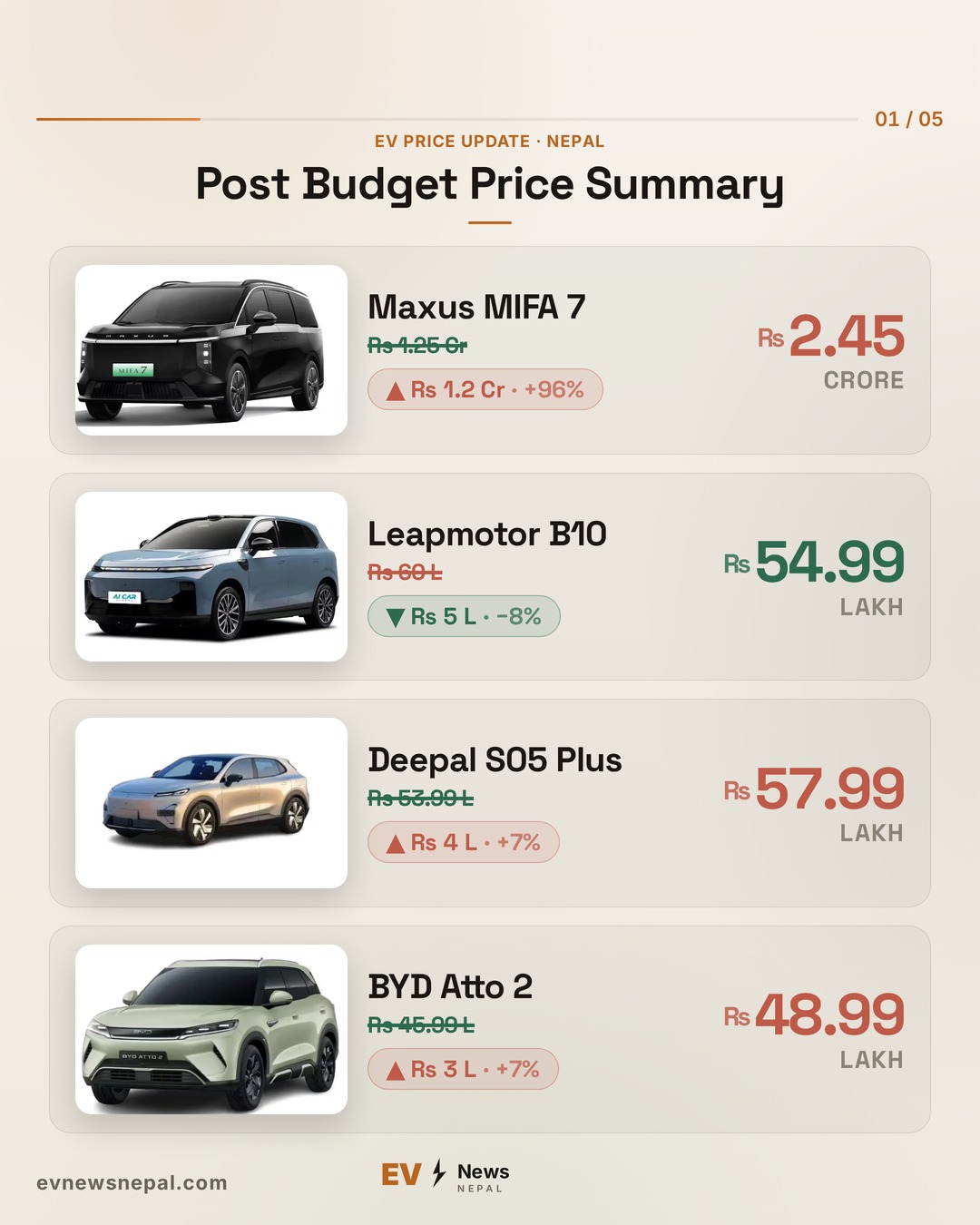
Nepal's 2026 budget swapped power-based EV tax for a price/CIF-based system — premium EVs jumped up to +96%, budget EVs dropped. See every EV price change.
Read moreLatest launches, price updates, comparisons & expert buying guides for Nepal's EV market.
Nepal's 2026 budget swapped power-based EV tax for a price/CIF-based system — premium EVs jumped up to +96%, budget EVs dropped. See every EV price change.
Read more
BMW's entry-level electric SUV, the iX1, now costs Rs 3,29,96,000 in Nepal — up about Rs 1.3 crore — after the FY 2026/27 budget shifted EV taxation from motor power to CIF value.

Paramount Motors adjusts pricing for MG EV lineup in Nepal due to new government tax policies. MG S6 EV sees a Rs 2 Lakh increase, now priced at Rs 71.99 Lakh for the Trophy Long Range variant. MG S5 EV variants (49 kWh and 62 kWh) each increase by Rs 1 Lakh, now priced at Rs 50.99 Lakh and Rs 55.99 Lakh respectively. Despite price hikes, MG S5 and S6 EVs remain key options in Nepal's competitive electric SUV market, targeting buyers with long-range capabilities and premium features. MG4 EV and MG IM6 prices remain unchanged amidst Nepal's evolving EV regulatory landscape.

The Finance Ministry has officially denied allegations of irregularities in electric vehicle (EV) imports through northern border customs points, stating all imports followed standard procedures and existing laws. A total of 649 BYD EVs, including Atto 1 and Atto 2 models, were imported through the Korala border customs point between Jestha 8 and Jestha 13, processed as pre-planned shipments with no evidence of timing manipulation linked to recent budget changes. Over 200 Kaiyi electric vehicles were also cleared through the Rasuwagadhi customs point, all processed under prevailing tariff rates and standard approval systems, with the ministry rejecting claims of pre-budget advantages. The ministry emphasized that EV imports rely on Letter of Credit banking arrangements and require weeks or months of planning due to physical arrival verification, making short-term policy-based timing adjustments impractical. Administrative reviews, including reassignment of customs officials and additional oversight, have been initiated as routine safeguards, while official data shows a decrease in EV imports this year compared to last year, indicating no abnormal surge linked to tariff expectations.

The BMW iX1 eDrive20 in Nepal now costs Rs. 3,29,96,000, a significant increase of Rs. 1.30 crore due to the government's new EV taxation policy.. The revised policy calculates taxes based on a vehicle's import value rather than motor output, impacting premium and luxury EVs.. The BMW iX1 features a 64.78 kWh battery pack, offering a WLTP-certified range of 430-475 km and utilizing BMW's fifth-generation eDrive technology.. The EV SUV produces 150 kW of power and 250 Nm of torque, accelerating from 0 to 100 km/h in 8.6 seconds with a top speed of 170 km/h.. Price revisions for other BMW electric models in Nepal vary depending on their import value, reshaping the pricing landscape for high-end electric vehicles.

Nepal's new EV tax system replaces kW-based levies with CIF value-based taxation, increasing costs for mid-range and premium models. Vehicles under Rs 20 lakh CIF face a 28.5% total tax burden, while those above Rs 50 lakh incur up to 130% levies. Exchange rate fluctuations could push vehicles between tax brackets, creating pricing instability for importers and buyers. The Clean Infrastructure Investment Tax aims to fund charging networks and battery recycling but may raise showroom prices. Lower-cost EVs may see minimal price changes, while higher-value electric vehicles face significant cost increases.

Nepal's government introduced a new "Clean Infrastructure Investment Fee" on imported electric vehicles to fund domestic EV infrastructure development.. The fee aims to support local EV production, charging station expansion, and battery management and recycling systems.. The policy shifts taxation from motor power (kilowatt capacity) to a price-based structure, expected to raise upfront import costs for EVs.. Revenue will specifically target enhancing the nation’s electric mobility ecosystem and charging network capabilities.. The change is anticipated to impact EV pricing and market dynamics as adoption and infrastructure growth continue in Nepal.

Nepal's government has shifted EV taxation from a kilowatt-based system to a price-based framework for the fiscal year 2026–27.. The new policy aims to improve transparency and practicality in the EV tax structure, addressing previous inconsistencies in motor capacity measurements.. A clean infrastructure investment fee has been introduced on EV imports to support local EV production and the development of charging stations and battery management systems.
EV conversion in Nepal faces regulatory and systems engineering challenges, not just mechanical ones, requiring comprehensive redesign of vehicles. Current lack of certification systems, testing protocols, and enforcement mechanisms risks unsafe informal workshops and inconsistent engineering practices. EV conversion is economically viable mainly for high-mileage commercial fleets, three-wheelers, delivery vehicles, and select ride-hailing segments rather than private passenger vehicles. Nepal's automotive workforce lacks EV-specific skills like high-voltage diagnostics and battery safety, highlighting the need for structured technician certification pathways. Successful EV conversion requires strong governance and regulatory discipline to ensure safety and standardization before scaling the market.
Nepal's EV market is growing rapidly due to rising fuel prices, government incentives, and increased environmental awareness. Current vehicle registration system treats EVs the same as petrol/diesel vehicles, making EV identification difficult for authorities and the public. Introducing green number plates for EVs would enable clear identification, simplify policy implementation (tax breaks, toll exemptions, priority parking), and support EV data collection for infrastructure planning. Global examples from India, China, Kenya, and the UK show green plates effectively promote and manage EV adoption. Implementing green plates now positions Nepal alongside global best practices in clean transportation as the EV market expands.
Nepal's EV market is growing rapidly due to rising fuel prices and government incentives. Current vehicle registration treats EVs the same as petrol/diesel cars, hindering policy implementation. Introducing green number plates for EVs would enable clear identification and support incentives like tax breaks and priority parking. This low-cost measure aligns Nepal with global practices and supports sustainable mobility goals. A new color for tourist vehicles could resolve conflicts with existing green plate usage for tourism.
Nepal's government is set to introduce a major policy shift, allowing the conversion of old petrol and diesel vehicles into electric vehicles (EVs) to promote sustainable mobility.. This initiative aims to overcome bureaucratic hurdles that have long stalled EV conversion projects, finally providing official permission for such conversions.. The EV conversion program is expected to reduce vehicle waste, make EV adoption more accessible and affordable, and contribute to a cleaner, greener future for Nepal.